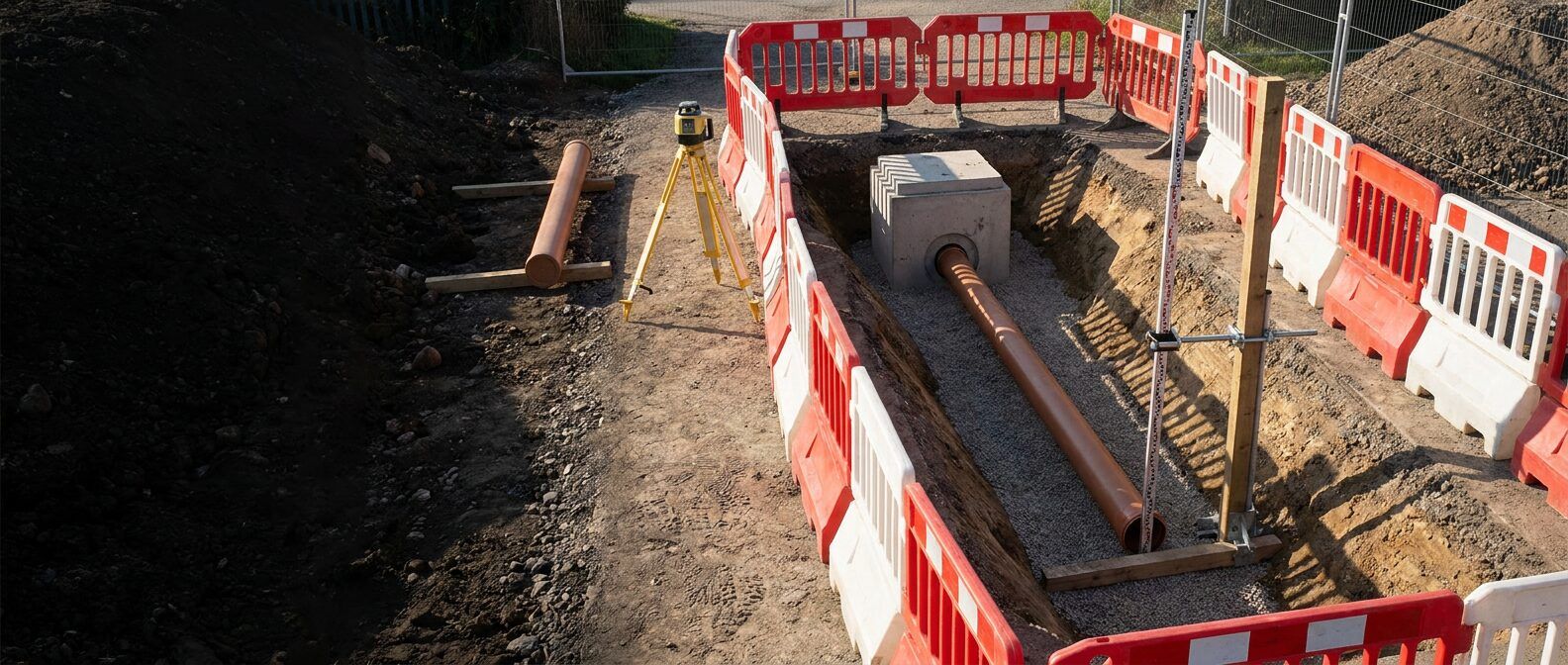
Drainage invert level calculator
Apply a drawing-specified gradient to a drainage run, produce a chainage level schedule, or check the actual fall between two surveyed invert levels.
Invert level is the level at the lowest internal point of a pipe. Chainage is distance measured along the run from a stated start point. A gradient written as 1 in 100 means the pipe falls one unit vertically for every 100 units travelled horizontally.
Project datum is the fixed level reference used across the drawings and survey. A benchmark is a stable point with a known level. Backfall means the pipe rises in the intended downstream direction. A traveller is a fixed-length setting-out aid used to transfer a level. The pipe crown is the outside top of the pipe, while battering means sloping an excavation side back to reduce collapse risk.
Level and fall calculator
Use levels from the current drainage drawing or survey. The opening figures are an illustrative geometry example, not a recommended drainage gradient.
Use metres to the project datum, keeping the same datum throughout.
Measure along the straight horizontal run, not the sloping pipe length.
Enter the N value from the approved drawing, for example 100 for 1 in 100.
Enter the surveyed downstream invert using the same project datum.
The final chainage is always included, even when it is not a whole interval.
Setting-out level schedule
Calculated from the start invert and selected gradient.
| Chainage | Invert level | Fall from start |
|---|---|---|
| 0.00 m | 100.000 m | 0 mm |
| 5.00 m | 99.950 m | 50 mm |
| 10.00 m | 99.900 m | 100 mm |
| 15.00 m | 99.850 m | 150 mm |
| 20.00 m | 99.800 m | 200 mm |
| 25.00 m | 99.750 m | 250 mm |
| 30.00 m | 99.700 m | 300 mm |
What the drainage levels mean
Keep the drawing direction, datum and units visible while setting out. Reversing a run or mixing millimetres and metres produces a plausible-looking but wrong answer.
Invert and cover level
The invert is the inside bottom of the pipe. A cover level is normally the finished level at the top of a chamber or surface. They are different references and should not be substituted for one another.
Chainage
Chainage measures horizontal distance from the stated start point. The table gives intermediate calculated levels for a straight, constant-gradient run.
Gradient
A larger denominator is a flatter gradient. For example, 1 in 200 falls half as much per metre as 1 in 100. Use the approved drawing value rather than selecting one from this calculator.
How the calculation works
All calculations use horizontal length and levels in metres. Results are also shown in millimetres per metre and percentage fall.
Set out a run
- Total fall
- Horizontal run divided by the gradient denominator
- Downstream invert
- Start invert minus total fall
Check surveyed levels
- Actual fall
- Start invert minus end invert
- Actual gradient
- Horizontal run divided by the absolute level change
Worked example
A 30m run starting at invert 100.000m and falling at 1 in 100 has a total fall of 0.300m, or 300mm. The calculated end invert is 99.700m. At 5m intervals, each schedule step falls 50mm. These figures demonstrate the geometry only.
Use the result on site
Treat the schedule as a check against controlled project information, not as a replacement for it.
Checking more than one run? Use the manhole schedule checker to review chamber references, downstream connections and levels across a connected schedule. It checks arithmetic and consistency, not drainage design.
- 1Confirm direction and datumMark the upstream and downstream points. Check that every level uses the same project datum and drawing revision.
- 2Check the instrumentSet up the laser or level on firm ground, verify its calibration status and take a benchmark check before measuring the pipe.
- 3Measure the pipe invertUse a suitable staff or traveller at the actual inside bottom of the pipe. Do not confuse the pipe crown, outside diameter or chamber cover with the invert.
- 4Record intermediate checksCheck the run at agreed chainages and before covering. Two correct end levels do not prove there is no local high point or backfall between them.
Limits and safety checks
Not a drainage design
This calculator does not size the pipe, select a minimum gradient, assess capacity, establish cover, design a chamber, or confirm compliance. Use the approved drainage design and project specification.
A straight-line check
The chainage schedule assumes one constant gradient between the entered endpoints. It does not detect deformation, local settlement, incorrect joints or an obstruction within the run.
Control excavation risk
Plan support or battering, safe access, edge protection, spoil position, water control and inspections before anyone works around an excavation. Do not enter an unsupported trench to take a level.
Locate buried services
Plan the work, locate and identify underground services, and use a safe digging method. A setting-out level does not establish that the proposed excavation path is clear.
Sources and further guidance
- Approved Document H: current Building Regulations guidance for foul and surface water drainage in England (HM Government).
- BS EN 1610:2015: construction and testing of drains and sewers (BSI).
- Excavation safety: collapse, support, access, services, water, edge protection and inspection guidance (HSE).
- HSG47 avoiding danger from underground services: planning, locating services and safe excavation (HSE).
Related resources
Aggregate & MOT Type 1 tonnage calculator
Work out the tonnage of MOT Type 1, sub-base, capping, sand, gravel, or topsoil by area and depth, with typical UK bulk densities, bulk-bag, and tipper-load counts.
Concrete specification quick reference for site
Application selector, exposure classes, cover depths, reinforcement weights, and slump guidance. Everything from BS 8500 that a site agent needs on one page.
Concrete volume calculator & mix selector
Work out concrete volume by shape, get an indicative BS 8500 strength class, a wastage allowance, and a ready-mix truck count for a UK pour.