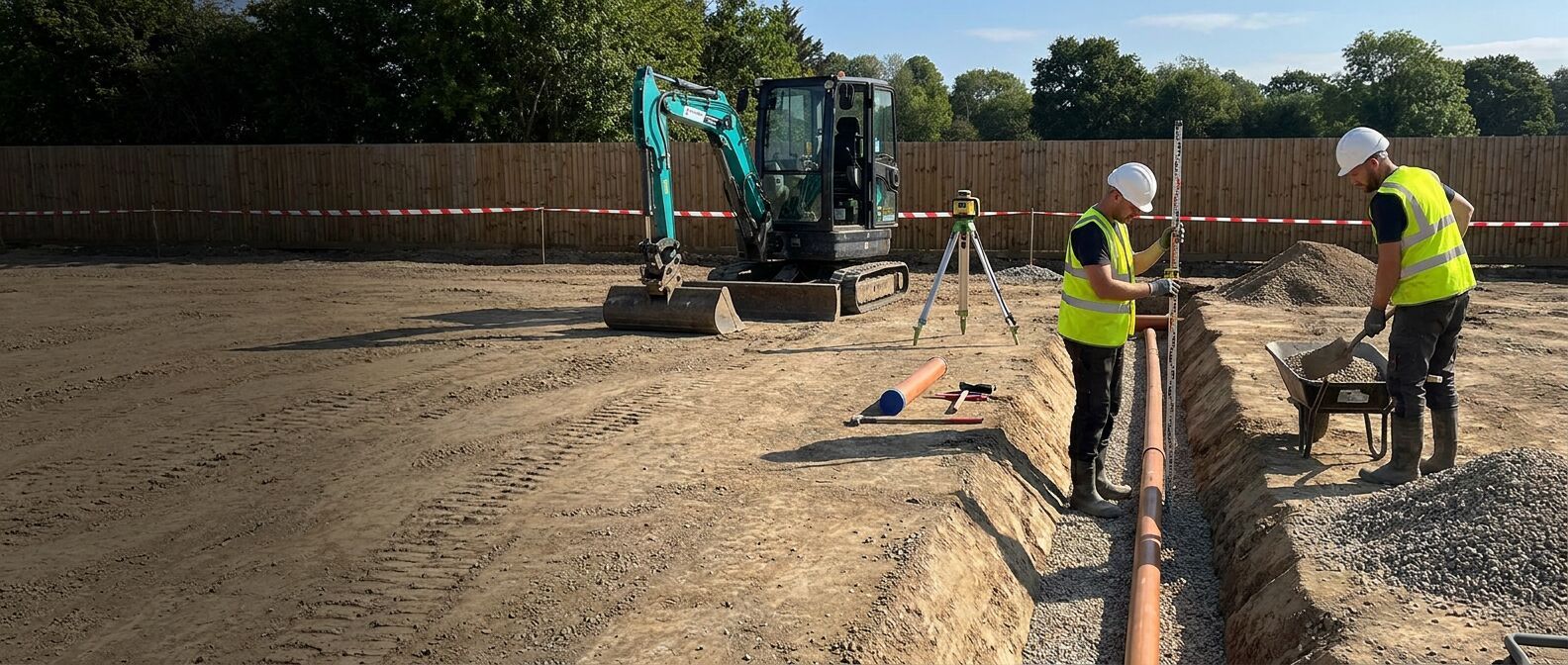
Pipe bedding and trench calculator
Enter the trench and pipe dimensions to estimate excavation, imported granular material, soil returned above the pipe, aggregate tonnage, bulk bags, and displaced soil.
Pipe bedding is compacted granular material, meaning specified graded stone or gravel, placed below the pipe. The surround is protective material beside and, where required, above it. Backfill is material returned above that protective envelope. The pipe crown is the top of the pipe. Displaced soil is the trench volume occupied by the pipe and imported granular material.
Bedding and trench quantity calculator
Use the dimensions from the drainage detail or pipe manufacturer's installation guide. The calculator deducts the circular pipe volume from the granular envelope rather than treating the whole trench as aggregate. It opens with an illustrative 20m worked example, not a recommended trench detail.
These presets reflect pages 35 to 37 of the Wavin OsmaDrain manual for unplasticised polyvinyl chloride (PVCu) pipe. The project drawing and selected pipe system take precedence.
Quantities are estimates for ordering, not a drainage or temporary works design. Confirm the trench profile, bedding detail, pipe outside diameter, aggregate grading, bulk density, and safe excavation method before work starts.
What the installation profiles mean
The selected preset is highlighted. The 50mm and 100mm starting details come from pages 35 to 37 of the Wavin OsmaDrain installation manual. Other pipe systems, loading conditions, and project specifications can require a different detail.
50mm granular bed, sidefill to crown
A 50mm minimum processed granular bed can be used where the material already in the trench bottom, known as as-dug ground, can be hand trimmed and is not puddled. Place and compact the specified material beside the pipe in accordance with the selected system.
50mm bed, granular 100mm above crown
Wavin's manual extends processed granular material at least 100mm above the crown when the backfill contains stones larger than 40mm, or when the pipe is deeper than 2m in poor ground.
100mm bed in difficult ground
Wavin specifies a minimum 100mm processed granular bed where as-dug material is unsuitable, including rock, mechanically trimmed compacted sand or gravel, and very soft or wet ground.
Custom detail
Use the dimensions on the structural pipe design, water company detail, specification, or manufacturer's installation drawing. Editing either depth switches the calculator to custom when it no longer matches a preset.
Bedding, surround, and backfill checks
Use the selected pipe system's specified material and installation detail. The 10mm, 40mm, 50mm, 100mm, 300mm, and 2m checks below come from pages 35 to 37 of the Wavin OsmaDrain manual and are not a universal substitute for the project specification.
Suitable as-dug ground
Where the prepared trench bottom, called the formation, can be hand trimmed and is not puddled, Wavin shows a 50mm minimum processed granular bed using nominal 10mm single-size aggregate.
Unsuitable formation
Rock, mechanically trimmed compacted sand or gravel, and very soft or wet ground require a 100mm minimum processed granular bed in the Wavin detail.
Large stones or poor deep ground
Extend processed granular material at least 100mm above the crown when backfill has stones larger than 40mm, or when the pipe is deeper than 2m in poor ground.
Initial backfill
Where the enhanced granular cover condition does not apply, the manual says the first 300mm of selected backfill should be free from stones larger than 40mm.
Why density stays editable
Bulk density is the delivered mass per cubic metre, including voids between particles. BS EN 1097-3 defines how loose bulk density is measured, but moisture, source rock, grading, and delivery condition change the result. The 1.79 t/m³ worked example above is derived from the linked product coverage, not a product specification. Replace it with the supplier's figure before ordering.
How the calculation works
Every result comes from the measured trench and pipe geometry. All millimetre inputs are converted to metres before calculating volume.
Excavation and pipe
- Gross excavation
- Length × trench width × average trench depth
- Pipe displacement
- π × outside diameter² ÷ 4 × length
Granular and backfill
- Bedding and surround
- Length × width × (bed + pipe OD + cover), minus pipe displacement
- Backfill above surround
- Gross excavation minus the full granular envelope, including the pipe space
Worked example
For the illustrative 20m run, 500mm trench, 900mm average depth, 110mm pipe, 50mm bed, and 100mm cover above crown: gross excavation is 9.00m³. The granular envelope is 2.60m³, but the pipe occupies 0.19m³, leaving 2.41m³ of bedding and surround. With no additional allowance and the example density of 1.79 t/m³, the result is about 4.31 tonnes, or six 850kg bulk bags.
Checks before excavation
A quantity result says nothing about whether the trench is safe or the drainage design is adequate.
Plan the excavation support
The HSE states that no ground can be relied upon to stand unsupported in all circumstances. Decide the support, sloping of the trench sides (battering), access, edge protection, spoil position, water control, and inspection arrangements before digging.
Locate underground services
Follow the HSG47 sequence: plan the work, locate and identify buried services, then use a safe excavation method. The calculated trench width is not permission to excavate through an unverified service corridor.
Check pipe structure and loading
Pipe stiffness, cover, traffic loading, native soil, embedment, compaction, and groundwater work together as one system. Use the structural pipe design and manufacturer's detail, especially under roads and yards.
Measure by drainage run
Split the quantity calculation where pipe diameter, trench width, depth, bedding detail, or material changes. Calculate each run separately, then add the order quantities. Chambers and fittings need separate excavation and material allowances.
Sources
- BS EN 1610:2015: construction and testing of drains and sewers, including embedment (material placed around the pipe), initial backfill, main backfill, and native soil (BSI).
- 10mm gravel jumbo bag: the 850kg bag mass and approximate 19m² coverage at 25mm used to derive the illustrative 1.79 t/m³ input (Wickes).
- OsmaDrain product and installation manual: PVCu bedding depth, granular surround, and selected-backfill details used by the presets and checks (Wavin).
- Approved Document H: current Building Regulations guidance for foul and surface water drainage in England (HM Government).
- BS EN 1097-3: test method for loose bulk density and voids in aggregate (BSI).
- Excavation safety: collapse, support, access, services, water, edge protection, and inspection guidance (HSE).
- HSG47 avoiding danger from underground services: planning, locating services, and safe excavation (HSE).
Related resources
Aggregate & MOT Type 1 tonnage calculator
Work out the tonnage of MOT Type 1, sub-base, capping, sand, gravel, or topsoil by area and depth, with typical UK bulk densities, bulk-bag, and tipper-load counts.
Concrete specification quick reference for site
Application selector, exposure classes, cover depths, reinforcement weights, and slump guidance. Everything from BS 8500 that a site agent needs on one page.
Concrete volume calculator & mix selector
Work out concrete volume by shape, get an indicative BS 8500 strength class, a wastage allowance, and a ready-mix truck count for a UK pour.