Aggregate tonnage calculator
Pick a material, enter the area and the compacted depth, and get the tonnage to order, plus bulk-bag and tipper-load counts. Covers MOT (Ministry of Transport) Type 1, sub-bases, capping, sand, gravel, and topsoil with typical UK bulk densities.
Tonnage calculator
Choose a material, set the area and the finished compacted depth, and the results update live. Tonnage uses a typical bulk density for the material, which you should confirm against your supplier's data sheet.
Indicative only. Bulk density varies with the source rock and grading, so always confirm the conversion factor on the supplier's product data sheet before ordering. Layer depths for trafficked areas should follow a pavement design based on the subgrade CBR (California Bearing Ratio, a measure of how much load the ground can carry), not a rule of thumb.
Bulk density and coverage by material
Typical compacted bulk densities used by the calculator. The selected material is highlighted. Coverage is the area one tonne fills at the stated depth. Bulk density (mass per unit volume of the laid material, including the air voids between particles) is measured to BS EN 1097-3 (the European test standard for the loose bulk density of aggregates); the figures below are representative, not a substitute for the supplier's data sheet.
| Material | Bulk density (t/m³) | Cover at 50mm | Cover at 100mm | Notes |
|---|---|---|---|---|
| MOT Type 1 sub-base | 2.0 | 10.0 m²/t | 5.0 m²/t | Well-graded crushed rock (0/31.5) to Series 800 clause 803. The standard load-bearing sub-base. |
| MOT Type 2 sub-base | 2.0 | 10.0 m²/t | 5.0 m²/t | More fines and smaller top size than Type 1. Lighter-duty sub-base where permitted. |
| Recycled Type 1 | 1.9 | 10.5 m²/t | 5.3 m²/t | Crushed concrete/brick to the Type 1 grading. Slightly lighter than primary limestone or granite. |
| Scalpings / crusher run (0/40) | 2.0 | 10.0 m²/t | 5.0 m²/t | As-dug crushed quarry material. Cheaper than Type 1 but graded less tightly. |
| Type 3 / open-graded sub-base | 1.6 | 12.5 m²/t | 6.3 m²/t | Reduced-fines, free-draining sub-base for permeable construction. More voids, so lighter per m³. |
| Capping (6F2 / 6F5) | 1.9 | 10.5 m²/t | 5.3 m²/t | Coarse recycled or as-dug capping to Series 600/800. Used below sub-base on weak subgrades. |
| Concreting ballast (all-in) | 1.9 | 10.5 m²/t | 5.3 m²/t | All-in aggregate (sand and stone blend) for mixing concrete. Quantities here are for laid volume. |
| Gravel / shingle (10–20mm) | 1.75 | 11.4 m²/t | 5.7 m²/t | Single-size rounded or angular stone for surfacing and drainage. Loose-laid, not compacted. |
| Sharp / grit sand | 1.6 | 12.5 m²/t | 6.3 m²/t | Coarse sand for screeds, paving beds, and concrete. Density rises when wet. |
| Building / soft sand | 1.5 | 13.3 m²/t | 6.7 m²/t | Fine sand for mortar and bedding. Bulks up when damp, so order by weight. |
| Topsoil | 1.5 | 13.3 m²/t | 6.7 m²/t | Screened topsoil for landscaping. Density varies widely with moisture and organic content. |
Coverage = 1 ÷ (density × depth). A common rule of thumb for MOT Type 1 is that one tonne covers about 10 m² at 50mm, which matches a bulk density of 2.0 t/m³.
What the grades mean
The common sub-base and aggregate grades, with the specification that defines them. "MOT" is the historic Ministry of Transport label still used for highway sub-base materials.
MOT Type 1
Well-graded crushed rock, slag, or crushed concrete with a 0/31.5mm grading (particles from dust up to about 31.5mm). Specified as a Type 1 unbound mixture in MCHW Series 800 clause 803 to BS EN 13285. The mix of sizes locks together under compaction to carry traffic loads, which is why it is the default sub-base.
MOT Type 2
Similar crushed material but with a higher fines content and a smaller top size. It compacts to a tighter, less permeable layer and is used for lighter-duty areas. Type 2 is restricted in highway design for heavier flexible roads, but is still widely sold for driveways and paths.
Type 3 / open-graded
A reduced-fines sub-base (often 0/40mm) that drains freely, used under permeable paving and SuDS surfaces. Fewer fines means more voids, so it weighs less per cubic metre and is no substitute for Type 1 where free drainage is not required.
Scalpings / crusher run
As-dug crushed quarry material (commonly 0/40mm) before it is screened to a tight grading. Cheaper than Type 1 and fine for tracks, temporary haul roads, and fill, but not a controlled sub-base for adoptable or heavily trafficked surfaces.
Capping (6F2 / 6F5)
Coarse granular material placed below the sub-base to bridge a weak subgrade, defined in MCHW Series 600/800. 6F2 is the finer recycled grade, 6F5 the coarser. Whether capping is needed depends on the subgrade CBR.
Ballast and sands
Concreting ballast is an all-in sand-and-stone blend for mixing concrete. Sharp sand suits screeds, paving beds, and concrete; building (soft) sand suits mortar. All bulk up when damp, so order them by weight, not by loose volume.
Typical compacted sub-base depths
Rule-of-thumb finished depths after compaction. The card matching your selected use is highlighted. These are starting points only: trafficked pavements should be designed to the subgrade CBR, not built to a default depth.
Footpath / patio sub-base
100mm
Pedestrian only. 75–100mm of well-compacted sub-base over a firm formation, blinded with sand before slabs or block paving.
Domestic driveway (cars)
150mm
Cars and light vans. 100–150mm of compacted Type 1 over a sound subgrade. Increase on soft or clay ground.
Car park / light vehicles
200mm
Regular light traffic and occasional delivery vehicles. Typically 150–225mm to a pavement design.
HGV access / hardstanding
250mm
Heavy vehicles and plant. 250mm+ of sub-base, often over capping, designed to the CBR. Always engineer-checked.
Shed / garden building base
100mm
Light loads. 100mm of compacted sub-base under a concrete or paved base is usually ample.
Custom depth
Set it
Enter your own compacted depth from the drawings or pavement design. Compact sub-base in layers of 150mm maximum.
Bulk bags and bulk deliveries
How aggregate is supplied in the UK. The calculator counts bulk bags at about 850 kg each and tipper loads at your selected size; confirm both with the supplier, as bag weights and payloads vary.
Bulk / dumpy bag
Typically 0.8–1.0 t of aggregate
- • Sold by weight, so a "bulk bag" is not a fixed volume
- • MOT Type 1 and stone usually around 850 kg; sand often 800 kg
- • Best for small jobs, hard access, or topping up a bulk load
8-wheel tipper / grab
Around 16–20 t per load
- • The workhorse bulk delivery for most sites
- • Grab lorries can place material over a wall or hedge
- • Needs firm, level access and room to tip the body
Smaller tippers
6-wheel ~16 t, 4-wheel ~10 t
- • Use where an 8-wheeler cannot reach or turn
- • Part loads usually carry a surcharge over the per-tonne rate
- • Order full loads where you can to keep the rate down
Practical tips from site
The things that aren't in the spec but every groundworker knows.
Compact in layers, not in one go
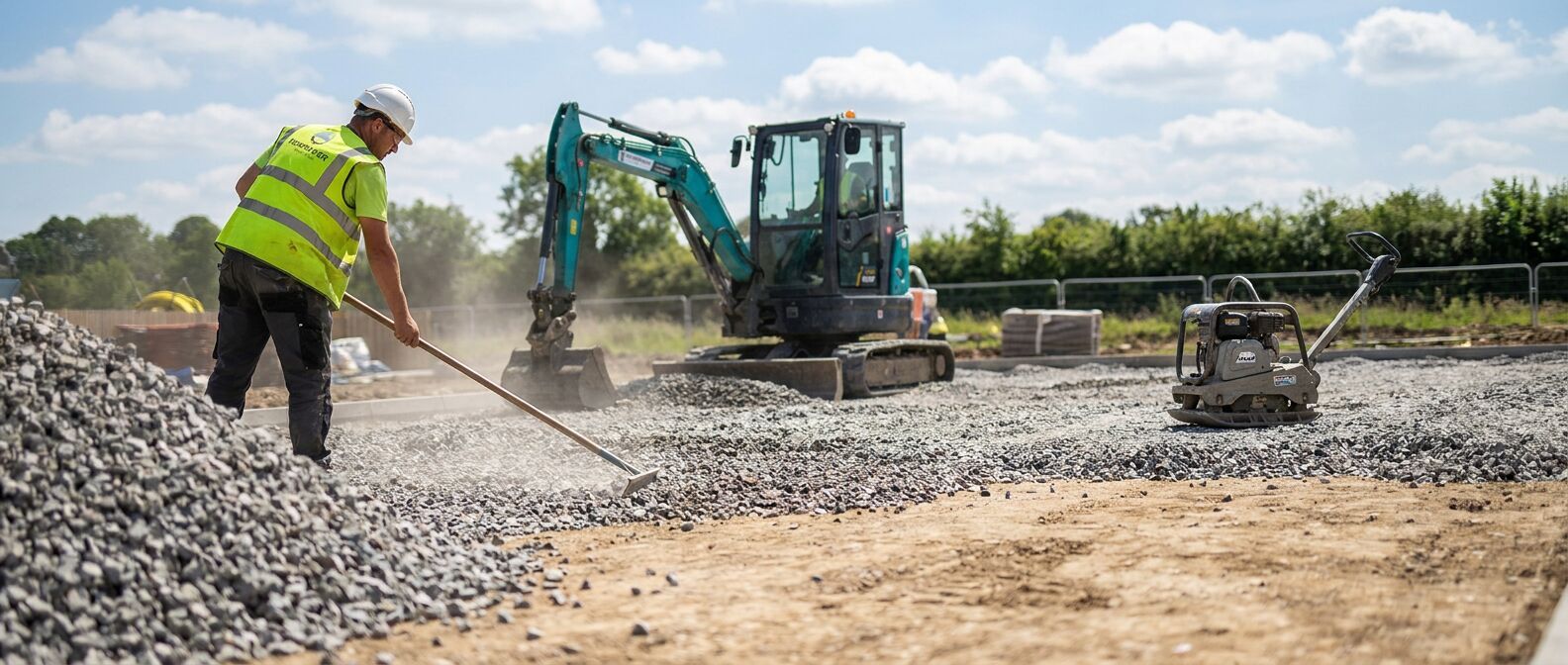
A vibrating roller or plate cannot compact a thick layer of sub-base properly. Lay and compact in layers of 150mm maximum (less for hand-guided plates). A 250mm sub-base means two passes of laying and compacting, not one. The tonnage is the same, but the programme and plant are not, so plan for it.
Order by weight, not by the look of the heap
Loose sub-base on the lorry takes up far more space than the finished compacted layer, and damp sand bulks up by a tenth or more. That is why aggregate is sold by the tonne, not the cubic metre. Work out the compacted volume you need, convert to tonnes with the bulk density, and order that weight.
Depth on trafficked ground is a design, not a guess
The depths in this tool are starting points for estimating quantities. For a road, yard, or any surface carrying vehicles, the sub-base and capping thickness should come from a pavement design based on the subgrade CBR. Build too thin over soft ground and the surface ruts and fails; the saving on stone is dwarfed by the cost of digging it out and starting again.
Recycled Type 1 is cheaper and usually fine
Recycled crushed concrete and brick, graded to the Type 1 envelope, performs well as a sub-base for most driveways, paths, and yards, at a lower cost and carbon footprint than primary quarried stone. It is slightly lighter per cubic metre. For adoptable highways and structural fill, check the specification allows recycled material and what testing it needs.
Blind the surface before you pave
A compacted Type 1 surface still has open voids and sharp edges at the top. Blind it with a thin layer of sand or grit sand before laying a damp-proof membrane, block paving, or slabs, so the bedding sits evenly and the membrane is not punctured. Allow a little extra sand in your order for blinding.
Sources
- Manual of Contract Documents for Highway Works Current MCHW document set and previous volume-structure search. Historic Series 800 defines Type 1 (clause 803), Type 2, and capping materials (National Highways).
- BS EN 1097-3 Tests for mechanical and physical properties of aggregates: determination of loose bulk density and voids (BSI).
- Approved Document A: Structure Foundation and ground-bearing guidance for buildings (HM Government).
- Specification for the Reinstatement of Openings in Highways Layer and material requirements when reinstating excavations in the public highway (Department for Transport).
Bulk densities are typical values consistent with published supplier conversion factors and the BS EN 1097-3 measurement basis. Confirm the exact figure on your supplier's product data sheet before ordering.
Built by Rospower Projects, a UK groundworks and civil engineering contractor. 35+ years laying sub-base and surfacing on site.
Discuss your projectRelated resources
Concrete specification quick reference for site
Application selector, exposure classes, cover depths, reinforcement weights, and slump guidance. Everything from BS 8500 that a site agent needs on one page.
Concrete volume calculator & mix selector
Work out concrete volume by shape, get an indicative BS 8500 strength class, a wastage allowance, and a ready-mix truck count for a UK pour.
Drainage invert level calculator
Calculate drainage falls, downstream invert levels and chainage schedules, or check the actual gradient between two surveyed invert levels.