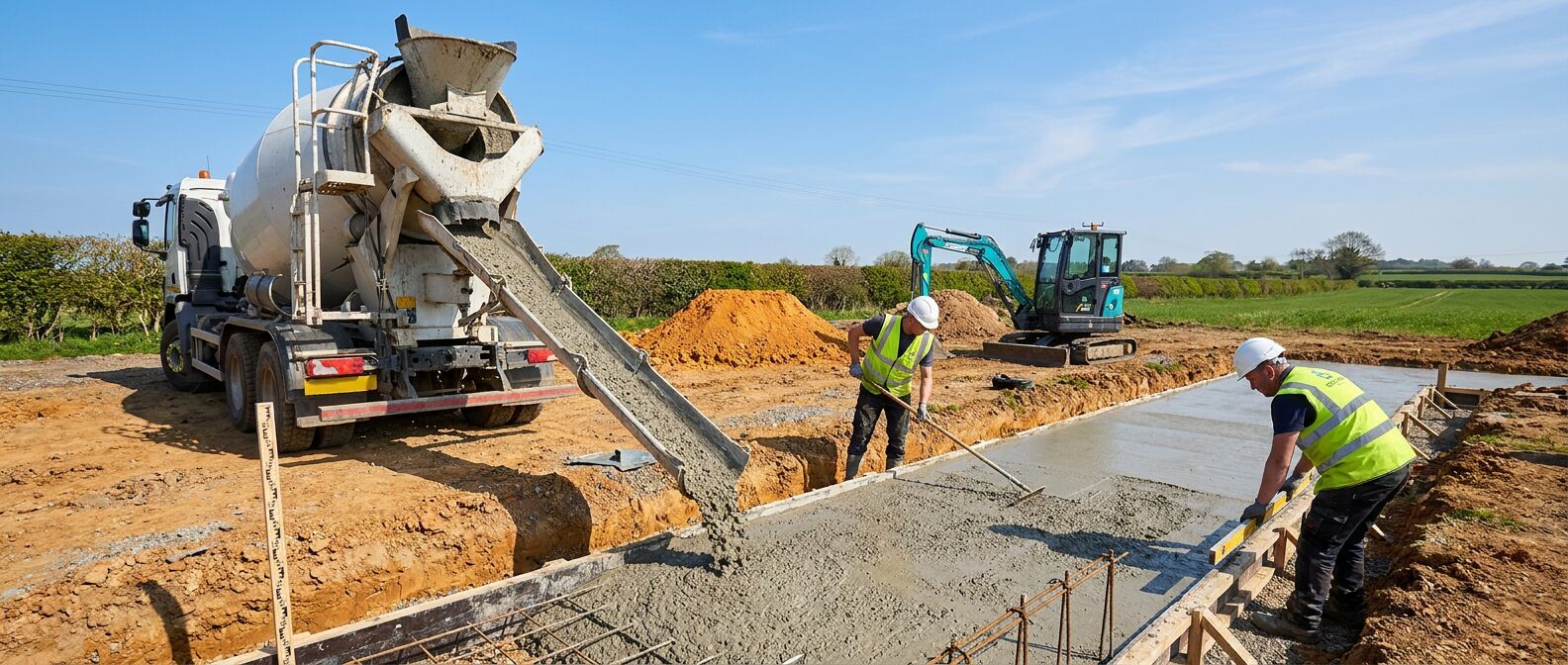
Concrete volume calculator
Enter the shape and dimensions of your pour. Get the volume in m³, an indicative BS 8500 strength class, a sensible wastage allowance, and the number of ready-mix trucks to discuss with your supplier.
Volume calculator
Pick a shape, enter dimensions in metres, and choose the application. The results update live with an indicative strength class and a ready-mix truck count.
e.g. 12 columns or 4 pads
Indicative only. Final mix design is the responsibility of the structural engineer and ready-mix supplier. Always check the structural drawings for the specified strength class and cover.
How each shape is calculated
Volume formulas used by the calculator. Net volume per element, multiplied by quantity, plus the chosen wastage allowance.
Slab / oversite
Flat horizontal pour.
V = L × W × T
Domestic oversite is typically 100mm thick. Garage slabs 100–150mm. Light industrial 150–200mm. Heavy industrial slabs 200mm+ with structural design.
Strip / trench fill
Linear foundation along a wall line.
V = L × W × D
Foundation width should be checked against Approved Document A Table 12. Concrete thickness, founding depth, and tree influence depend on design and ground conditions (see tree heave guide).
Pad base
Isolated rectangular base under a column or post.
V = L × W × D
Pad size sized by structural engineer for column load and ground bearing capacity. Typically 1.0–2.5m square × 300–600mm deep for steel-framed industrial buildings.
Column (square / rectangular)
Vertical column or pier.
V = L × W × H
Concrete columns typically 300–500mm square. Wastage tends to be higher (7.5–10%) due to formwork voids and pump losses on small pours.
Column (round)
Circular column, pier, or bored pile.
V = π × (d/2)² × H
Round columns use formwork tubes (e.g. Sonotube). Bored piles use the same formula but at much greater height – cast separately by piling subcontractor.
Weight check
Concrete weighs ~2,400 kg per m³ (normal weight).
Mass = V × 2,400
A 6 m³ load of normal-weight concrete is about 14.4 tonnes before vehicle tare. Check access for mixer trucks in the 26-32 tonne GVW range.
Indicative strength class by application
Common BS 8500 designations the batching plant recognises. Confirm the final class, exposure, slump, aggregate size, and cement type against the drawings and supplier's advice.
| Application | Strength class | Designated mix | Typical slump | Notes |
|---|---|---|---|---|
| Blinding / oversite | C6/8 | GEN 0 | S3 (100–150mm) | 75–100mm thick under foundations, before rebar. |
| Mass / trench fill | C12/15 | GEN 2 | S3 (100–150mm) | General mass fill where no higher foundation or exposure specification applies. |
| Strip foundation (unreinforced) | C16/20 | GEN 3 | S3 (100–150mm) | Standard domestic strip per Approved Document A. |
| Strip foundation (reinforced) | C25/30 | RC25/30 | S3 (100–150mm) | Reinforced strip on weaker ground or to engineer's design. |
| Pad / ground beam (reinforced) | C25/30 | RC25/30 | S3 (100–150mm) | XC2 exposure (buried in non-aggressive soil). |
| House slab / garage (unreinforced) | C16/20 | GEN 3 | S3 (100–150mm) | 100–150mm thick over DPM and hardcore. |
| Ground slab (light industrial) | C25/30 | RC25/30 | S3 (100–150mm) | 150–175mm with mesh per TR34. Pumpable mix often specified. |
| Ground slab (heavy industrial) | C32/40 | RC32/40 | S2–S3 (50–150mm) | 200mm+ with fibres or mesh. Engineer-designed to TR34. |
| External slab / car park | C28/35 | RC28/35 / PAV1 | S3 (100–150mm) | PAV2 where de-icing salts or severe freeze/thaw exposure are specified. |
| Reinforced column / wall | C32/40 | RC32/40 | S4 (160–210mm) | High slump for compaction around dense rebar cages. |
| External paving (PAV) | C28/35 | PAV1 | S2 (50–90mm) | Air-entrained for freeze/thaw resistance. Use PAV2 where de-icing salts are expected. |
Strength class notation C(cylinder)/(cube) per BS EN 206. Designated mixes per BS 8500. Full exposure class, cover depth, and cement type guidance is on the concrete specification reference.
Ready-mix trucks and ordering
Truck capacities and minimum loads in the UK market. The calculator assumes a common 6 m³ delivered load; confirm maximum load size and access with the supplier.
Common truckmixer load
Typical delivered load around 6 m³
- • The Concrete Society lists 6 m³ as the most common truck size
- • Larger 8 m³ mixers can be around 32 tonnes fully loaded
- • Standard chute reaches about 2.7m from the rear of the truck
Mini-mix (6-wheeler)
Drum 4–5 m³ · tight access
- • Smaller mixer for loads up to about 4 m³, depending on supplier
- • Narrower wheelbase fits residential streets and lanes
- • Surcharge over standard rate (often £50–100 extra per load)
Part-load / volumetric
For pours under 3 m³
- • Most suppliers apply a part-load charge below 4 m³
- • Volumetric "concrete on demand" lorries mix on site, pay only for what you use
- • Useful when timing is uncertain or volume is hard to predict
Practical tips from site
The things that aren't in the spec but every site agent knows.
Why a 5% wastage allowance is the floor, not the ceiling
5% covers normal spillage, formwork bulge, and the half-tonne or so left coating the drum at end of pour. Add 7.5% for awkward pours (deep trenches, narrow access, multiple lifts), 10% for irregular shapes or pumped concrete (more lost in the pump line and at washout). Running short by even 0.5m³ on a 20m³ pour means a part-load surcharge plus a delayed finishing crew. It's almost always cheaper to over-order and pay for a small return than to under-order.
Round up to the nearest 0.25 m³ when you order
Most UK ready-mix suppliers sell in 0.25m³ increments and quote per cubic metre with a minimum part-load charge below 4 m³. A 3.6m³ net pour with a 5% allowance becomes a 4.00m³ order. Always confirm the order volume in writing with the supplier, including strength class, slump, and aggregate size, before the morning of the pour.
The pump line steals concrete you've already paid for
A 100m boom pump line holds around 0.5–1.0 m³ of concrete that gets discarded at washout. On long pumped pours that loss is real. Either order an extra 0.5 m³ to cover it or agree with the supplier that the start-up grout (the cement slurry used to lubricate the pump line) is delivered separately at a discounted rate.
Volumetric trucks for small or uncertain pours
If you're not sure of the final volume (irregular trench, levels still being set, multiple small elements), a volumetric "concrete on demand" lorry carries cement, aggregate, and water separately and mixes only what you draw off. You often pay closer to the volume used, with less return waste, but charging increments and standing time vary by supplier. Per-cubic-metre rate is higher than ready-mix, but the saving on waste and contingency can win for pours under 4 m³.
Check concrete temperature and contact surfaces
BS EN 206 requires ready-mixed concrete as delivered to be at least 5°C, and BS EN 13670 requires the concrete to stay above 5°C until it reaches 5MPa. Surfaces in contact with fresh concrete should be above freezing and clear of ice or snow. In winter, ask the supplier about heated concrete or accelerator admixtures. In hot weather, manage workability with plasticiser or retarder by specification rather than adding water on site.
Sources
- BS 8500-1:2023 Concrete: complementary British Standard to BS EN 206. Method of specifying and guidance for the specifier (BSI).
- BS EN 206:2013+A2:2021 Concrete: specification, performance, production and conformity (BSI).
- Approved Document A: Structure, foundation structure guidance and strip footing width tables (HM Government).
- The Concrete Centre publications, technical guidance on industrial floors (TR34), basements, and structural design.
- The Concrete Society: ready-mixed trucks, truck load sizes and chute reach.
- The Concrete Society: cold weather concreting, low temperature requirements for delivered and curing concrete.
- The Concrete Society: hot weather concreting, point-of-discharge temperature and hot weather risks.
Built by Rospower Projects, a UK groundworks and civil engineering contractor. 35+ years pouring concrete on site.
Discuss your projectRelated resources
Aggregate & MOT Type 1 tonnage calculator
Work out the tonnage of MOT Type 1, sub-base, capping, sand, gravel, or topsoil by area and depth, with typical UK bulk densities, bulk-bag, and tipper-load counts.
Concrete specification quick reference for site
Application selector, exposure classes, cover depths, reinforcement weights, and slump guidance. Everything from BS 8500 that a site agent needs on one page.
Drainage invert level calculator
Calculate drainage falls, downstream invert levels and chainage schedules, or check the actual gradient between two surveyed invert levels.