Foundation depth near trees
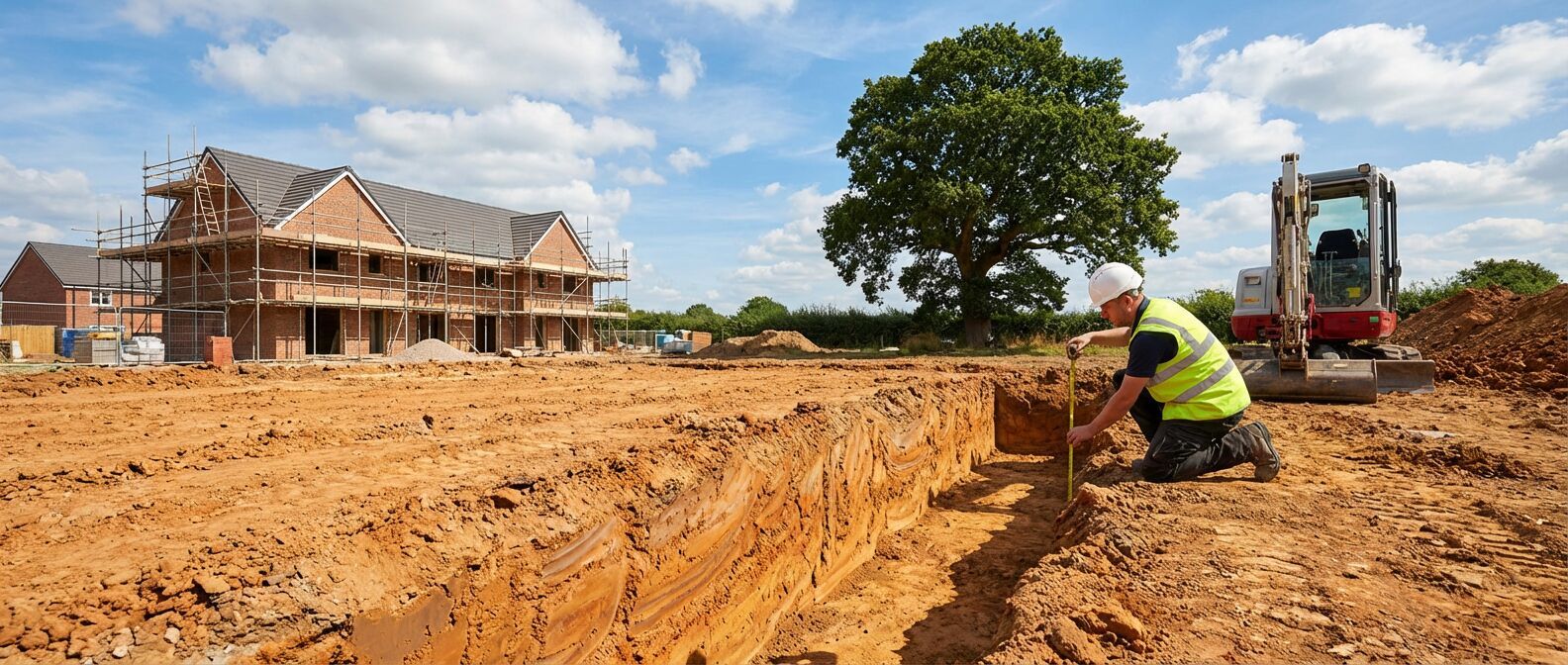
Estimate the minimum strip foundation depth required when building on shrinkable clay near trees. Based on NHBC Standards Chapter 4.2 and BRE Digest 240.
This is a guidance tool, not a substitute for engineered design
Foundations on shrinkable clay near trees are a structural risk. The values here give you a directional estimate based on widely cited NHBC and BRE guidance, but final design must be confirmed by a structural or geotechnical engineer working from a site-specific ground investigation. NHBC-warranted homes need depths verified against the current edition of NHBC Standards Chapter 4.2.
Always specify a soil investigation (boreholes or trial pits with PI testing) before signing off foundation depth on any site with mature trees within ~1.25× the tree's mature height.
Depth calculator
Enter tree and soil details. The calculator returns a D/M ratio, risk zone, and indicative depth range.
Selecting a species sets the water demand and a typical mature height. You can override the height below.
If unsure, see the soil reference below. Most clays in the South East and East are high.
Use the species' mature height even if the current tree is smaller. Trees grow.
Centre of the tree trunk to the nearest face of the foundation.
D/M ratio
0.50
D divided by mature height
Risk zone
High
Within tree influence
Table-based depth
2.00 m
Verify with engineer
How the calculation works
The method uses the broadleaf and conifer curves in NHBC Standards Chapter 4.2, Tables 11 to 19.
- Determine the influence ratio. Divide D (distance from tree to foundation) by M (the species' mature height). A tree closer than its mature height is generally inside its zone of influence.
- Combine tree form, water demand and soil shrinkability. NHBC uses separate curves for conifers and broadleaf trees. That distinction can materially change the result even where D/M and water demand are the same.
- Read off the table-based depth. The calculator interpolates between the 0.05 D/M intervals in Tables 11 to 19 and rounds up to the next 0.05 m. Results above 2.5 m are referred for engineer design, as required by NHBC.
- Add a sacrificial layer or compressible board. Where heave is the risk (after a tree is removed or pruned), foundations alone are not enough. A void former or compressible material on the ground side of the trench is typically specified by the engineer.
Soil shrinkability reference
Modified plasticity index (PI) is the standard measure. Without lab testing, the geological description is a reasonable guide.
High shrinkability
Modified PI > 40%
- • London Clay
- • Gault Clay
- • Kimmeridge Clay
- • Oxford Clay
- • Lower Lias Clay
- • Reading Beds (Lambeth Group)
- • Wadhurst Clay (variable)
Medium shrinkability
Modified PI 20-40%
- • Charmouth Mudstone
- • Mercia Mudstone (some)
- • Glacial till / boulder clay (most)
- • Lambeth Group sandy clays
- • Crag deposits with clay binder
Low shrinkability
Modified PI 10-20%
- • Weathered Mercia Mudstone
- • Sandy clays (low fines)
- • Low PI glacial till
- • Some alluvium with sandy fraction
Don't guess. Soils within the same geological formation can vary. The PI is established by a lab Atterberg test on a sample from the trench depth. On any tree-influenced site, a borehole or trial pit with PI testing pays for itself many times over in design certainty and warranty acceptance.
Tree water demand reference
Water demand is a function of species, not the individual tree. A young oak will be classed the same as a mature one.
High water demand
Greatest influence on shrinkable clay
- • Oak (Quercus)
- • Willow (Salix)
- • Elm (Ulmus)
- • Hawthorn (Crataegus)
- • Eucalyptus
- • Leyland Cypress (Cupressocyparis)
- • Hybrid Black Poplar
- • Lombardy Poplar
Moderate water demand
Most common UK garden trees
- • Ash, Beech, Lime, Plane
- • Sycamore, Maple, Cedar, Pine
- • Larch, Yew
- • Cherry, Apple, Pear, Plum
- • Walnut, Horse chestnut, Sweet chestnut
Low water demand
Smaller influence zone
- • Birch (most species)
- • Holly, Hornbeam
- • Rowan / mountain ash
- • Hazel, Laburnum, Elder
- • Mulberry, Fig, Magnolia
Practical guidance from site
What's not in the code but matters on the day you set out the dig.
A removed tree is not a solved problem
If a mature tree was removed within the last few years, the soil under its old footprint may still be desiccated, and clay rehydration causes heave (the opposite of subsidence). Building over recently cleared ground without proper investigation is one of the most common causes of cracking in new homes. Treat a recently felled tree the same as a live one until soil moisture content has been verified.
Hedgerows count too
A 1.5 m hedge of mixed species, 30 years old, behaves like a stand of mature trees. Use the species with the highest water demand in the hedge, take the mature height of that species, and apply the calculator. Don't measure the current visible height of the hedge.
Pile and beam often beats deep strip
For depths over about 2.5 m, mini-piling with a ground beam typically becomes more economical than continuing the strip foundation deeper. The crossover depends on site access and rig availability. On constrained urban infill plots, ask the engineer to price both options before settling on deep strip.
Heave precautions are an engineering decision, not a default
Where heave is a risk (after tree removal, or where a future tree might be removed), the engineer typically specifies a compressible filler against the trench wall on the tree side, often a low-density board such as Cordek Cellcore or similar. Slip membranes prevent the swelling clay from gripping and lifting the foundation. These are detailed on a site-specific basis. Don't assume them; don't omit them.
Sources
- NHBC Standards 2026, including Chapter 4.2: Building near trees, for NHBC-warranted homes
- BRE Digests at the BRE Bookshop (search for Digest 240, "Low-rise buildings on shrinkable clay soils Part 1", and Digest 298, "The influence of trees on house foundations in clay soils")
- Approved Document A: Structure (HM Government, current edition)
- BS 8004:2015 Code of practice for foundations (BSI Knowledge)
Built by Rospower Projects, a specialist groundworks and civil engineering contractor. We build foundations on every UK soil type.
Discuss your projectRelated resources
Aggregate & MOT Type 1 tonnage calculator
Work out the tonnage of MOT Type 1, sub-base, capping, sand, gravel, or topsoil by area and depth, with typical UK bulk densities, bulk-bag, and tipper-load counts.
Concrete specification quick reference for site
Application selector, exposure classes, cover depths, reinforcement weights, and slump guidance. Everything from BS 8500 that a site agent needs on one page.
Concrete volume calculator & mix selector
Work out concrete volume by shape, get an indicative BS 8500 strength class, a wastage allowance, and a ready-mix truck count for a UK pour.