Percolation test & soakaway sizer
Work out your Vp value, size a soakaway from your drained area, and check if the ground is suitable for a septic drainage field. BRE Digest 365 and Approved Document H2 in one page.
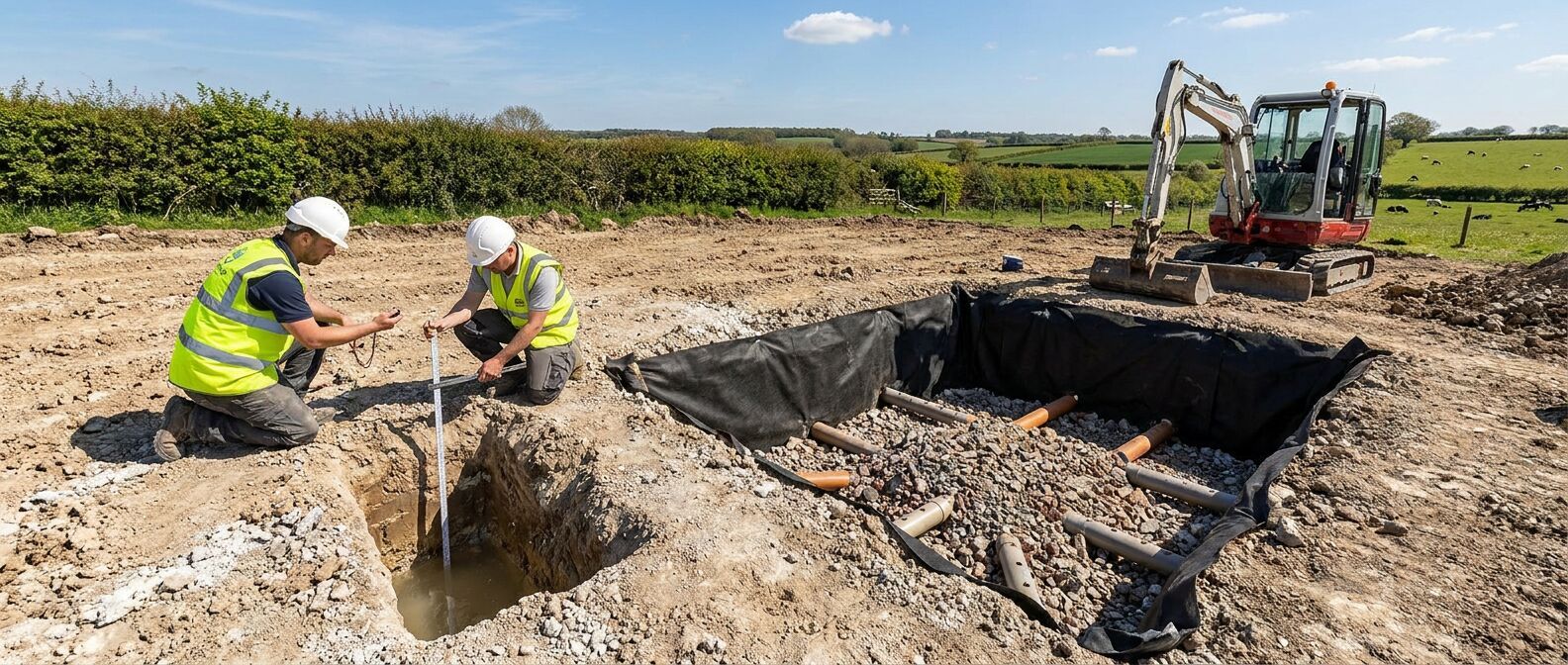
How to do a percolation test
The standard percolation test from Building Regulations Approved Document H2 and GOV.UK groundwater risk guidance, used for soakaway design and septic drainage field suitability.
- 1 Dig a test pit 300mm square and at least 300mm deep below the proposed invert. For septic drainage fields, use at least two trial holes along the proposed trench line.
- 2 Fill the pit with water to at least 300mm depth and let it drain away completely. This wets the surrounding soil so the test reflects long-term conditions, not first-fill behaviour.
- 3 Refill the pit to a depth of 300mm. Time how long it takes for the water level to fall from 75% full (225mm) to 25% full (75mm). That's a 150mm drop.
- 4 Repeat steps 2 and 3 until you have at least three consistent drop times. Use the average for your design Vp value.
- 5 Calculate Vp = average drop time (seconds) ÷ 150mm. Vp is your soil's percolation value in seconds per millimetre.
Vp calculator: from your drop times
Enter the time taken for water to drop 150mm in three representative trials from your test set. Use minutes and seconds. Trial 1 is often fastest because the soil is still saturating.
What your Vp value means
Suitability bands from BRE Digest 365 for soakaways, and GOV.UK groundwater risk guidance with BS 6297:2007+A1:2008 for septic drainage fields.
| Vp (s/mm) | Soil type (typical) | Surface water soakaway | Septic drainage field |
|---|---|---|---|
| < 12 | Coarse gravels, fissured chalk, very fast sands | Works, but lined to control discharge rate | Unsuitable: contamination risk to groundwater |
| 12 - 100 | Sands, sandy gravels, silty sands | Ideal: standard BRE 365 sizing applies | Suitable: BS 6297 sizing applies |
| 100 - 140 | Silty sands, sandy clays | Marginal: large soakaway and check half-empty time | Unsuitable: drainage field will not discharge fast enough |
| > 140 | Clays, peat, made ground | Not viable: use storm crates, balancing pond, or sewer connection | Not viable: use packaged treatment plant or sewer connection |
If your Vp varies by more than ~50% between trials, run more trials. The percolation rate must stabilise before the result is design-quality. Trial 1 typically reads fastest because the surrounding soil is not yet saturated.
Soakaway storage volume calculator
A first-pass storage check for surface water soakaways serving small private installations (single dwelling, modest paving). For larger or critical schemes, use the full BRE Digest 365 method with site-specific design rainfall.
Roof plan area + impermeable paving
Real value comes from FEH or Met Office data
Crates are smaller for the same storage
Storm storage required
1.6 m³
80m² × 20mm rainfall
Excavation volume
5.3 m³
Allowing for void ratio
Suggested pit dimensions
1.7 × 1.7 × 1.8m
L × W × depth (rectangular)
Half-empty time
~3 hours
Must be under 24h per BRE Digest 365 to be ready for the next storm
Setback from buildings
5m minimum
Approved Document H3: keep at least 5m from buildings and roads. Check boundary offsets with Building Control.
Method note. This calculator uses the simplified storage-balance check for small private installations (storage volume = drained area × design storm depth, divided by void ratio). The full BRE Digest 365 method also subtracts the discharge through the soakaway sides during the design storm, which can reduce required storage by 15-30% on free-draining ground (low Vp). For schemes serving more than one dwelling, paved areas over 200m², or sites with restrictive ground (Vp > 100), commission a proper drainage design.
Septic drainage field sizing (BS 6297)
Where there's no mains sewer, septic-tank effluent must discharge to a drainage field. The required floor area scales with population and Vp.
The BS 6297:2007+A1:2008 formula for the floor area of a septic drainage field is:
A = p × Vp × 0.25
A = floor area (m²) · p = persons served · Vp = percolation value (s/mm)
Trenches are typically 0.5-1.0m wide and 0.7-1.0m deep, laid at gradients between 1:200 and 1:400 in compacted gravel. Total trench length = floor area ÷ trench width. Maximum recommended trench length is 30m per run (BS 6297 §6.3).
| Population (persons) | Vp 20 | Vp 50 | Vp 80 | Vp 100 |
|---|---|---|---|---|
| 3 (small dwelling) | 15 m² | 37.5 m² | 60 m² | 75 m² |
| 5 (typical 3-bed) | 25 m² | 62.5 m² | 100 m² | 125 m² |
| 7 (large family) | 35 m² | 87.5 m² | 140 m² | 175 m² |
| 10 (small holiday let / B&B) | 50 m² | 125 m² | 200 m² | 250 m² |
Approved Document H2 specifies 150 litres per person per day as the design wastewater flow for a typical dwelling. Use the actual occupancy if known, otherwise count 1 bedroom = 2 persons (single double room) per Building Regulations.
Consents and the General Binding Rules
Discharging to ground or surface water is regulated by the Environment Agency in England (with equivalents in Scotland, Wales, and Northern Ireland).
Foul (septic / treatment plant)
- • Septic tank discharge to ground can meet the General Binding Rules if flow is ≤ 2 m³/day, the sewage is domestic, the system uses a compliant drainage field, and it does not cause pollution.
- • Discharging septic effluent direct to surface water has been banned since January 2020. You must replace with a drainage field or upgrade to a treatment plant.
- • If you exceed the binding rules thresholds, you need a bespoke environmental permit.
Surface water (soakaways)
- • A soakaway for clean roof and paved area runoff usually does not need a permit, but it must comply with Building Regulations Part H and be sized to BRE Digest 365.
- • Building Control inspectors typically ask to see percolation test results before signing off the drainage strategy.
- • SuDS hierarchy: discharge to ground first, surface water second, sewer last (Approved Document H3).
Common mistakes from site
Things that go wrong with soakaways and drainage fields that aren't always in the standards.
Testing too high in the soil profile
A topsoil percolation test reads fast, then the actual soakaway sits in the subsoil clay below and barely drains. Always test at the depth the soakaway will operate, not at the surface. If your soakaway invert is 1.5m below ground, the percolation pit base needs to be at least 1.5m below ground too.
Ignoring the seasonal water table
A pit dug in August on a clay site can drain. The same pit in February sits half-full of groundwater because the winter water table has risen above the soakaway invert. BRE Digest 365 requires the soakaway base to be at least 1m above the highest seasonal water table. If you're not sure, do the test in the wettest months or commission a borehole and standpipe.
Mixing foul and surface water into one soakaway
A soakaway is for clean rainwater only. A drainage field is for septic-tank effluent only. Combining them is a common reason building control rejects a private drainage scheme. The two systems have different setback rules, different sizing methods, different consenting regimes. They also serve different purposes: a soakaway is for managing storm peaks, a drainage field is for steady-state biological breakdown.
Forgetting the geotextile
A rubble-filled soakaway without a geotextile wrap silts up within a few years. Fines from the surrounding soil migrate into the void spaces between stones and the storage capacity collapses. Wrap the rubble or crates in a non-woven geotextile (typical specification: 150-200 g/m² needle-punched polypropylene). It is one of the cheapest things on the job and one of the most common omissions.
Over-relying on a single test
Approved Document H2 requires three trial drop times. On variable ground (most UK sites), a single fast trial 1 followed by two slow trials is normal because the surrounding soil saturates as the test continues. The third trial is the design value. If you only do one test, you'll size a soakaway that works on the day and fails six months later when the surrounding ground stops accepting water.
Sources
- Approved Document H: Drainage and waste disposal (HM Government, 2015 edition with 2024 amendments). Sections H2 and H3 cover wastewater treatment systems and rainwater drainage.
- BRE Bookshop: Digest 365 Soakaway design - the technical reference for surface water soakaway sizing in the UK.
- BS 6297:2007+A1:2008 Code of practice for the design and installation of drainage fields used for wastewater treatment.
- Environment Agency: General Binding Rules for small sewage discharges to ground.
- LABC Local Authority Building Control technical guidance on private drainage approvals.
Built by Rospower Projects, a specialist groundworks and civil engineering contractor. 35+ years on site.
Discuss your projectRelated resources
Aggregate & MOT Type 1 tonnage calculator
Work out the tonnage of MOT Type 1, sub-base, capping, sand, gravel, or topsoil by area and depth, with typical UK bulk densities, bulk-bag, and tipper-load counts.
Concrete specification quick reference for site
Application selector, exposure classes, cover depths, reinforcement weights, and slump guidance. Everything from BS 8500 that a site agent needs on one page.
Concrete volume calculator & mix selector
Work out concrete volume by shape, get an indicative BS 8500 strength class, a wastage allowance, and a ready-mix truck count for a UK pour.