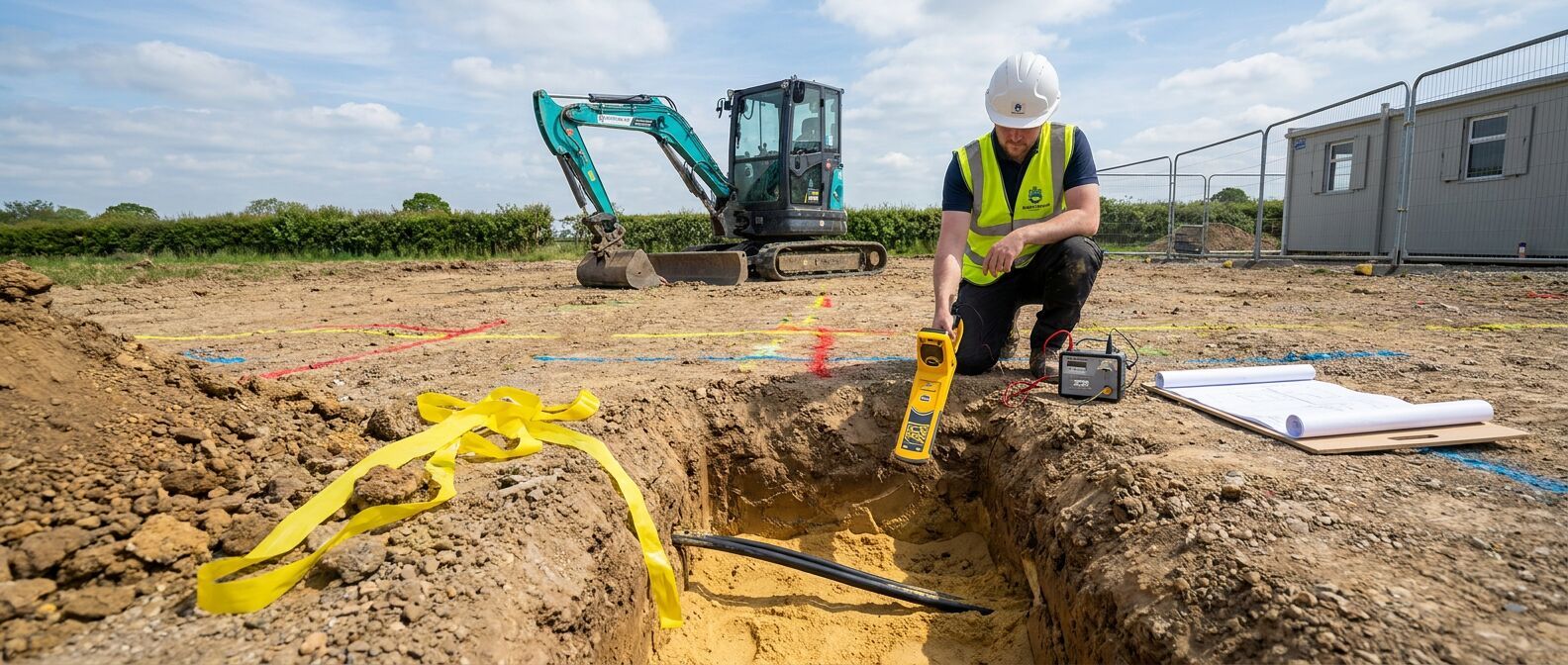
Underground services safe digging
Plan buried service searches, permits, cable avoidance scans, trial holes, and emergency actions before excavation starts.
What counts as a buried service?
Buried services are underground utility assets such as electricity cables, gas pipes, water mains, sewers, telecoms ducts, street lighting cables, fuel lines, and private site services. HSG47, the HSE guidance on avoiding danger from underground services, expects a safe system based on plans, locating, marking, safe excavation, and emergency arrangements.
CAT
Cable avoidance tool. It detects some buried metallic services and live power signals, but it cannot prove an area is service-free.
Genny
Signal generator used with a CAT to apply a traceable signal to a service or tracer wire.
Permit
A permit to dig is a project control used to confirm plans, scans, markings, method, supervision, and emergency contacts before breaking ground.
Check the digging risk
Set the current controls. The result highlights the controls that need attention before excavation starts.
Digging status
Proceed only under the permit
Core controls are in place. Keep the permit live and stop if the ground does not match the information.
Open controls
Control cards
The selector highlights the controls most likely to need action. A clear CAT scan does not remove the need for plans, markings, and cautious excavation.
Utility plans and site walkover
Gather records from utility owners, the client, previous contractors, and site operators. Compare drawings with covers, cabinets, lighting columns, meters, poles, scars, chambers, and service entries.
Treat records as aids, not proof. Private services and abandoned assets are often missing.
CAT and Genny survey
Use the correct modes and mark routes clearly on the ground. Follow the manufacturer's instructions, check the equipment before use, and repeat the scan as excavation progresses. The person using it must understand its limits and the type of services expected.
Non-metallic pipes, unenergised cables, deep services, and congested corridors can be missed. A locator does not prove that the ground is service-free.
Permit to dig
Where the project uses a permit-to-dig system, the permit should confirm the scope, drawings used, scan record, marked routes, method, authorised plant, hand-dig zones, supervision, and emergency contacts.
Reissue or amend the permit if the dig line, depth, plant, or ground conditions change.
Trial holes and exposing services
Use hand digging or vacuum excavation to prove line and level where the route affects the work. Support exposed services and protect them from plant, materials, and traffic.
Do not assume a service follows a straight line between visible points.
Mechanical excavation controls
Use machines only where controls show it is safe to do so. Keep bucket teeth, breakers, augers, and trenching attachments away from marked or suspected routes until services are exposed.
Use a banksman where visibility, public interface, or service congestion creates extra risk.
Emergency response
Brief workers on what to do if a cable, pipe, duct, or unknown object is struck or exposed. Keep utility emergency numbers and site location details available at the work face.
Stop work, keep people away, and contact the asset owner or emergency services where needed.
Permit checklist
This checklist uses a permit to dig as a conservative project control. HSG47 says a formal permit system may be appropriate for particularly hazardous work. Follow the project RAMS and control arrangements. If any item is uncertain, stop and improve the information before excavation starts.
Emergency actions after a strike
These are prompts for briefing and emergency planning. Follow the asset owner's emergency instructions and call emergency services where there is immediate danger.
Electric cable
Stop work, keep people away, avoid touching plant or exposed conductors, and contact the network operator. If plant is live, the operator should stay in the cab if safe to do so until told otherwise.
Gas or fuel pipe
Stop work, extinguish ignition sources, evacuate upwind where possible, prevent vehicles entering the area, and call the gas emergency number or emergency services.
Water, sewer, or telecoms
Stop work, protect the area, prevent collapse or flooding risks, and contact the asset owner. Do not backfill or conceal damage before it is assessed.
Sources
- HSE HSG47 avoiding danger from underground services - core guidance for plans, locating, safe digging, and emergency controls
- HSE buried services safety topic - construction guidance for underground services
- HSE excavation near underground electrical cables - electrical service strike guidance
- PAS 128:2022 underground utility detection specification - current BSI specification for detection, verification, location, and permit-to-break-ground support
- CDM 2015 Regulation 25 - energy distribution installation precautions
- HSE CIS80 construction phase plan - construction phase planning prompts under CDM 2015
Related resources
PPE compliance quick reference for UK groundworks
EN standard decoder, task-based PPE selector, hard hat replacement lookup, and the April 2022 employer-pays rule. What to spec and what to refuse when the PPE rep calls.
Site safety induction checklist & toolbox talk quick reference
Interactive CDM 2015 induction checklist, 20 toolbox talk topics, RIDDOR quick reference, and seasonal safety considerations.
Temporary works compliance checklist
BS 5975 duty holder roles, excavation support selector, inspection checklists, and permit templates. The practical compliance tool for TWCs and site supervisors.