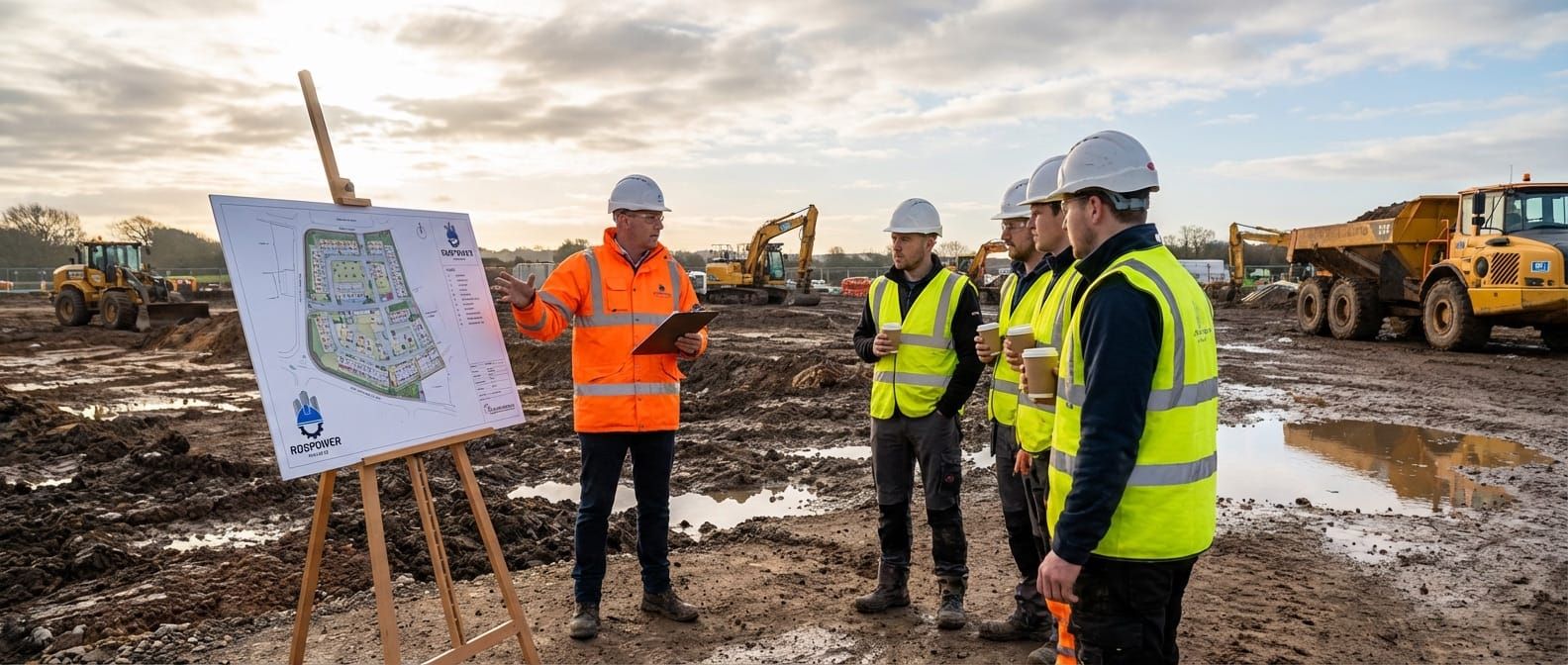
Site safety induction & toolbox talk reference
Everything a supervisor needs for Monday morning. CDM 2015 induction checklist, toolbox talk topics, and RIDDOR quick reference.
Site induction checklist
CDM 2015 requires a site-specific induction for every worker before they start. Tick off each topic as you cover it. Expand any item for detail on what to include.
Site-specific hazards
Emergency procedures
Welfare facilities
PPE requirements
Reporting and permits
Environmental controls
Site rules
Toolbox talk topic reference
20 topics most relevant to groundworks and civils sites. Each includes key talking points and common enforcement patterns to make the message concrete.
1 Excavation collapse and trench safety CDM Reg 22 | HSE high-priority topic
Key points:
- • Excavations can collapse without warning; support, batter back, bench, or otherwise make the sides safe before entry
- • Trench support (shoring, trench boxes, or hydraulic walling) required for vertical-sided excavations
- • Spoil heaps at least 1m back from trench edges
- • Daily inspections by a competent person; after heavy rain, inspect before re-entering
- • Safe access/egress at all times (ladders within 5m of any point in the trench)
- • Keep spoil, plant, and other loads back far enough to avoid surcharge and collapse at the excavation edge
Common enforcement pattern: Workers enter a vertical-sided trench before support is installed, spoil is left near the edge, and no competent excavation inspection is recorded after weather changes or altered ground conditions.
2 Underground services and cable strikes HSE HSG47 | Electricity at Work Regulations 1989
Key points:
- • Always use CAT and Genny before breaking ground (not just CAT alone)
- • Obtain up-to-date service drawings before starting (utility companies, LinesearchbeforeUdig)
- • Hand dig within 500mm of any known service
- • Treat all cables as live until proven otherwise
- • If you strike a service: stop work, evacuate, call the utility company. Never attempt to repair
- • CAT operators must hold valid training (EUSR or equivalent)
Common enforcement pattern: Teams break ground using old or incomplete service drawings, do not trace services with suitable locating equipment, and machine excavate too close to a suspected cable or pipe.
3 Plant and pedestrian segregation Site traffic management | HSE high-priority topic
Key points:
- • Designated pedestrian routes separate from plant movements
- • No walking behind or alongside operating plant without banksman
- • Avoid reversing where possible; where it cannot be avoided, use clear controls such as segregation, one-way systems, cameras, alarms, and a trained signaller where needed
- • Set plant exclusion zones to suit the machine, attachment, visibility, and task, then keep pedestrians out of them
- • Eye contact with operator before entering work area
Common enforcement pattern: Pedestrian routes drift into active plant zones, reversing is allowed where a one-way route could be planned, and signallers or physical segregation are missing where visibility is poor.
4 Manual handling on site Manual Handling Operations Regulations 1992
Key points:
- • Avoid manual handling where possible (use plant, barrows, material handlers)
- • HSE guideline: maximum 25kg for regular lifting (less in awkward positions)
- • Kerbs, manhole covers, and drainage components are common causes of back injury
- • Two-person lifts for anything over 25kg or awkward shape
- • Warm up before heavy manual work, especially in cold weather
5 Hand-arm vibration (HAVS) and trigger time Control of Vibration at Work Regulations 2005
Key points and trigger times:
- • Daily exposure action value (EAV): 2.5 m/s² A(8)
- • Daily exposure limit value (ELV): 5 m/s² A(8) - must not exceed
| Equipment | Typical vibration | Time to EAV | Time to ELV |
|---|---|---|---|
| Wacker plate (small) | 4-8 m/s² | ~1 hour | ~4 hours |
| Breaker (hand-held) | 12-25 m/s² | ~15 mins | ~1 hour |
| Disc cutter (petrol) | 6-12 m/s² | ~30 mins | ~2 hours |
| Whacker rammer | 10-20 m/s² | ~20 mins | ~1.5 hours |
| Needle scaler | 8-20 m/s² | ~20 mins | ~1.5 hours |
Rotate workers between vibrating and non-vibrating tasks. Keep records of exposure time. Symptoms: tingling, numbness, white fingertips in cold. HAVS is irreversible once established.
6 Silica dust and RPE COSHH 2002 | Workplace Exposure Limit: 0.1 mg/m³
Key points:
- • Cutting concrete, kerbs, paving, or blocks generates respirable crystalline silica (RCS)
- • RCS causes silicosis (irreversible lung disease) and lung cancer
- • Wet cut wherever possible (water suppression on disc cutters)
- • Use suitable RPE selected through COSHH assessment, commonly FFP3 for silica dust tasks, with face-fit testing for tight-fitting masks
- • Face-fit testing required for tight-fitting RPE
- • Never sweep up silica dust dry; use vacuum or dampen first
7 Working at height (including from ground level) Work at Height Regulations 2005
Key points:
- • "Working at height" includes working at ground level next to an excavation (risk of falling in)
- • Provide suitable barriers or edge protection where people could fall into excavations, openings, or other hazardous edges
- • Ladders: 3-point contact, secured at top, extending 1m above landing point
- • Scaffold: only erected/modified by competent persons (CISRS card holders)
- • Falls from height remain the number one cause of fatal construction injuries in the UK
8 Noise exposure and hearing protection Control of Noise at Work Regulations 2005
Key points:
- • Lower action value: 80 dB(A) - make hearing protection available
- • Upper action value: 85 dB(A) - hearing protection mandatory, hearing protection zones required
- • Rule of thumb: if you need to shout to be heard at 2m distance, noise levels exceed 85 dB(A)
- • Hearing loss is permanent and cumulative. It develops over years, not from a single exposure
- • Common sources: breakers (100-115 dB), disc cutters (95-105 dB), piling rigs (85-110 dB)
9 Confined space entry Confined Spaces Regulations 1997
Key points:
- • Manholes, chambers, deep excavations, and tanks can all be confined spaces
- • Never enter without a permit, risk assessment, and rescue plan
- • Atmospheric testing before entry (oxygen levels, toxic gases, combustible gases)
- • Top person must be present at all times during entry
- • Never attempt a rescue without proper training and equipment - most confined space fatalities are rescuers
Common enforcement pattern: A worker enters a chamber without atmospheric testing, a rescue plan, or trained standby support, then a colleague attempts an improvised rescue and is also exposed.
10 Mental health and wellbeing Mates in Mind | Lighthouse Charity
Key points:
- • ONS data for England found especially high suicide risk in low-skilled male construction occupations, which is why site-level support matters
- • Watch for signs: withdrawal, mood changes, increased absence, quality of work dropping
- • Ask: "You alright? Anything going on?" in a quiet moment, not in front of the team
- • Lighthouse Charity helpline: 0345 609 1956 (24/7, free, construction-specific)
- • Samaritans: 116 123 (24/7, free)
Read more: Mental Health on Construction Sites
RIDDOR quick reference
When and how to report. Getting this wrong can result in prosecution separate from the incident itself.
| Type | Threshold | Deadline | Who reports |
|---|---|---|---|
| Fatal injury | Any work-related death | Immediately by phone, then online within 10 days | Employer / person in control of premises |
| Specified injury | Fractures (not fingers/toes/thumbs), amputation, loss of sight, crush injuries, burns covering >10% of body | Within 10 days | Employer |
| Over-7-day incapacitation | Worker unable to do normal duties for >7 consecutive days (not counting the day of the accident) | Within 15 days of the accident | Employer |
| Dangerous occurrence | Collapse of scaffolding, excavation collapse, crane failure, contact with overhead line, gas leak | Within 10 days | Person in control |
| Occupational disease | Doctor diagnosis of HAVS, occupational dermatitis, occupational asthma, carpal tunnel (linked to work) | As soon as a doctor notifies you | Employer |
How to report: Online at hse.gov.uk/riddor. For fatal accidents or specified injuries to workers, HSE also allows phone reporting on 0345 300 9923.
Common mistake: confusing "specified injury" with "over-7-day." A broken wrist is a specified injury and must be reported within 10 days, regardless of time off work. An over-7-day report is for injuries that incapacitate but aren't on the specified list.
Seasonal safety considerations
Hazards change with the seasons. Adjust your toolbox talks and risk assessments accordingly.
Summer hazards
UV exposure and sunburn
Construction workers receive 5-10x more UV exposure than office workers. Long-sleeved shirts, neck protection, sunscreen SPF 30+. Skin cancer is the most common occupational cancer in construction.
Heat stress and dehydration
Symptoms: dizziness, confusion, muscle cramps, dark urine. Provide shaded rest areas, enforce water breaks (minimum 250ml every 30 minutes in hot conditions), schedule heavy work for cooler hours.
Insect stings and Lyme disease
Tick checks after working in long grass or near woodland. Bee/wasp stings can cause anaphylaxis; know who carries an EpiPen. First aider should be aware of allergies.
Leptospirosis (Weil's disease)
Transmitted via rat urine in water. Risk when working near watercourses, in sewers, or in flooded excavations. Cover cuts and abrasions. Wash hands before eating.
Sources
- CDM 2015 Regulations (legislation.gov.uk)
- L153: Managing health and safety in construction (HSE Approved Code of Practice)
- HSE Construction sector guidance
- RIDDOR reporting (HSE)
- Hand-arm vibration guidance (HSE)
- HSG47: Avoiding danger from underground services (HSE)
Built by Rospower Projects. We run site inductions every Monday morning. 35+ years managing safe construction sites.
Discuss your projectRelated resources
PPE compliance quick reference for UK groundworks
EN standard decoder, task-based PPE selector, hard hat replacement lookup, and the April 2022 employer-pays rule. What to spec and what to refuse when the PPE rep calls.
Temporary works compliance checklist
BS 5975 duty holder roles, excavation support selector, inspection checklists, and permit templates. The practical compliance tool for TWCs and site supervisors.
Underground services safe digging
Interactive checklist for buried services, utility plans, cable avoidance scans, permit-to-dig controls, trial holes, and emergency response.