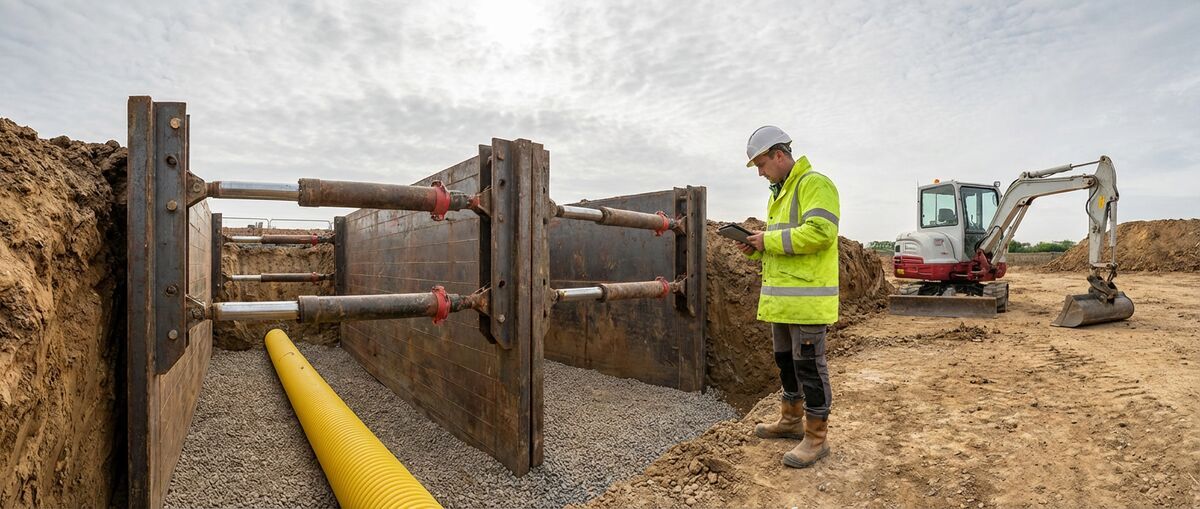
Temporary works compliance checklist
BS 5975 roles, excavation support, inspection frequencies, and permit references. Built for TWCs, site agents, and anyone who signs off excavations.
BS 5975 duty holders
Every construction project with temporary works needs these roles controlled under BS 5975-1:2024. On a small project one person can hold multiple roles, but each role must be explicitly assigned and documented.
Temporary works coordinator
Appointed by the principal contractor
- • Maintains the TW register for the project
- • Ensures every TW item has a design and a design check
- • Issues permits to load and permits to strike/dismantle
- • Inspects or delegates inspection of TW on site
- • Signs off completion before the TW is loaded or struck
Competence: CSCS TWC card (CITB-accredited training), or equivalent experience documented and assessed. Must understand the categories of TW on their project.
Temporary works designer
Must be a competent engineer
- • Designs the temporary works to a recognised standard
- • Produces drawings, calculations, and a design brief
- • Specifies materials, loading limits, and erection sequence
- • Responds to site queries and design changes
Competence: Chartered or incorporated engineer (CEng/IEng) with TW design experience, or a specialist TW design consultancy. The TWD cannot also be the independent design checker.
TW supervisor (site)
Supervises erection, use, and striking
- • Erects TW to the designer's drawings and sequence
- • Reports deviations or problems to the TWC immediately
- • Ensures no loading before the permit to load is issued
- • Ensures no striking before the permit to strike is issued
Competence: Site agent, foreman, or supervisor with practical knowledge of the TW type being erected. CSCS Supervisor (gold) card minimum. Must be briefed on the specific TW design before work starts.
Does this work need a TWC?
BS 5975-1:2024 applies to temporary works management procedures. In practice, the following categories require a formally appointed TWC with a documented procedure.
0 of 8 categories checked. Select the TW categories present on your project.
Excavation support selector
Select your excavation depth and ground type. You'll get the recommended support method, indicative cost range, and key inspection points.
Recommended support
Battering or stepping
Safe batter angle
45° (1:1)
Indicative cost
Low
Excavation volume only
Excavation inspection checklist
Per CDM 2015 Regulation 22, a competent person must inspect excavations at the start of every shift, after any event that may have affected stability, and at least every 7 days. Use this checklist as a prompt for each inspection.
Face stability
Support systems
Water
Surcharge and edge protection
Access and egress
Services and contamination
of 15 items checked
Complete all checks before signing off the excavation as safe to work in.
Inspection frequencies by TW type
Minimum inspection intervals per CDM 2015 and BS 5975. Your site-specific TW procedure may require more frequent inspections.
| TW type | Routine inspection | After adverse event | By whom |
|---|---|---|---|
| Excavations (all types) | Start of every shift + at least every 7 days | After heavy rain, vibration from plant, changes to surcharge loading, or any event affecting stability | Competent person (site agent, TWC, or delegated supervisor) |
| Formwork / falsework | Before each concrete pour (permit to load) + during the pour | After any movement, settlement, or reported defect | TWC or TW supervisor |
| Temporary propping | Daily visual check + formal inspection weekly | After impact, vibration, or change to loading | TWC |
| Crane bases / hard standings | Before each crane erection or relocation | After heavy rain or change to ground conditions | Crane supervisor + TWC |
| Cofferdams | Every shift + continuous monitoring of water levels | After tidal events, flood, or change to river level | TWC with specialist input |
CDM 2015 Regulation 22 sets the legal minimum for excavation inspections. BS 5975 sets the framework for all other TW types. Inspection records must be kept on site and be available for HSE inspection. Use Form F91 (excavation) or your company's equivalent.
The permit process
BS 5975 requires a formal permit system for loading and striking temporary works. Here's what each permit covers and what the TWC checks before signing.
Permit to load
Issued by the TWC before the temporary works can accept their design load (e.g. before a concrete pour into formwork, before placing fill against a retaining structure).
TWC checks before signing
- • TW erected to the approved design drawing
- • Independent design check completed and signed
- • Foundation/bearing conditions match assumptions
- • All connections, pins, and wedges secure
- • No deviations from the design (or deviations agreed with the TWD)
- • Monitoring points in place (if specified)
Permit to strike / dismantle
Issued by the TWC before temporary works can be removed. Premature striking is one of the most common causes of TW-related collapses.
TWC checks before signing
- • Permanent works have reached the required strength (cube results for concrete)
- • Minimum curing period has elapsed (typically 3-7 days for formwork to slabs)
- • Structural engineer has confirmed the element is self-supporting
- • Striking sequence agreed (progressive release, not sudden removal)
- • Adjacent TW not affected by the removal
- • Exclusion zone established below the TW being struck
RIDDOR reportable events (TW-related)
These temporary works incidents must be reported to the HSE under RIDDOR within 10 days (or immediately for fatalities and specified injuries).
| Event | Reporting deadline | Examples |
|---|---|---|
| Collapse of falsework | Immediate | Partial or complete failure of falsework towers supporting formwork, regardless of whether anyone was injured |
| Collapse of scaffold over 5m | Immediate | Partial or complete collapse of any scaffold exceeding 5m in height |
| Collapse of excavation wall | Immediate (dangerous occurrence) | Collapse of an excavation face that was deep enough to bury or trap a person, even if no one was in the trench at the time |
| Collapse of building or structure | Immediate | Unplanned collapse of any wall, floor, or structural element during construction, including collapse caused by TW failure |
| Over-7-day injury | Within 15 days | Any injury caused by TW failure that results in more than 7 consecutive days off work (not counting the day of the accident) |
Common enforcement patterns
Unsupported trench work. HSE enforcement commonly follows where workers enter trenches without designed support, battering, edge protection, safe access, and inspection records. CDM 2015 Regulation 22 requires excavations to be supported or battered where necessary to prevent collapse.
Uncontrolled formwork changes. Temporary works failures often trace back to site modifications that were not returned to the temporary works designer or checker. The permit to load should only be issued after the installed works match the checked design.
Weather and surcharge not controlled. Excavations and retaining works need fresh inspections after events that may affect stability, including heavy rain, vibration, surcharge loading, or a change in groundwater conditions. These triggers should be written into the inspection regime.
Formwork striking times
Minimum periods before formwork removal, per BS EN 13670 and typical UK practice. These assume CEM I concrete cured at an average temperature of 15-20°C. Cold weather extends these periods significantly.
| Element | Side formwork (non-load-bearing) | Soffit (load-bearing) | Notes |
|---|---|---|---|
| Walls and columns | 12-18 hours | N/A | Concrete must be strong enough to resist damage during stripping. Wait longer in cold weather. |
| Beam sides | 12-18 hours | N/A | Side forms only. Soffits remain until the beam is self-supporting. |
| Slab soffits (props remain) | N/A | 3-4 days | Soffit boards can be removed if back-propping is in place. Props carry the load until the slab reaches design strength. |
| Slab soffits (props removed) | N/A | 7-14 days | Cube test results required. Concrete must reach 75% of design strength before props are fully removed. |
| Beam soffits | N/A | 14-21 days | Beams are more critical than slabs. Always verify with cube results. Never strip beam soffits based on time alone. |
These are guidance values, not fixed rules. Your structural engineer or TWD sets the actual striking criteria for the project. The TWC issues the permit to strike only when the criteria are met. If average daily temperature drops below 5°C, double the times shown. Below 0°C, do not assume any strength gain until the concrete thaws.
Sources
- BS 5975-1:2024 Temporary works: management procedures for the control of temporary works
- BS 5975-2:2024 Temporary works: falsework design and implementation
- CDM 2015 Construction (Design and Management) Regulations 2015 (Regulation 22: Excavations)
- RIDDOR 2013 Reporting of Injuries, Diseases and Dangerous Occurrences Regulations
- Temporary Works Forum guidance documents and toolbox talks
- CIRIA C760 Guidance on embedded retaining wall design
- HSE: Excavation safety guidance for employers and workers
Built by Rospower Projects, a specialist groundworks and civil engineering contractor. 35+ years on site.
Discuss your projectRelated resources
PPE compliance quick reference for UK groundworks
EN standard decoder, task-based PPE selector, hard hat replacement lookup, and the April 2022 employer-pays rule. What to spec and what to refuse when the PPE rep calls.
Site safety induction checklist & toolbox talk quick reference
Interactive CDM 2015 induction checklist, 20 toolbox talk topics, RIDDOR quick reference, and seasonal safety considerations.
Underground services safe digging
Interactive checklist for buried services, utility plans, cable avoidance scans, permit-to-dig controls, trial holes, and emergency response.