PPE compliance quick reference
EN standard decoder, task-based selector, replacement lookup, and the 2022 employer-pays rule. What to spec and what to refuse when the rep calls.
A PPE rep will show up at your cabin every quarter. He will quote a price, show you a glossy catalogue, and ask for the order. You need to know what to insist on: which EN standard, which rating, which shelf life, and who pays when the subcontractor's labourer turns up on Monday without boots. This page answers all four.
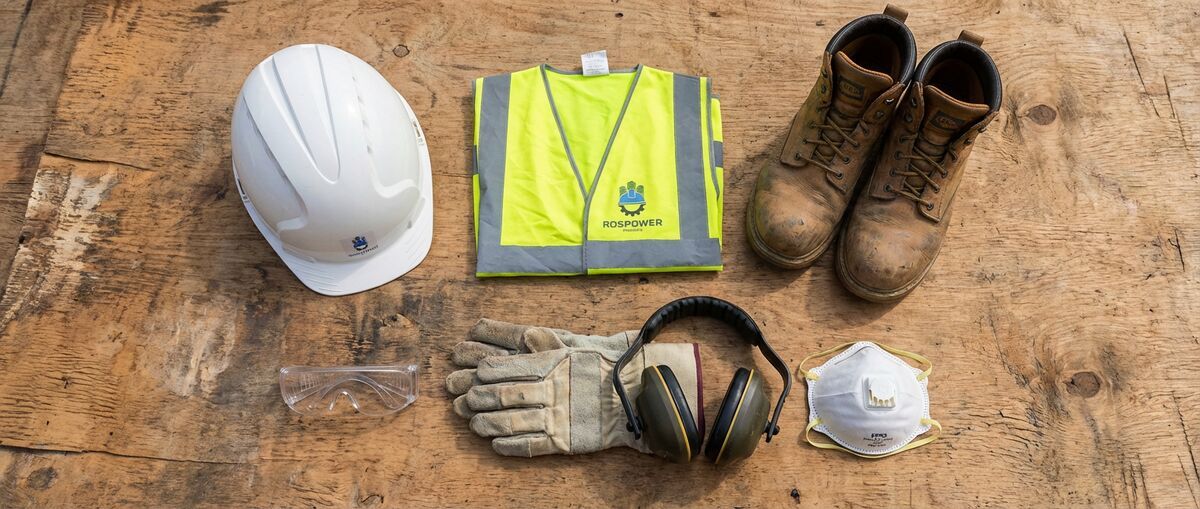
Minimum kit for a UK groundworks site
Six items every worker needs before they walk through the gate. Add respiratory protection the moment anyone picks up a disc cutter.
| Item | Standard to insist on | Typical retail | Realistic life on site |
|---|---|---|---|
| Hard hat | BS EN 397, vented if summer, with chinstrap clip | £8–£25 | 5 years from stamped date, sooner after any impact |
| Hi-vis | BS EN ISO 20471, class 2 inside site, class 3 near live traffic | £12–£35 | 12–18 months before colour fade drops it out of spec |
| Safety boots | BS EN ISO 20345, S3 minimum for wet groundworks, with steel or composite midsole | £45–£110 | 9 months (cheap), 3 years (good PU sole, leather upper) |
| Safety glasses | BS EN 166, F-rated for impact (45 m/s), anti-mist coating | £3–£12 | Replace on first scratch that sits in the line of sight |
| Gloves | BS EN 388 cut level B minimum for kerbs and rebar, level D for steel handling | £2–£15 | Consumable. Change when the palm wears through |
| Hearing protection | BS EN 352, SNR 25–30 dB for breaker work | £2 plugs – £25 defenders | Foam plugs: single use. Defenders: 2–5 years with care |
| FFP3 mask (silica work) | BS EN 149 FFP3 for silica dust tasks, subject to COSHH assessment and face-fit | £4–£8 each | One shift per mask, or until breathing resistance rises |
Full kit per head lands at £80–£140 retail. Buying S1P boots instead of S3 saves £20 and costs you a pair every nine months. The maths rarely works out.
Task-based PPE selector
Pick a task. Get the kit spec. Use this at the morning toolbox talk when a new activity starts.
Safety footwear decoder (S1P / S3 / S5)
Those letters aren't sales codes. They're the actual BS EN ISO 20345 classification. Matching the boot to the ground decides whether your labourer is still in the same pair in 12 months.
Antistatic, energy-absorbing heel, penetration-resistant midsole. Closed heel. Not water-resistant.
Right for: dry slab work, interior second-fix, joiner's boots. Wrong for anyone working in mud or standing water.
Everything S1P plus water-resistant upper, cleated sole, full penetration resistance. Will keep feet dry for 60 minutes of standing in water.
Right for: 95% of UK groundworks. Drainage, earthworks, foundations, kerbs.
Wellington-spec. One-piece moulded rubber or PU, waterproof to the top of the boot, steel toe, midsole.
Right for: deep mud, pumping operations, flooded trenches, concrete pours over the ankle. A second pair kept in the van.
Hi-vis class: when class 2 stops being enough
BS EN ISO 20471 splits hi-vis into three classes by reflective area, not by how bright the fabric looks. The wrong class on a highway job is an instant failure at the first audit.
| Class | Reflective area | Where it belongs |
|---|---|---|
| 1 | 0.14 m² background, 0.10 m² retroreflective | Roads under 30 mph, car parks. Not a groundworks spec. |
| 2 | 0.50 m² background, 0.13 m² retroreflective | Inside a fenced site, plant-and-pedestrian environments. Standard vest or chest bib. |
| 3 | 0.80 m² background, 0.20 m² retroreflective | Live highway, National Highways works, anywhere traffic runs above 30 mph on the other side of the cones. |
Long-sleeved jackets hit Class 3 naturally because of the sleeve bands. A vest alone tops out at Class 2. Keep a handful of Class 3 jackets in the container for the weeks when your crew works on the highway side.
Hard hat replacement lookup
Every BS EN 397 shell carries a manufacture date moulded inside the brim (an arrow and month numbers around a year). Enter that date. A fresh knock also voids the shell, regardless of age.
The harness inside the shell has its own life: typically two years from first use. Replace harnesses ahead of the shell if the webbing frays, the ratchet slips, or the date-of-first-use label is more than two years old.
RPE and face-fit testing
A tight-fitting mask works because it seals against the skin. A beard blocks the seal. Stubble over a day old blocks the seal. A face-fit test confirms the seal for a specific worker on a specific mask model.
- •FFP2 does not pass silica. The Workplace Exposure Limit for respirable crystalline silica is 0.1 mg/m³. FFP2 gives an Assigned Protection Factor of 10; FFP3 gives APF 20. Cutting, grinding, or breaking concrete needs FFP3 as the floor.
- •Face-fit is annual and mask-model-specific. A worker fitted to a 3M 8835 is not automatically fitted to a Moldex 2505. Record the test: worker, mask, tester, date, pass/fail. HSE inspectors ask for the log before anything else.
- •Cost budget: £40–£60 per worker per year for a qualitative fit test, £80–£120 for quantitative. BSIF Fit2Fit registered testers only.
- •Bearded workers need powered air-purifying respirators (PAPRs) or loose-fitting hoods. APF 40 for a PAPR; face-fit not required. Budget £400–£800 for the unit.
Who pays: the April 2022 change that still catches firms out
Until 6 April 2022, the PPE at Work Regulations 1992 made the employer responsible for providing PPE to employees. CIS subbies and casual labour fell outside that duty. The Personal Protective Equipment at Work (Amendment) Regulations 2022 closed the gap.
The rule now:
Every worker, including limb (b) workers (casual labour, CIS subbies paid day rate, short-term hires), must be supplied with required PPE by the employer, at no cost to the worker. Deducting the price of boots or hi-vis from a day rate is unlawful.
Where this bites:
- •The subby labourer who turns up Monday without boots is your problem, not his
- •Replacement for lost or damaged PPE is also on the employer. Charge for repeat loss is arguable; refusing the first replacement is not
- •Face-fit testing, annual eye tests where DSE-related, and RPE filters all sit on the employer invoice
See the HSE guidance on the 2022 amendment: Personal protective equipment at work regulations from 6 April 2022.
Records an inspector will ask for
Thin records turn a good site into a losing one during an HSE visit. Four registers, kept current, cover most of what you need.
Worker name, item, size, serial number where marked, date issued, signature on receipt. One row per issue. Keep for employment plus 3 years.
Worker, mask make and model, test type (qualitative/quantitative), tester name and Fit2Fit number, pass/fail, date. Retest annually. Keep 3 years minimum.
Pre-use check by wearer (recorded in a pocket card), detailed inspection every 6 months by a competent person, annual thorough examination. Retire after a fall arrest event.
Which item, for whom, why (end of life, damage, loss), and date. Shows a pattern of care rather than reactive spend.
Five mistakes HSE finds on small sites
- 1 FFP2 masks in a silica-dust environment. Common because FFP2 is cheaper and more comfortable. HSE issues an improvement notice on the spot when a disc cutter sits beside a box of FFP2. FFP3 minimum.
- 2 General-purpose gloves doing HAV work. Anti-vibration gloves to EN ISO 10819 reduce perceived vibration but do not reduce exposure enough to act as a control. Control HAV by tool choice and trigger time, not by glove spec.
- 3 Faded hi-vis. UV breaks down the fluorescent pigment. A vest that looks pale yellow instead of lime green has dropped below the colour requirement in BS EN ISO 20471. Replace on colour, not on wear.
- 4 No face-fit records for RPE users. This is the first thing an inspector asks for when they see a tight-fitting mask on site. A pass-fit test without a written record doesn't exist.
- 5 Deducting PPE cost from a subby's day rate. Unlawful since April 2022. The argument "he's self-employed" no longer applies to limb (b) workers under the 2022 amendment.
Sources
- Personal Protective Equipment at Work (Amendment) Regulations 2022 (legislation.gov.uk)
- L25: Personal Protective Equipment at Work (ACOP and guidance) (HSE)
- HSE guidance on PPE at work regulations from 6 April 2022
- HSE PPE sector guidance
- RPE and face-fit testing guidance (HSE)
- Fit2Fit accreditation scheme (BSIF)
- BSIF Registered Safety Supplier scheme
Compiled by Rospower Projects. Every crew we put on site wears branded hi-vis, EN 397 hats, and S3 boots as day one kit. No deductions, no exceptions.
Discuss your projectRelated resources
Site safety induction checklist & toolbox talk quick reference
Interactive CDM 2015 induction checklist, 20 toolbox talk topics, RIDDOR quick reference, and seasonal safety considerations.
Temporary works compliance checklist
BS 5975 duty holder roles, excavation support selector, inspection checklists, and permit templates. The practical compliance tool for TWCs and site supervisors.
Underground services safe digging
Interactive checklist for buried services, utility plans, cable avoidance scans, permit-to-dig controls, trial holes, and emergency response.