Mental health on construction sites: what's actually working and what supervisors can do
Construction has the highest rate of male suicide of any UK industry. Most 'awareness' campaigns haven't changed the numbers. Here's what the evidence says about what actually works on site.
By Eddie Lyons, Construction director
Generated by your browser's built-in AI. May not be fully accurate.
The statistic most often quoted in construction comes from the ONS occupational mortality data: in England, low-skilled male construction workers had a suicide risk 3.7 times the national average in the 2011-2015 dataset. That is a narrower claim than “all construction workers in the UK today”, but it is still serious enough to demand attention on site.
Most people in construction are already aware of the problem. The harder question is what actually works, and what a foreman or supervisor should do about it on a Monday morning when they’ve got a team to run and a programme to hit.
The numbers, honestly
ONS occupational data has consistently shown elevated suicide risk in parts of the construction workforce, especially among lower-skilled male construction roles and some skilled trades. Even where the exact rate varies by occupation and dataset, the pattern is serious enough that site supervisors should treat it as a real operational issue, not a PR topic.
That doesn’t mean nothing has changed. Awareness is clearly higher than it used to be, more companies now talk openly about mental health, and industry charities such as Mates in Mind and the Lighthouse Construction Industry Charity are more visible on sites than they were a few years ago.
But awareness and action are different things. Knowing that mental health matters hasn’t translated, at scale, into fewer deaths.
Why construction is different
Generic “workplace mental health” advice doesn’t account for what makes construction fundamentally different from office-based work. These aren’t abstract “risk factors.” They’re the daily reality of the industry:
Financial volatility
Many construction workers are self-employed or on insecure project-based work. That means no guaranteed sick pay, no paid gaps between contracts, and immediate pressure on cash flow when work stops. A two-week illness doesn’t just affect your health; it can also mean zero income and the fear of losing your place on a project.
The maths are stark: a self-employed groundworker earning £200/day who misses two weeks of work loses £2,000 of gross income, with no safety net whatsoever. If they’re already carrying van finance, tool costs, and a mortgage, that two-week gap can trigger a debt spiral that takes months to recover from.
Physical toll and chronic pain
Groundworks, steelfixing, bricklaying, and other physically demanding trades damage bodies over time. Chronic back pain, knee problems, shoulder injuries, and hand-arm vibration syndrome (HAVS) are common among experienced workers. Chronic pain is strongly associated with depression and substance misuse. Many workers self-medicate with alcohol or painkillers rather than seeking treatment, because taking time off for medical appointments means losing income.
Transient work patterns
A construction worker might be on a different site every few months, working with a different team, in a different part of the country. This constant upheaval makes it difficult to build the stable social connections that protect mental health. You don’t have colleagues you’ve known for years. You have people you’ve worked with for six weeks.
For workers “on the road” (living away from home Monday to Friday in digs or B&Bs), the isolation is compounded. You’re away from your family, your friends, and your community for most of the week. Your evenings are spent in a bedsit or shared accommodation. The main social activity is the pub. This pattern is extremely common in UK construction and extremely damaging to mental health and relationships.
Presenteeism culture
“Man up” and “get on with it” are phrases that still define much of construction culture, even if they’re said less openly than they used to be. Admitting to struggling is perceived as weakness. Taking a mental health day is treated differently from taking a day off for a twisted ankle. The shift is happening, but it’s slow, and it’s uneven. On some sites, talking about mental health is normal. On others, it would still mark you out.
Substance use
Alcohol and drug misuse can become coping mechanisms for the stressors listed above. These aren’t moral failings, but they do make everything worse, particularly financial problems, sleep, mood, and relationship breakdown.
What the evidence says works
The research (from UCL, King’s College London, the Health in Construction Leadership Group, and Mates in Mind programme evaluations) points to several approaches with measurable impact:
Peer support on site
One of the more practical interventions is having trained peer supporters (sometimes called “Mates”) on site who workers already know and trust. The reason is simple: construction workers will usually talk to someone they know before they call a stranger on a helpline.
A peer supporter doesn’t need to be a therapist. They need to be someone who can recognise when a colleague is struggling, start a conversation, and know how to signpost to professional help. Mental Health First Aid-style training can help, but it only works if the culture on site makes those conversations possible.
Routine check-ins
The “Monday morning two-minute conversation” has genuine evidence behind it. It doesn’t need to be a formal welfare meeting. A foreman who asks “how was your weekend, everything alright?” and actually listens to the answer is doing more than most corporate wellbeing programmes. The research shows that regular, informal contact between supervisors and workers creates an environment where someone is more likely to speak up before they reach crisis point.
The critical word is “routine.” A one-off check-in after someone has visibly broken down is reactive. A weekly, casual conversation as part of normal site life is preventive.
Financial wellbeing support
Given that financial stress is the primary trigger, interventions that address money directly have outsized impact. Some construction companies now offer:
- Wage advance schemes (allowing workers to access earned pay before the normal payment cycle)
- Referrals to free debt advice services (StepChange, National Debtline)
- Financial literacy toolbox talks covering CIS tax, budgeting, and emergency funds
- Signposting to the Lighthouse Charity financial assistance programme
These aren’t wellness perks. They’re practical interventions that address the root cause of the problem for many workers.
Flexible working where possible
Construction isn’t a remote-work industry, but small flexibilities make a disproportionate difference. Letting someone leave an hour early on Friday to see their kids. Accommodating a medical appointment without docking pay. Being reasonable about start times for someone dealing with a family crisis. These signals tell workers that they’re valued as people, not just as pairs of hands. And they cost very little.
What doesn’t work (or hasn’t worked yet)
Being honest about what hasn’t moved the needle matters, because resources are limited and companies should spend them on things that actually help:
Posters on welfare cabin walls
Mental health awareness posters become invisible within a week. They’re the equivalent of a fire exit sign: technically present, functionally ignored. Every site has them. Nobody reads them after day one.
One-off “awareness days”
A single mental health awareness day (green ribbon, guest speaker, free tea) generates a brief spike in conversation and then nothing. Without follow-up structures (ongoing peer support, regular check-ins, actual resources), the awareness day is a box-ticking exercise. Workers see through it immediately.
EAP phone lines alone
Employee Assistance Programmes offer free confidential counselling via telephone. They can be useful as a backstop for workers who are already prepared to seek help, but on their own they are rarely enough to change day-to-day site culture.
Sending one person on a Mental Health First Aid course
Training one person per site and considering the job done is the most common approach. It’s also one of the weakest versions of what could be a good intervention. One person gets overwhelmed, becomes the “mental health person” and ends up carrying the whole issue alone.
What a supervisor can do Monday morning
This is the practical section. If you’re a foreman, supervisor, or site manager reading this, here’s what the evidence says makes a difference:
Spot the signs
People who are struggling rarely announce it. They show it in behaviour changes:
- Turning up late repeatedly when they were previously reliable
- Withdrawing from banter or social interaction on site
- Not eating at break times, or eating significantly more/less
- Quality of work dropping without an obvious technical reason
- Increased anger or irritability, especially over small things
- Appearance decline: not maintaining PPE, looking unkempt when they didn’t before
- Talking about money problems, debts, or relationship breakdown
None of these individually mean someone is in crisis. But a pattern of several, especially in someone who was previously steady, is a signal.
Start the conversation
The hardest part. Here’s what the Mates in Mind training recommends:
Do:
- Pick a quiet moment, not in front of the team. A walk to the stores, a moment in the van, end of the day
- Be direct but not clinical: “I’ve noticed you seem a bit off lately. Everything alright?”
- Listen. Don’t try to fix the problem. Just let them talk
- Ask: “Is there anything I can do?” and mean it
- Follow up. Check in again in a few days. The first conversation rarely gets the full picture
Don’t:
- Ask in front of other workers
- Say “man up,” “everyone goes through it,” or “it could be worse”
- Promise confidentiality you can’t deliver (if someone discloses suicidal intent, you may need to involve others)
- Try to be a therapist. Your job is to listen and signpost, not to diagnose or treat
- Forget about it after one conversation. Consistency matters more than a single grand gesture
Know where to signpost
Have these numbers in your phone. Not on a poster. In your phone, where you can actually access them:
- Lighthouse Charity helpline: 0345 609 1956 (24/7, free, confidential, construction-specific)
- Samaritans: 116 123 (24/7, free)
- SHOUT text service: text SHOUT to 85258 (24/7, free)
- Mates in Mind: matesinmind.org (workplace resources and training)
- Building Mental Health: lighthousecharity.org/building-mental-health-charter-project (framework and tools)
- StepChange debt advice: 0800 138 1111 (free, for financial crisis situations)
The Lighthouse Charity is the most construction-specific option. They understand the industry, they’ve heard it all before, and they can provide both emotional support and practical financial assistance.
Training and resources
If you want to go further:
- Mates in Mind offers tiered training: a general awareness session for all workers, a mental health “champion” course for supervisors, and ongoing support for organisations
- MHFA England runs the Mental Health First Aid course (2 days) with construction-specific scenarios
- Lighthouse Charity offers free wellbeing training sessions, financial support, and a 24/7 helpline
- Building Mental Health provides a free framework for construction companies implementing mental health programmes
- CITB funds mental health awareness training through the Employer Networks grant system (see our CITB Levy & Grants guide for how to claim)
The honest conclusion
The construction industry has a mental health crisis that it has acknowledged but not solved. Awareness has increased. The conversation has opened up. But the structural factors that drive the crisis (financial insecurity, physical toll, transient work, cultural norms) haven’t fundamentally changed.
What has changed is that individual supervisors, foremen, and site managers can make a genuine difference to the people in their teams. Not by running programmes or printing posters, but by paying attention, asking the question, and knowing where to send someone who needs more help than a conversation can provide.
If you run sites and you want to do this properly, the investment is small: two days of MHFA training for your supervisors, the Lighthouse Charity helpline in every phone, and a commitment to checking in regularly. That’s it. It won’t show up in a KPI dashboard. But it might make the difference for someone on your team.
If you or someone you know is in crisis, call the Lighthouse Charity on 0345 609 1956 or Samaritans on 116 123. Both are free, confidential, and available 24 hours a day.
Related articles
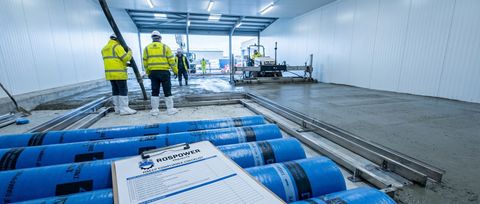
Groundworks for food manufacturing: what makes it different?
Food-grade drainage, BRC-compliant slabs, cold storage foundations, and contamination protocols explained for UK groundworks contractors.

UK construction events worth attending in 2026: a subcontractor's honest guide
A practical guide to UK construction events, meet-the-buyer days and industry expos still worth attending in 2026.
Our new website is live
We've refreshed the Rospower website to better reflect who we are and the work we deliver across the UK. Take a look around.