Groundworks for food manufacturing: what makes it different?
Food-grade drainage, BRC-compliant slabs, cold storage foundations, and contamination protocols explained for UK groundworks contractors.
By Eddie Lyons, Construction director
Generated by your browser's built-in AI. May not be fully accurate.
Search for “food factory groundworks” and you’ll find almost nothing useful. The food facility builders (Clegg Food Projects, Pentadel, Stancold, FSC) write about their design-build services from a main contractor perspective. Drainage manufacturers publish product specifications for their own ranges. Training providers cover food safety theory without connecting it to what happens in the ground.
The result is that developers, project managers, and architects planning food manufacturing facilities don’t know what to specify, what to budget, and what questions to ask their groundworks contractor. And most groundworks contractors don’t know what they don’t know, because they’ve never worked in a food environment and assume it’s just another industrial unit.
It’s not. The groundworks scope on a food manufacturing facility is 30-50% more complex and more expensive than equivalent standard industrial work. Here’s why.
Why food facilities are different
The answer is three letters: BRC.
The BRC Global Standard for Food Safety (now BRCGS) is the certification that most UK food manufacturers need to supply major retailers. Tesco, Sainsbury’s, M&S, Aldi, Lidl: if you want your product on their shelves, you need a BRC audit, and you need to pass. The standard covers everything from ingredient traceability to pest control to staff hygiene. And it covers the building, including the foundations, drainage, and external works that sit squarely in the groundworks package.
A failed BRC audit doesn’t just cost money. It can shut down production. It can lose retail contracts. It can end a business. That’s why the specifications for food facility groundworks are so much tighter than standard industrial, and why getting them wrong is not a snagging item you fix later. It’s a fundamental failure.
Beyond BRC, facilities producing chilled or frozen food must also consider SALSA (Safe and Local Supplier Approval) for smaller producers, and sector-specific standards like Red Tractor for agricultural supply chains. Each one adds requirements that flow down to the groundworks specification.
Drainage: the critical difference
If there’s one thing that separates food facility groundworks from standard industrial, it’s drainage. In a standard warehouse, drainage just needs to work: collect surface water, move it to an outfall, don’t flood. In a food facility, drainage needs to prevent contamination, allow thorough cleaning, resist chemical attack, and be auditable during inspections.
Internal process drainage
Food production areas generate process water: wash-down from cleaning, spillage from production lines, condensate from cooling systems. This water cannot mix with surface water drainage. It requires a completely separate system, and the specification is demanding:
Stainless steel channel drains. Not standard polypropylene channels. Food-grade facilities typically specify ACO, Blucher, or equivalent stainless steel channels rated for the specific chemical and thermal loads of the production process. The channel profile must be smooth (no crevices where bacteria can harbour), with removable grates that can be lifted for cleaning. Typical specification: AISI 304 or 316 stainless steel, minimum 1.5mm wall thickness, slot drain or heelguard grate depending on traffic type.
Falls to drain. The concrete slab must be laid with falls directing all water to the channel drains. The minimum fall in a food production area is typically 1:60 (about 17mm per metre), though many specifications require 1:40 (25mm per metre) in high-wash areas. This means the slab is not flat. It’s a carefully graded surface with multiple fall directions, and getting the levels right during the pour is critical. A flat spot where water ponds is a contamination risk and a BRC audit failure.
Interceptors. Food production generates fats, oils, and grease (FOG) that cannot enter the public sewer system. Grease interceptors (sized to the anticipated flow rate and FOG loading) are required before the process water reaches the foul drainage system. These are typically below-ground chambers that require careful installation with proper access for maintenance and emptying. The groundworks contractor needs to coordinate the interceptor position with the mechanical engineer designing the internal drainage layout.
Separate systems. A food facility will typically have three separate drainage networks running through the groundworks package:
- Process water from production areas (to interceptors, then foul sewer)
- Foul drainage from welfare facilities (direct to foul sewer)
- Surface water from roofs, car parks, and external areas (to attenuation and outfall)
These three systems must not cross-connect. Ever. A BRC auditor will check.
External drainage
The external works around a food facility also differ from standard industrial:
Vehicle wash areas need dedicated drainage with interceptors. Vehicles arriving at a food facility (delivery lorries, waste collection vehicles) are often washed before entering the yard. The wash water, contaminated with road dirt, fuel residue, and whatever the vehicle was carrying previously, needs contained drainage with oil and silt separation.
Waste compound drainage must prevent leachate from entering the surface water system. The waste storage area (bins, compactors, skips) sits on an impermeable surface with bunded drainage routed to the foul system.
Yard falls are designed for cleaning, not just rainwater management. The entire yard surface around a food facility should be capable of being washed down, with falls directing wash water to collection points. This means more extensive drainage infrastructure than a standard industrial yard.
Concrete slabs for food environments
A standard industrial slab (C32/40, A393 mesh, power-floated to SR3 or FM2) will not pass a BRC audit in a food production area without additional treatment. Here’s what food-grade slabs require:
Surface finish
A standard power-float finish has micro-porosity at a microscopic level. Under a BRC inspection, this micro-porosity is a contamination risk: bacteria can colonise in the surface pores, and cleaning chemicals cannot fully penetrate to sterilise them. Food production slabs typically require one of:
- Resin coating applied to the cured slab. Epoxy or polyurethane resin systems (from manufacturers like Flowcrete, Stonhard, or Sika) create a seamless, non-porous, chemically resistant surface. The groundworks contractor needs to provide a slab surface suitable for the resin application: clean, flat, free of laitance, and at the correct moisture content. Typically this means a power-float to FM2 minimum, with any surface defects remediated before the resin contractor arrives.
- Surface hardener applied to the wet concrete during the power-float process. Lithium silicate or sodium silicate treatments densify the surface and reduce porosity. This is less robust than a full resin system but suitable for lower-risk areas (dry storage, packaging, despatch).
Joint treatment
Every joint in a concrete slab is a potential harbourage point for bacteria. In a food production area, joints must be minimised (use steel fibre reinforcement to extend joint spacing from 6m to 12m or more) and those that remain must be sealed with food-grade joint sealant. Sawcut joints should be clean-cut, filled with a flexible polyurethane sealant rated for the cleaning chemicals used in the facility.
The groundworks contractor’s joint layout becomes a critical design decision, not an afterthought. Coordinate with the food safety consultant and the resin flooring contractor before pouring.
Specification
A typical food-grade slab specification:
- Concrete: C32/40 minimum, with consideration for C40/50 in heavy-traffic areas
- Reinforcement: Steel fibre (typically 25-40kg/m³ Dramix or equivalent) for joint spacing control, or A393 mesh if fibre is not permitted
- Thickness: 200mm minimum in production areas, 250mm+ in cold storage
- Surface: Power-float to FM2 minimum (FM1 preferred for resin application)
- Falls: 1:60 minimum to channel drains, 1:40 in high-wash areas, built into the slab (not surface-applied screed)
- DPM: 1200 gauge minimum, lapped and taped, turned up at edges
- Joints: Minimised, sealed with food-grade polyurethane sealant
Cold storage foundations
If the food facility includes chilled (0-5°C) or frozen (-18°C to -25°C) storage, the groundworks become significantly more complex. Cold storage foundations are specialist work, and getting them wrong is expensive: frost heave can lift and crack a slab within months, and remediation requires complete demolition and rebuild.
The frost heave problem
When a large area of concrete is held at sub-zero temperatures, the cold penetrates through the slab into the subgrade. If the ground below the slab reaches 0°C, moisture in the soil freezes, expands, and pushes the slab upward. This is frost heave, and it can generate forces strong enough to crack a 250mm reinforced concrete slab and distort the building structure above it.
Prevention methods
Heated sub-slab coils (the most common method). A network of glycol-filled heating pipes is installed within or immediately below the slab, connected to a thermostatically controlled heating system. The coils maintain the subgrade above freezing temperature regardless of the air temperature above the slab. Typical specification: 25mm HDPE pipes at 600mm centres, embedded in 50mm of sand blinding, with a glycol heating system providing 20-30W/m². The groundworks contractor installs the pipe network and coordinates with the M&E contractor for the heating plant connection.
Ventilated void (alternative method). Instead of heating coils, a void is created below the slab (using void formers like Cordek Cellcore or Claymaster) that allows air circulation to prevent the subgrade from freezing. This approach works well in chilled storage (0-5°C) but may not provide sufficient protection for deep-freeze environments (-25°C) without supplementary heating.
Additional requirements
Insulation. Cold storage slabs require insulation between the slab and the cold space above. Typically 150-250mm of high-density expanded polystyrene (EPS 200 or 300 grade) or PIR board, positioned above the DPM. The insulation must be rated for the compressive loads from racking and fork trucks.
Vapour barrier. The temperature differential between the warm subgrade and the cold storage creates condensation risk. A heavy-duty vapour barrier (minimum 1200 gauge, though 2000 gauge is common for cold stores) is required above the insulation to prevent moisture migration into the insulation layer.
Thicker slabs. Cold storage slabs are typically 250-300mm thick (compared to 150-200mm for standard industrial) to accommodate the insulation layers below and the high point loads from racking systems above.
Ground gas barrier. If the site is in a radon or methane area, the gas barrier must be compatible with the cold storage build-up. Standard gas membranes are tested at ambient temperature; verify that the specified membrane retains its properties at the design temperature.
External works for food sites
The external works scope around a food facility extends beyond standard industrial specifications in several ways:
Pest management in hard landscaping
BRC auditors inspect external areas for pest harbourage potential. This means:
- No gaps between kerbs and surfaces where rodents can burrow
- Sealed joints in paving rather than open jointed block paving
- Minimal vegetation adjacent to the building (no planting beds against external walls)
- Smooth surface finishes on boundary walls and plinths (no rough blockwork where insects can nest)
- Drainage gullies with rodent-proof gratings
The groundworks contractor needs to understand that every kerb line, every surface joint, and every drainage access point is subject to pest management scrutiny.
Loading bay approaches
Standard industrial sites often use tarmac for yard surfaces. Food facilities frequently specify concrete for the loading bay approaches and the immediate yard area around the building for several reasons: concrete is easier to clean, resists chemical attack from wash-down better than tarmac, and doesn’t soften in high temperatures (relevant for food facilities generating waste heat). Heavy-duty concrete yard slabs (typically C40/50, 250mm minimum, reinforced) with falls to drainage add significantly to the groundworks scope.
Waste compound
The waste storage area requires:
- Impermeable concrete base with 100mm upstands (bunding)
- Dedicated drainage to the foul system (not surface water)
- Interceptor for leachate containment
- Wash-down facility with hot water supply point
- Secure fencing to prevent pest access
Working in live food production environments
If the groundworks are for an extension, modification, or remediation of an existing food facility (rather than a new build), the contamination protocols are extreme. A live food production facility operates under HACCP (Hazard Analysis and Critical Control Points), and any construction work within or adjacent to production areas must comply with the facility’s HACCP plan.
What this means in practice
Physical separation. Construction areas must be completely sealed from production areas. Temporary dust barriers, sealed doors, and negative pressure in the construction zone (extraction fans pulling air from the construction area to outside, preventing dust migration to production areas). The groundworks contractor provides or accommodates these separations.
Dust control. Concrete cutting, excavation, and demolition generate dust that is a critical contamination risk. All cutting must be wet-cut. Excavation spoil must be removed immediately, not stockpiled. Dust monitoring may be required at the boundary of the construction zone.
Temporary drainage management. If existing drainage must be modified while the facility is operating, temporary drainage must be installed to maintain continuous service. No production area can be left without functioning drainage, even for a single shift.
Access protocols. Construction workers entering a live food facility typically need: clean PPE (changed at the facility boundary), hair nets, beard nets, no jewellery, hand washing on entry, separate welfare facilities from production staff. Some facilities require induction training before construction workers are permitted on site.
Programme constraints. Work generating noise, vibration, or dust may be restricted to outside production hours. A food facility running two shifts (06:00-22:00) leaves a four-hour window for disruptive work. This has a significant impact on programme and cost, and needs to be factored into the tender.
Our track record
This isn’t theory for us. Rospower has delivered food-grade groundworks for manufacturing facilities through our relationship with Pentadel, a specialist food facility design-build contractor. The work covers everything described in this article: food-grade drainage systems, BRC-compliant slab specifications, cold storage foundations, and external works designed for food safety compliance.
We understand what a BRC auditor will look at, what a food safety consultant will specify, and what a production manager needs from the finished building. That knowledge comes from having done it, not from reading about it.
Planning a food facility?
If you’re a food manufacturer, design-build contractor, or architect working on a new food production, processing, or storage facility, talk to a groundworks contractor who’s done it before. The specifications are different, the tolerances are tighter, and the consequences of getting it wrong are severe.
Get in touch to discuss your project. We’ll provide a detailed capabilities statement and references from food facility work.
Rospower Projects is a specialist groundworks and civil engineering contractor based in Fulmer, Buckinghamshire. Constructionline Silver accredited, NERS approved, with specific experience in food manufacturing facility groundworks, cold storage foundations, and BRC-compliant drainage systems. Contact us or call to discuss your food facility project.
Related articles
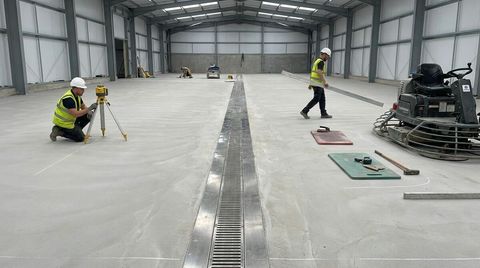
Floor slabs and falls for food production: drainage that passes audit
In a food factory the floor is a drainage surface, not a flat slab. How to set falls, channels and finishes so a BRCGS auditor passes the floor first time.
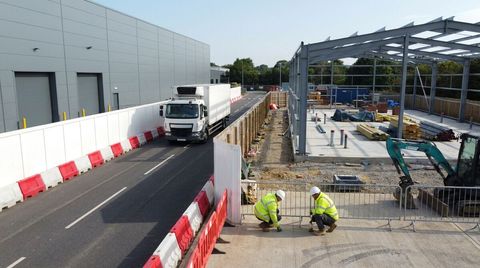
Food factory service tie-ins: prove readiness before shutdown
A practical readiness plan for drainage and utility tie-ins at a live food factory, including isolation, rollback, testing and return to service.
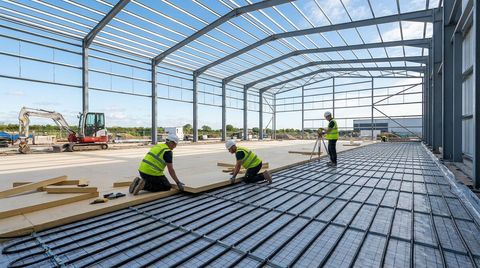
Cold storage foundations: stopping frost heave before it lifts the floor
A frozen store slab held below zero freezes the ground beneath it and heaves. Why cold storage foundations need under-slab heating, not just insulation.