Coal tips to cable trenches: building renewable energy on former mine sites
Former collieries across the UK are becoming solar farms, wind sites, and geothermal heat networks. The groundworks are nothing like greenfield, and that's the point.
By Eddie Lyons, Construction director
Generated by your browser's built-in AI. May not be fully accurate.
Williamthorpe Colliery in Chesterfield closed in 1970. For fifty years, its spoil heaps sat there, slowly revegetating, occasionally catching fire from residual combustion in the buried coal waste. In spring 2026, a 2MW solar farm funded by a £700,000 GB Energy grant is due to complete on that same land.
Williamthorpe is not unusual. Across the UK, former collieries, open-cast mines, and industrial spoil tips are being converted into renewable energy sites. Coed-Ely in the Rhondda Valley: 84 acres of reclaimed colliery tip becoming a solar farm. Welbeck in Nottinghamshire: 30MW of solar spread across five former colliery sites. Lochhead in Scotland: 80,000 panels on a former open-cast mine. In Gateshead, mine water pumped from flooded shafts at 15°C heats 350 homes through a district heat network, at prices below the market rate.
The logic is straightforward. These sites are large, flat (or can be made flat), already disturbed, and often have existing grid connections from their industrial past. Planning authorities generally prefer renewable development on brownfield land over greenfield agricultural land. The government’s clean power targets need both.
What’s less straightforward is the civil engineering.
The ground is not what you’re used to
Greenfield solar farm groundworks follow a predictable pattern. You strip topsoil, form haul roads, trench cables, drive piles for the mounting frames, and build substation compounds. The ground conditions are usually well understood: agricultural topsoil over clay, chalk, sand, or rock. You can predict what the excavator bucket will hit.
Former mine sites break every one of those assumptions.
What’s actually in the ground
A colliery spoil heap is not natural geology. It’s a man-made deposit of coal shale, mudstone, sandstone fragments, coal fines, and whatever else came out of the shaft or pit. The material is poorly graded, variably compacted, and chemically active. Coal waste generates acid mine drainage when exposed to rainwater and oxygen. Some tips contain enough residual coal to sustain underground combustion for decades.
Open-cast sites present different problems. The ground was excavated to depths of 30-50 metres, the coal removed, and the overburden backfilled in reverse order. The resulting ground profile bears no resemblance to the original geology. You might find clay overlying sandstone overlying clay again, with voids, soft spots, and perched water tables at unpredictable depths.
Both types of site can contain:
- Elevated heavy metals (lead, zinc, cadmium, arsenic) leached from mineralised coal measures
- Hydrocarbon contamination from surface processing operations, fuel storage, and washery plants
- Acidic leachate from pyrite oxidation in coal shale (pH values below 3 are not uncommon)
- Methane and carbon dioxide from ongoing decomposition of organic material in the fill
- Buried structures: shaft caps, headgear foundations, rail tracks, conveyor bases, washery infrastructure
Ground investigation is not optional
On a greenfield solar farm, you might get away with a desktop study and a handful of trial pits. On a former mine site, you need a full Phase 2 ground investigation before you can design anything. That means boreholes, trial pits, gas monitoring wells, chemical analysis of soil and groundwater, and a detailed interpretive report.
The Coal Authority maintains records of mine workings, shaft locations, and coal seam depths. A Coal Authority mining report is the first document any contractor should request. It will tell you where recorded shafts are, what depth the workings reached, and whether there are any current subsidence claims. It will not tell you about unrecorded workings, shallow adits, or trial borings that predate systematic record-keeping.
Budget for ground investigation on a brownfield renewable site runs two to five times higher than greenfield equivalent. A 20-hectare greenfield solar farm might need £15,000-£25,000 of GI. The same area on a former colliery tip could run £50,000-£80,000 or more, depending on the contamination regime and the density of buried structures.
Earthworks on spoil: different rules
Conventional solar farm earthworks involve stripping 150-200mm of topsoil, stockpiling it for reinstatement, and grading the formation to design levels. On a spoil tip, the topsoil (if it exists at all) may be a thin layer of self-seeded vegetation over raw colliery waste. The formation material is the spoil itself.
Compaction
Colliery spoil compacts unpredictably. The material is a mix of hard rock fragments and soft coal fines, with variable moisture content. Standard compaction testing (plate bearing tests, CBR values) can give misleading results because a single large stone fragment under the plate skews the reading. You need more test points, and you need to interpret the results with an understanding of what the material actually is.
Where spoil needs to be re-profiled (cutting high spots and filling low areas), the compaction specification must account for the material’s tendency to settle over time. Coal shale fines are susceptible to collapse settlement when wetted, meaning a fill that tests well during dry construction weather may settle 50-100mm after the first prolonged rainfall. Surcharging (pre-loading with temporary spoil stockpiles) can accelerate this settlement before you install the mounting frames, but it adds weeks to the programme.
Piling
Solar panel mounting frames on greenfield sites are typically installed on driven steel piles, 2-3 metres deep, using a hydraulic pile driver mounted on an excavator. Fast, cheap, and repeatable.
On colliery spoil, driven piles meet obstructions. Rock fragments deflect the pile, boulders stop it entirely, voids allow it to drop further than expected. Pull-out resistance varies wildly across the site because the spoil density changes every few metres.
Options include:
- Screw piles, which handle variable ground better than driven piles but cost 30-50% more per pile position
- Concrete ground anchors poured into pre-drilled holes
- Ballasted ground-mount systems that sit on the surface without penetrating the ground, useful where contamination must not be disturbed
Each option has a cost and programme implication. The right choice depends on the GI results, the contamination management strategy, and what the planning consent allows.
Contamination: the cost you can’t skip
Brownfield renewable sites sit in a regulatory framework that greenfield sites never encounter. The Environmental Permitting Regulations and Part 2A of the Environmental Protection Act 1990 apply to any development on land affected by contamination. The developer needs a remediation strategy approved by the local authority before construction begins.
For a solar farm on a former mine site, the remediation strategy typically involves one of three approaches:
Containment. Leave the contaminated material in place, install a capping layer (typically 500mm of clean imported material over a geotextile membrane), and manage surface water so it doesn’t infiltrate the contaminated ground. This is the most common approach for solar farms because the end use (solar panels, access tracks, grassland) doesn’t involve human habitation or food growing.
Removal. Excavate contaminated material and dispose of it at a licensed facility. Expensive (£30-£80 per tonne for disposal, plus excavation and haulage) and only justified where contamination is localised and severely above threshold values.
Treatment. Bioremediation, stabilisation, or soil washing to reduce contaminant concentrations in situ. Rarely used on solar farm sites because the timescale (months to years for bioremediation) doesn’t align with construction programmes.
The earthworks contractor’s role in all three approaches is central. Containment requires careful placement of capping materials with verified clean status. Removal requires segregation of contaminated and clean material, stockpile management, and chain-of-custody documentation for every lorry leaving site. Even “do nothing” strategies require the earthworks team to avoid disturbing capped areas during construction.
Mine water geothermal: a different kind of renewable groundworks
The Gateshead mine water scheme takes water from flooded mine workings at a constant 15°C, runs it through heat pumps, and delivers heating to 350 homes. The concept is being replicated at sites across the former coalfields: Seaham in County Durham, Caerau in South Wales, Dawdon near Sunderland.
The civil engineering scope for a mine water heat network is distinct from solar or wind:
- Borehole drilling into flooded mine workings, sometimes to depths of 100-200 metres
- Pumping infrastructure housed in surface compounds
- District heating pipework in trenches along public highways and through housing estates, typically pre-insulated steel or plastic pipe at 80-120mm diameter
- Energy centre construction for the heat pump plant, including reinforced concrete bases, acoustic enclosures, and electrical switchgear compounds
For a groundworks contractor, district heating pipework installation is essentially utility trenching at scale: 600-900mm deep, in adopted roads, with full traffic management and statutory undertaker coordination. The skillset is the same one you’d use on water main or gas main installation.
Why this matters for contractors
The UK has roughly 40,000 former mine sites. The Coal Authority manages around 3,300 abandoned coal mines and 1,000 former spoil heaps. Planning policy favours brownfield development. GB Energy is actively funding renewable projects on former industrial land. The pipeline is real and growing.
Contractors who can demonstrate experience in contaminated land earthworks, ground investigation interpretation, and remediation strategy implementation have a narrowing competitive field. Most groundworks firms have never worked on a spoil tip. They’ve never managed coal tar contamination or coordinated with the Coal Authority on shaft proximity works. That gap is the opportunity.
If your firm has worked on brownfield sites, even in a non-renewable context (housing on former gasworks, commercial development on filled ground), that experience translates directly. The regulatory framework, the GI process, and the earthworks methodology are the same. The end use is different, but the ground doesn’t care what you’re building on top of it.
Eddie Lyons is construction director at Rospower Projects. We deliver earthworks, groundworks, and civil engineering packages across the UK, including renewable energy infrastructure on greenfield and brownfield sites. Get in touch if you’re planning a project.
Related articles
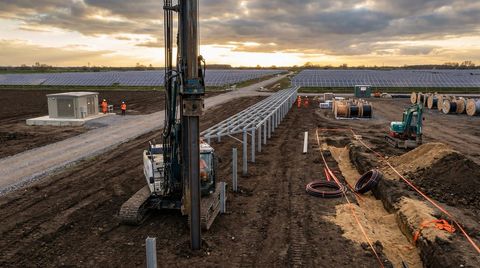
UK's largest solar farm approved: what 800MW of groundworks looks like
The 800MW Springwell Solar Farm just got consent. What civil engineering contractors actually build on a project this size: piling to cable trenching.
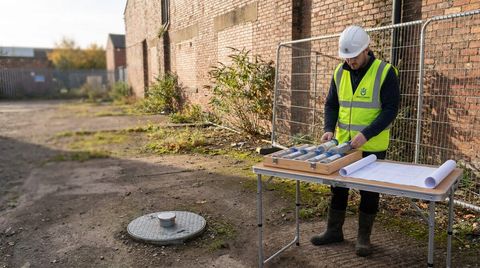
Brownfield ground investigation: write the questions before the scope
Commission a brownfield investigation around the design and contamination decisions it must support, with clear outputs, access limits and review points.
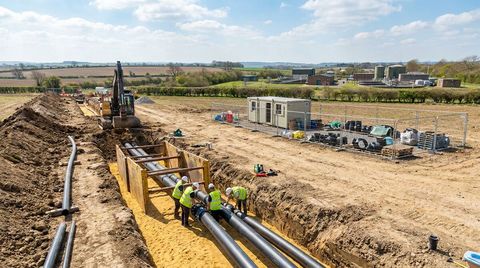
Ofwat's £104bn water investment: what civil engineering contractors need to know about AMP8
Ofwat approved £104bn of water sector investment for 2025-2030. For civils contractors, AMP8 is the largest utility pipeline in a generation.