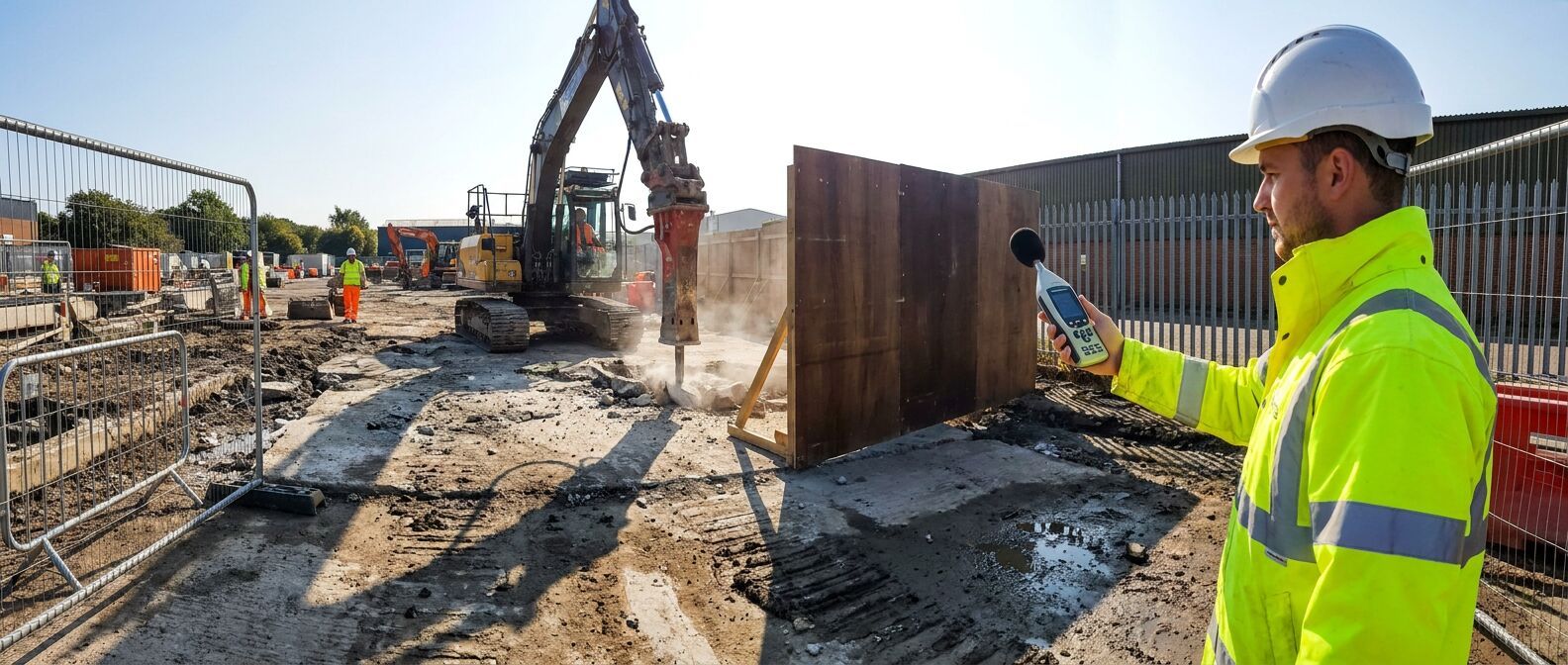
Construction noise screening calculator
Combine evidenced source levels, distance, operating time and project-specific corrections to screen construction activity noise at a sensitive receptor.
Planning screen, not a compliance assessment
Replace the example values with measured or otherwise justified project data. There is no universal construction noise limit, so this tool compares the result only with a target you enter from a planning condition, consent, management plan or acoustic assessment.
Activity noise at a receptor
LAeq,T is the energy-equivalent A-weighted sound-pressure level over interval T. Add up to eight sources that could operate during the same assessment period. Each reference level must represent that individual source during active operation at a known distance, not a level already averaged across inactive time or containing background and other plant.
Use the whole-minute period required by the project assessment.
Enter a whole number from 1 to 720 minutes.
No default target is assumed.
Enter 30 to 100 dB(A), or leave the target blank.
Maximum of eight sources reached.
| Source | Distance change | On-time change | Project correction | Contribution |
|---|---|---|---|---|
| Example source A | -9.5 dB | -3.0 dB | 0.0 dB | 67.4 dB(A) |
| Example source B | -6.0 dB | 0.0 dB | 0.0 dB | 69.0 dB(A) |
How the screening calculation works
The screen uses simplified point-source distance, on-time and energy-combination arithmetic. It is not a BS 5228 prediction or assessment, and project-specific acoustic judgement remains with the assessor.
1. Adjust for distance
For an entered reference sound-pressure level, the screen uses 20 x log10(reference distance / receptor distance). Doubling the distance reduces the level by about 6 dB. Use this only for a compact point-like source where both distances are in the acoustic far field and the measurement geometry remains comparable. Do not use it for inward extrapolation, a moving source, a line source or a different screening condition.
2. Adjust for on-time
The on-time correction is 10 x log10(on-time / assessment period). A source running for half the period contributes 3 dB less than the same source running continuously.
3. Apply evidenced corrections
Enter a signed project correction only where an acoustic assessment justifies it. Negative values can represent documented attenuation; positive values can represent effects such as a façade reflection. The tool does not guess either effect.
4. Combine sources by energy
Decibels cannot be added arithmetically. Each contribution is converted to sound energy, summed and converted back with 10 x log10(sum of 10^(level / 10)).
Choose defensible source data
The result is only as useful as the input evidence. Keep the level, operating condition, material, method and reference distance together in the project record.
Measured activity LAeq
Use a representative measurement for the same plant, task and operating condition, with the measurement distance recorded. Measure distance rather than estimating it.
BS 5228 or project library
Select a genuinely comparable dataset entry and retain its table reference. Historic generic data may not represent a newer attachment, enclosure, material or duty cycle.
Do not enter sound power directly
Sound power level, LWA, describes total acoustic output. This calculator expects an LAeq sound-pressure level at a known distance. Convert LWA through a competent BS 5228 method first.
Why the tool has no compliance flag
UK construction noise is assessed in context. Planning conditions, agreed working hours, existing sound levels, receptor sensitivity, activity duration and local authority requirements can all change the relevant test.
Use the project-specific target
The receptor is the exact assessment point, such as a boundary, garden or building façade position. Enter a target only when its metric, period, position and free-field or façade condition match the calculation. A daytime LAeq target cannot be reused automatically for an evening, night or short noisy activity.
Escalate complex cases
Use a competent acoustic consultant where sources move widely, barriers change, reflections or ground effects matter, tonal or impulsive character is important, or the site is close to homes, schools, hospitals or other sensitive uses.
Section 60 and Section 61 checks
- Section 60 allows a local authority to control matters including plant, working hours, noise levels and steps to minimise noise from construction works.
- Section 61 provides a route to apply in advance for consent covering the works and proposed noise-control method.
- Local authorities commonly ask for a plant schedule, method, programme, receptor plan, prediction, monitoring proposal and control measures. Requirements vary, so confirm the receiving authority's process. The Bexley contractor guidance is one published example, not a national template.
Sources and scope
- BS 5228-1:2009+A1:2014 Current BSI code of practice for construction and open-site noise control, prediction and assessment.
- Environment Agency noise and vibration management guidance Source-data, measurement-distance and propagation considerations.
- GOV.UK planning guidance on noise Context, duration, timing and receptor sensitivity in planning decisions.
- London Borough of Bexley Section 61 guidance Example local authority expectations for plant data and applications.
Links were checked on 30 August 2026. The arithmetic is a simplified screening implementation, not a reproduction of a complete BS 5228 assessment method.
Related resources
Aggregate & MOT Type 1 tonnage calculator
Work out the tonnage of MOT Type 1, sub-base, capping, sand, gravel, or topsoil by area and depth, with typical UK bulk densities, bulk-bag, and tipper-load counts.
CIS & self-employment tax guide for UK construction workers
Interactive take-home pay calculator, CIS deduction rates explained, and a self-employed vs limited company decision flow with real construction day rates.
Concrete specification quick reference for site
Application selector, exposure classes, cover depths, reinforcement weights, and slump guidance. Everything from BS 8500 that a site agent needs on one page.