Daily noise exposure calculator (LEP,d)
Add noisy tasks to estimate eight-hour-normalised daily exposure (LEP,d) and HSE exposure points, an additive measure of noise dose.
Daily exposure calculator
Add each noisy task a worker does in the day and how long they spend on it. The HSE-backed presets use conservative screening values. For an assessment, replace them with a representative LAeq, the average A-weighted level at the worker's ear during the task. dB(A) means decibels weighted to approximate human hearing. Manufacturer data is suitable only when it represents the real task and worker position; a declared sound-power value, which describes the equipment's total acoustic output, is not interchangeable with exposure at the worker's ear.
What your result means
The Control of Noise at Work Regulations 2005 set three thresholds on daily personal noise exposure, LEP,d: the noise energy normalised to an eight-hour working day. The lower exposure action value (EAV) is 80 dB(A), the upper EAV is 85 dB(A), and the exposure limit value (ELV) is 87 dB(A). Each also has a separate peak sound pressure value in dB(C), meaning C-weighted decibels used for sudden impact noise: 135, 137 and 140 dB(C).
Below the lower EAV
Under 80 dB(A) · under 31.6 points
The daily lower action value is not reached. Keep exposure as low as reasonably practicable and check peak noise separately, because a short impact can still trigger action even when the daily average is lower.
At or above the lower EAV
80 to under 85 dB(A) · 31.6 to under 100 points
Assess the risk, give workers information and training, and make hearing protection available on request. Protection is offered here, not yet mandatory.
At or above the upper EAV
85 to under 87 dB(A) · 100 to under 158.5 points
Reduce exposure by means other than hearing protection so far as is reasonably practicable first. Hearing protection and hearing protection zones become mandatory. Provide health surveillance where the risk assessment shows a risk, including workers regularly exposed above the upper EAV.
At or above 87 dB(A) before protection
87 dB(A) or more · 158.5 points or more
This is not, by itself, an ELV breach because this calculator does not apply hearing-protector attenuation. The exposure received after correctly worn protection must not exceed 87 dB(A). Control the source and time first, then assess the protected exposure separately using suitable frequency data and HSE's hearing-protection calculator or competent advice.
The exposure limit value is the one threshold judged with hearing protection taken into account; the two action values are judged without protection. Peak sound pressure is checked separately: impact tools such as nail guns and cartridge tools can breach a peak action or limit value in a single blow even when the averaged daily exposure looks acceptable.
Indicative task noise levels
HSE example levels to help screen an assessment. Each preset uses the rounded-up value shown in bold, usually the top of HSE's range. The last column shows how quickly that value reaches the upper action value on its own. A task is highlighted only while its preset level has not been overwritten.
| Task | Indicative level dB(A) | Reaches upper EAV after |
|---|---|---|
| Cutting & grinding | ||
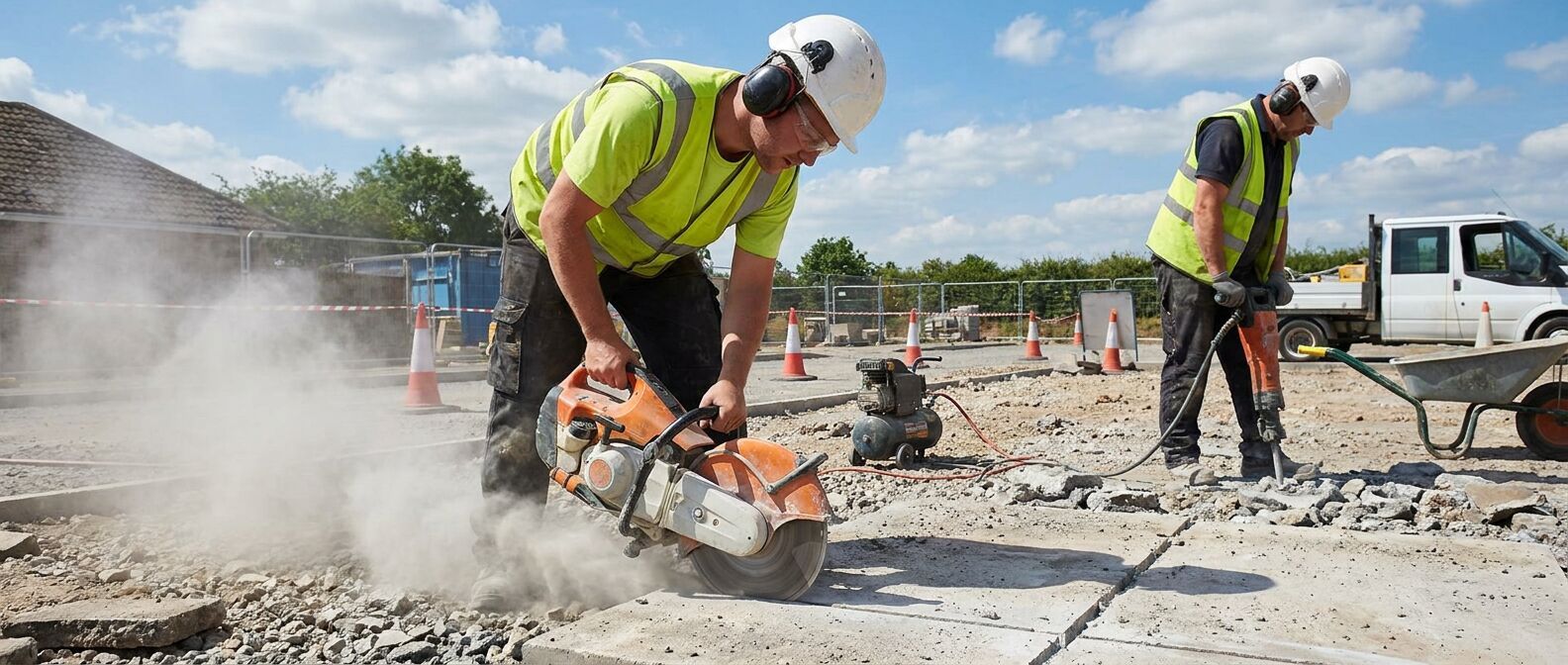
| Petrol cut-off saw (slabs) | 110 dB(A) default HSE: 108.6 to 109.8 measured mean dB(A), RR1182 | 2 min |
| Battery cut-off saw (slabs) | 102 dB(A) default HSE: 101.3 measured mean dB(A), RR1182 | 10 min |
| Pedestal grinder (metal) | 95 dB(A) default HSE: 90 to 95 dB(A), Engineering | 48 min |
| Circular saw (metal) | 105 dB(A) default HSE: 95 to 105 dB(A), Engineering | 5 min |
| Sawing concrete products | 96 dB(A) default HSE: 81 to 96 dB(A), Concrete | 38 min |
| Woodworking | ||
| Circular saw (woodworking) | 102 dB(A) default HSE: 97 to 102 dB(A), Woodworking | 10 min |
| Bench saw / multiple rip saw | 102 dB(A) default HSE: 102 typical dB(A), WIS13 | 10 min |
| High-speed router | 103 dB(A) default HSE: 103 typical dB(A), WIS13 | 8 min |
| Portable woodworking tool | 101 dB(A) default HSE: 101 typical dB(A), WIS13 | 12 min |
| Impact work | ||
| Hammering steel | 100 dB(A) default HSE: 95 to 100 dB(A), Engineering | 15 min |
| Riveting | 110 dB(A) default HSE: 100 to 110 dB(A), Engineering | 2 min |
Values come from HSE's cut-off saw research (RR1182), woodworking risk examples, woodworking machine data (WIS13), engineering noise examples, and concrete-product examples. They are screening values, not substitutes for representative task data. Times assume the task is the only noise source that day; other tasks and background noise reach the value sooner.
Exposure points ready reckoner
The HSE daily noise exposure ready-reckoner lets you add exposure across tasks without a spreadsheet. Read the points per hour for the noise level, multiply by the hours exposed, then add every task in the day. The exact lower and upper action values are 31.6 and 100 points. HSE's hand reckoner rounds the lower value to 32.
| Noise level dB(A) | Points per hour | Reaches upper EAV (100) | Reaches 87 dB(A) before protection |
|---|---|---|---|
| 80 | 4 | 12+ h | 12+ h |
| 82 | 6 | 12+ h | 12+ h |
| 85 | 13 | 8 h | 12+ h |
| 88 | 26 | 4 h 1 min | 6 h 21 min |
| 91 | 50 | 2 h 1 min | 3 h 11 min |
| 94 | 100 | 1 h | 1 h 36 min |
| 97 | 200 | 30 min | 48 min |
| 100 | 395 | 15 min | 24 min |
Points per hour are HSE's rounded ready-reckoner figures; the calculator above uses the precise formula, so totals can differ slightly from a hand calculation. The 87 dB(A) column is an unprotected-exposure reference, not an ELV verdict. Every 3 dB doubles sound energy and exposure points.
How the calculation works
Two equivalent ways to express the same daily exposure. LEP,d is the formal measure in the regulations; points are the practical way to add it up on site.
Daily exposure LEP,d
For one task, the partial exposure is the noise level adjusted for how long it runs against an 8-hour reference day:
LEP,dpartial = L + 10 × log₁₀(T ÷ 8)
where L is the level in dB(A) and T is the time exposed in hours. For several tasks, the daily LEP,d combines them on an energy basis, which is what the points below do arithmetically.
Exposure points
Points rise with the sound energy and in proportion to time, so they add up directly across tasks:
points = 12.5 × T × 10(L − 85) ÷ 10
100 points equals the upper action value (85 dB(A)). Total points and LEP,d are linked by LEP,d = 85 + 10 × log₁₀(points ÷ 100), which is how this tool converts between the two.
Reducing exposure on site
The regulations expect noise to be controlled at source first, with hearing protection as a backstop, not the primary control. The two levers on the exposure itself are a quieter method and less time in the noise.
Control at source before reaching for protection
Above the upper action value the law requires exposure to be reduced by means other than hearing protection so far as is reasonably practicable: a quieter tool or process, cutting with a different method, damping or enclosing a fixed plant item, or moving people away from the source. Hearing protection is what covers the noise you cannot yet design out, not the first answer.
3 dB is a doubling, so small cuts count double
Because the scale is logarithmic, every 3 dB(A) is a doubling of sound energy and doubles the exposure points. Halving the time in the noise takes 3 dB off the daily exposure, and a task 3 dB quieter delivers the same drop. A 6 dB reduction cuts the points to a quarter, which is why choosing lower-noise kit or shortening a loud task moves the result far more than it looks.
Match the hearing protection to the noise, do not overprotect
Protectors are rated by an SNR (single number rating) or HML values, which give attenuation for high-, medium- and low-frequency noise. Choose enough attenuation to control the risk, but avoid reducing the level at the ear below 70 dB(A): HSE warns that overprotection can isolate people from warnings and site communication and encourage them to remove the protectors. Real-world attenuation is lower than the laboratory rating, so HSE recommends allowing for real-world factors.
Protection only works when it is worn, all the time
Hearing protection is rated for continuous use. Taking defenders off for even a short spell in a loud area undoes much of the benefit, because the exposure keeps adding up while they are off. In a designated hearing protection zone, protection has to be worn by everyone who enters, not just the operator, and the zone marked accordingly.
Sources
- The Control of Noise at Work Regulations 2005, regulation 4 (exposure limit values and action values, including the peak dB(C) values)
- HSE INDG362: Noise at work, a brief guide (action values, employer duties, the two-metre shout test)
- HSE: noise exposure calculators and ready-reckoners (the daily-exposure points system this tool mirrors)
- HSE: daily noise exposure ready-reckoner (the rounded exposure-point table)
- HSE: the Control of Noise at Work Regulations, what you must do (duties at the lower EAV, upper EAV and ELV)
- HSE: hearing protection (protector selection and avoiding overprotection)
- HSE L108: Controlling noise at work (guidance on the regulations)
- HSE RR1182: battery and petrol cut-off saws (measured in-use noise values used in the task presets)
- HSE: woodworking noise controls (example circular-saw range used in the task presets)
- HSE WIS13: Noise at woodworking machines (example woodworking noise levels used in the task presets)
- HSE: noise in engineering (example process noise ranges used in the task presets)
- HSE: concrete and cement noise controls (example saw noise range used in the task presets)
Related resources
Hand-arm vibration (HAVS) exposure calculator
Add the power tools used in a shift to get the daily hand-arm vibration exposure in m/s² A(8) and HSE exposure points, with a traffic-light check against the EAV and ELV and the time each tool is safe to use.
Aggregate & MOT Type 1 tonnage calculator
Work out the tonnage of MOT Type 1, sub-base, capping, sand, gravel, or topsoil by area and depth, with typical UK bulk densities, bulk-bag, and tipper-load counts.
CDM 2015 dutyholder identifier
Interactive decision pathway for UK construction projects. Identify your CDM role, principal dutyholder appointments, F10 notification position, and pre-start document checks.