Flood risk permits: plan the civils start
Plan outfalls and works near watercourses in England around the correct consent, application evidence and a clear release point before mobilisation.
By Connor Lyons, Commercial director, MRICS
Generated by your browser's built-in AI. May not be fully accurate.
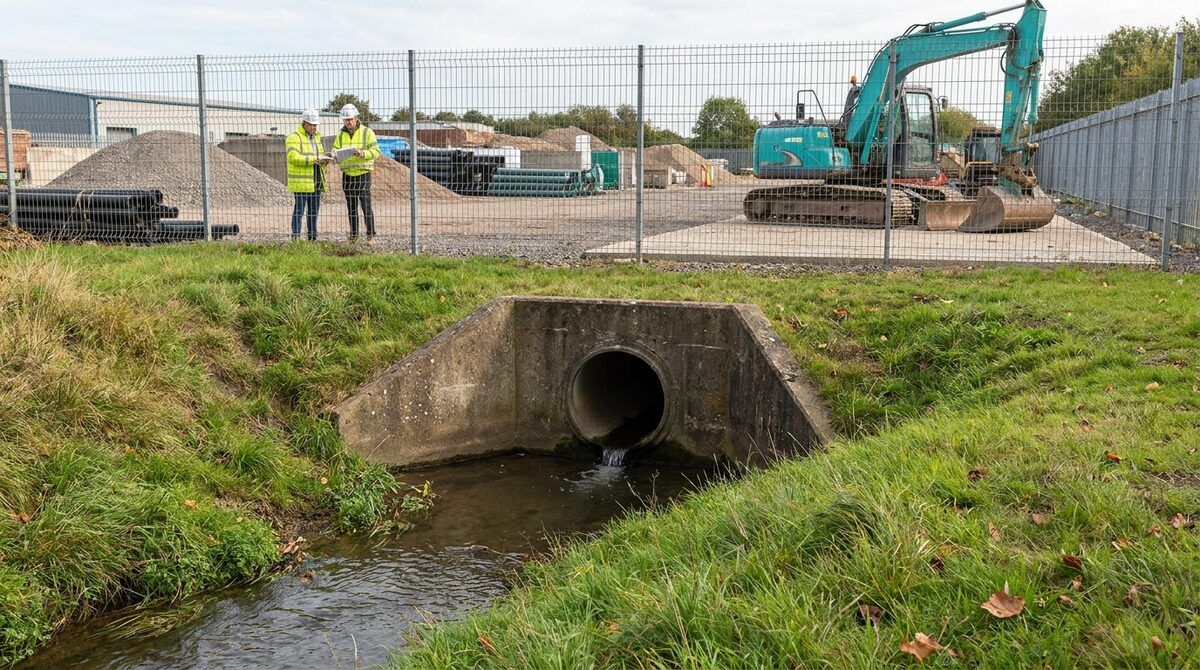
The Environment Agency updated its flood risk activity permit guidance on 9 October 2026. Applicants in England will normally receive a decision within four months, according to the current guidance. A developer planning an outfall, culvert or other work near a watercourse should resolve the consent route before treating the civils start as fixed.
That is a programme question for the client and contractor as well as the environmental adviser. A contractor can have drawings, an available excavator and a proposed start date while the team still needs permission for the work at the receiving watercourse. The useful enquiry asks who owns that decision, which evidence they need and what remains on hold.
This is an England-focused procurement and coordination guide. The project team must obtain competent advice on the actual activity and location. It is not a permit decision, legal opinion or construction method statement.
Use the current timing, with a defined starting point
The EA’s revised guidance gives a normal four-month decision period, with timing affected by risk, complexity and consultation. It also explains that the agency confirms when an application is duly made: it has the information and payment required to begin assessment. Sending an incomplete form does not establish that point.
Ask the applicant to record submission and duly-made confirmation separately. Keep requests for further information visible, with an owner and response date. When the planner enters an assumed determination date, name the basis and the person who will confirm it. Do not turn the guidance’s normal period into a guaranteed approval date or a promise that works can start immediately afterwards.
Identify the watercourse before allocating the permission
The EA regulates relevant works on or near main rivers, and its regime also covers activities near certain flood defences, culverts and sea defences, or, where the work does not have planning permission, elsewhere on a main river’s floodplain. Do not decide the authority solely from the receiving channel. For an ordinary watercourse, the client should check the permission route with the lead local flood authority or internal drainage board while also checking any applicable EA controls. The EA’s watercourse ownership guidance also separates watercourse permissions, planning, land access and other possible licences.
Give the adviser a location plan and the precise activity, including temporary works. A label such as “drainage connection” is too broad to explain whether the contractor will alter a bank, install a headwall, excavate nearby or use an existing structure. The team should establish the classification and authority from the actual site evidence, not the apparent width of a ditch.
Use the watercourse consent brief builder to assemble the activity, drawing references, separate discharge and access questions, and the authority’s recorded answer in one working enquiry pack.
Keep the receiving landowner’s agreement alongside the regulatory record. Permission to enter or build on somebody else’s land answers a different question from permission under an environmental regime. Record the extent of each agreement against the same drawing revision so the contractor can see which boundary each one covers.
Check the activity-specific route before assuming a permit application is needed. The EA identifies excluded flood risk activities and activities that may qualify for a registered exemption, as well as standard rules and bespoke permits. An exclusion has conditions; an exemption must be registered before the work and its conditions still apply. Record the applicable basis rather than treating “no permit” as unrestricted authority to start. The four-month guidance concerns permit decisions, not a universal wait for every watercourse activity.
Separate the physical works from the water being discharged
An outfall has a physical structure and a proposed discharge. The project team should check both. The EA publishes separate guidance on water discharge and groundwater permits, including when a discharge needs permission. A flood risk activity permit does not settle every question about the water the team intends to send through the pipe.
Describe the proposed permanent drainage and any temporary construction water management separately. Ask the competent adviser to confirm which permissions or other applicable routes cover each activity. Our temporary dewatering checklist helps record a different set of proposed pumping and discharge checks; it does not approve building an outfall or altering a riverbank.
Prepare an application around the activity
For a bespoke flood risk activity permit, the applicant must provide the relevant risk assessment. The EA’s risk-assessment guidance asks applicants to address flood risk, drainage and environmental effects, supported by relevant plans, surveys and assessments. Standard rules have a different assessment basis; the team must check whether the actual activity meets every applicable condition.
Give the appointed adviser the permanent design and the proposed construction sequence together. The adviser needs to understand temporary access, excavation, material storage and the watercourse interface, rather than seeing only the finished headwall. The contractor should identify practical uncertainties before someone describes the method as agreed.
The applicant can request pre-application advice. The EA offers basic advice and a paid enhanced service for more complex requests. Its guidance asks for targeted questions and enough location and proposal information; the agency does not confirm that a proposal is suitable or likely to be approved through that advice service.
Put the consent boundary into the tender
Before comparing prices, the buyer should issue a short responsibility schedule with the design information. Use it to agree the package rather than assuming every bidder has included the same consent work.
| Buyer to confirm | Evidence to issue or request | What the contractor needs to know |
|---|---|---|
| Applicant and adviser | Named appointments and the authority being consulted | Who answers application questions and supplies missing information |
| Activity and boundary | Location, drawing revision and permanent/temporary works description | Which operations the proposal and any permission actually cover |
| Consent route and status | Applicable exclusion, exemption registration or permit route; submission, duly-made confirmation and open requests where relevant | Which programme dates are confirmed and which are assumptions |
| Access and interfaces | Land agreements, working limits and separate discharge decisions | Where the team may work and which interfaces remain unresolved |
| Release to construct | Permission conditions, approved method references and the authorised project decision | Which workfront is released, by whom and subject to what conditions |
Ask each bidder to identify exclusions, assumptions and any separately priced application support. Keep changes to the design or proposed method in the same record. A price based on an existing outfall and a price based on constructing a replacement do not describe the same package.
Release a defined workfront
The project team should check the actual permission and conditions against the construction information before releasing the affected work. Record any remaining restrictions and the person authorised to resolve them. A programme bar marked “permit” is too thin a record for a supervisor deciding where an excavation can begin.
For an industrial yard, coordinate this boundary with the warehouse drainage strategy and the contractor’s package. If unrelated work can proceed, the project team should define that separate workfront expressly. Availability of plant does not resolve the authority to work beside the watercourse.
For a Rospower Projects enquiry, send the current layout, watercourse or outfall information and the consent position with the proposed programme. Contact our team to discuss the civils scope while the relevant designer and adviser establish the project-specific requirements.
Connor Lyons is commercial director at Rospower Projects. Meet the team on our about page.
Related articles

How civil engineering projects actually get managed: what subcontractors need to get right
A practical UK guide to managing civils programmes, procurement, variations, cost records, temporary works, and site communication.
How long do warehouse groundworks take?
A realistic, stage-by-stage programme for warehouse groundworks, with typical durations and the ground, drainage and weather risks that move the date.
From demolition to groundworks: agree the release point
Plan the demolition-to-groundworks handover: record residual structures, services, surveys, access, open risks, evidence and release authority.