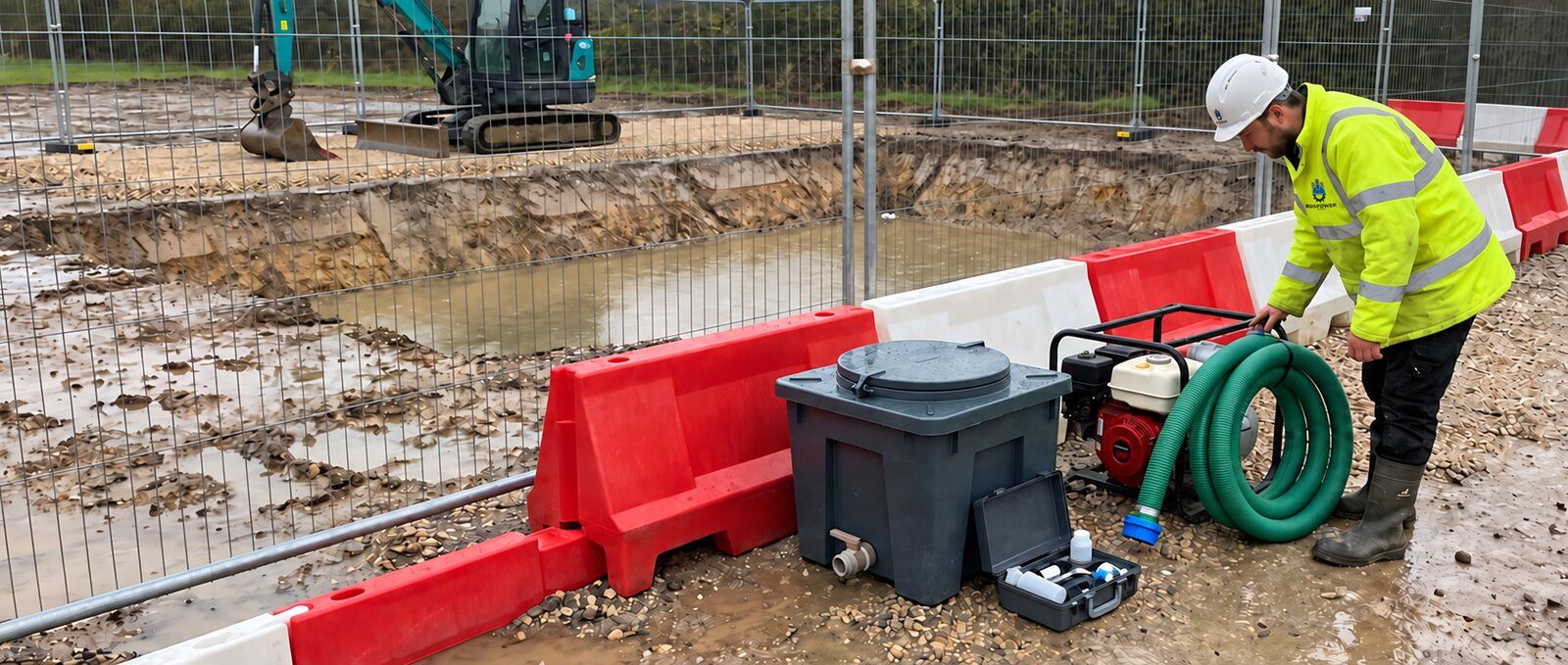
Switched-off pump with a capped hose beside a fenced temporary excavation in a UK civil engineering setting

Temporary dewatering readiness checklist

An England-only evidence worksheet for a proposed temporary excavation discharge. It records gaps and escalation actions, not permission to pump.

Updated

Share

This is not permission to pump

RPS 261 does not change the legal requirement to obtain a water discharge activity permit for a short-term temporary discharge of uncontaminated water from an excavation to surface water. The Environment Agency says it will not normally take enforcement action only where the activity matches the RPS, every condition is met, and there is no actual or likely pollution or harm to human health.

A completed worksheet is an evidence record only. It does not approve a permit, decide whether a permit is needed, approve a pumping design or authorise discharge.

Evidence worksheet

The worksheet stays in this browser. It does not save, upload or share answers.

Record details
Readiness is incomplete because one or more answers are unknown. Unknown is not an affirmative answer. Do not use this worksheet to authorise pumping or to treat a permit as approved.

Affirmative evidence

0

Unknown or incomplete

26

No or failed condition

0

Activity scope and permit triggers

Answer yes only where the project evidence supports the statement. A no or unknown needs action.

1.Is the proposed activity in England?

RPS 261 applies to England only.

If no or unknown: Use the regulator and guidance for the nation where the activity takes place.

2.Is this a short-term, intermittent or temporary discharge from an excavation?

The RPS describes this narrow activity only.

If no or unknown: Seek permit advice for a different or continuing activity.

3.Can you evidence that the water is uncontaminated and wholly or mainly rainwater?

RPS 261 describes clean water from rainwater or infiltrated groundwater collected at the bottom of a temporary excavation on an uncontaminated site.

If no or unknown: Stop and obtain competent water-quality and permitting advice before discharge.

4.Is the proposed receiving point surface water, rather than ground or groundwater?

Surface water includes rivers, streams, estuaries, lakes, canals and coastal waters. The RPS does not apply to discharges to ground or groundwater.

If no or unknown: Do not treat this worksheet as applicable. Check the correct discharge route and permit requirements.

5.Is the discharge not continuing as part of another activity that requires a permit?

RPS 261 does not apply where the activity continues as part of another activity that requires a permit.

If no or unknown: Identify the wider activity and obtain permit advice.

6.Can you evidence that this is not pump-and-treat of contaminated groundwater or water from contaminated land?

RPS 261 says pump-and-treat discharges require a water discharge activity permit.

If no or unknown: Apply for a water discharge activity permit and obtain specialist treatment advice.

7.Can you evidence that this discharge is not from quarry activities?

RPS 261 says quarry-activity discharges require a water discharge activity permit.

If no or unknown: Apply for a water discharge activity permit.

Conditions to evidence

These prompts record the operational controls required by RPS 261.

1.Can you keep the discharge to uncontaminated, clean water only?

This is a condition of RPS 261.

If no or unknown: Do not discharge under this worksheet. Escalate for a suitable treatment and permit route.

2.Can you evidence that discharge will remain within three consecutive months?

The clock continues even if discharge pauses during that period and does not reset.

If no or unknown: Apply for a water discharge activity permit if the activity is likely to exceed three consecutive months.

3.Are controls in place to minimise contaminants, including silt, entering the excavation?

RPS 261 requires the level of contaminants entering the excavation to be minimised.

If no or unknown: Record the control method and verify it before any discharge.

4.Are controls in place to minimise water entering the excavation?

Consider rainfall, runoff, groundwater ingress and a high water table.

If no or unknown: Record the controls and seek technical advice where the source cannot be managed safely.

Exclusions and receiving-water checks

These exclusions need evidence before a temporary discharge is considered further.

1.Can you evidence that the discharge does not cause, and is not likely to cause, pollution or harm to human health?

This is a stated RPS boundary as well as a condition to avoid pollution of surface water.

If no or unknown: Do not discharge. Escalate immediately for pollution prevention and regulatory advice.

2.Can you evidence that the discharge rate is no more than 10% of the receiving water’s Q95 low flow?

Q95 is the dry-weather low-flow reference used in RPS 261. This worksheet does not calculate it.

If no or unknown: Obtain the receiving-water flow evidence and a competent review before discharge.

3.Can you evidence that no site drainage from haul roads, storage areas or working areas will be discharged?

RPS 261 excludes this site drainage.

If no or unknown: Separate and contain site drainage. Seek a permit route if it cannot be excluded.

4.Can you evidence that the discharge contains no chemical dosing agent, flocculant or coagulant?

RPS 261 excludes water containing these agents.

If no or unknown: Do not discharge under RPS 261. Obtain specialist and permitting advice.

5.Can you evidence that the site is not contaminated by oil, metals, hydrocarbons, solvents, pesticides or other polluting substances?

RPS 261 excludes discharges from a site with these contaminants.

If no or unknown: Stop and obtain contaminated-land, water-quality and permitting advice.

6.Can you evidence that naturally elevated substances will not exceed environmental quality standards?

RPS 261 excludes sites with naturally elevated concentrations above environmental quality standards.

If no or unknown: Obtain competent water-quality and regulatory advice.

7.Can you evidence that concrete wash water will not be discharged?

Concrete wash water is excluded even if it has been treated.

If no or unknown: Keep concrete wash water entirely separate and use an approved management route.

8.Can you prevent machinery being used in the excavation while dewatering takes place?

RPS 261 says machinery must not be used in the excavation during dewatering.

If no or unknown: Change the work sequence and controls before proceeding.

9.Can you evidence that the discharge does not risk spreading non-native invasive species, parasites or disease?

RPS 261 excludes a discharge with this risk.

If no or unknown: Stop and obtain ecological or specialist advice.

10.Can you evidence that the discharge will not cause surface-water flooding?

Causing flooding from surface water is excluded.

If no or unknown: Do not discharge until a competent assessment and control route are in place.

11.Can you evidence that the discharge will not cause erosion or scouring of the receiving watercourse bank or bed?

RPS 261 excludes erosion or scouring of the receiving watercourse.

If no or unknown: Obtain a suitable discharge and energy-dissipation design, then seek advice.

12.Has a protected-habitat and local-site screen evidenced no discharge within, or less than 500 metres upstream of, a protected site?

The RPS list includes SSSI, SAC, SPA, site of community importance, Ramsar and candidate or proposed designations, marine conservation zones, ancient woodland, local and national nature reserves, and local wildlife sites.

If no or unknown: Do not rely on RPS 261. Record the screening result and seek Environment Agency or ecological advice.

Records and recheck

Keep the decision trail with the work package, not only in this browser.

1.Is there a record plan to retain evidence for two years from the last use of RPS 261 and make it available to the Environment Agency on request?

Keep the completed record, supporting evidence, dates and changes together.

If no or unknown: Set up the record before work begins.

2.Has the live RPS 261 page been rechecked immediately before use?

The Environment Agency may amend or withdraw it before its review date of 30 April 2028.

If no or unknown: Recheck the live RPS and record its update status before use.

Separate abstraction question

RPS 261 only concerns the discharge activity. It does not decide the abstraction route.

1.Is either no water being abstracted, or the daily abstraction volume and source recorded separately?

Dewatering may require both an abstraction licence and a water discharge activity permit. RPS 261 covers only the discharge activity.

If no or unknown: Check the separate abstraction route. This worksheet does not determine any abstraction exemption or RPS 368 position.

Unresolved actions

Each unknown or no answer remains here until evidence or a competent decision changes the answer. This list is not a permit decision.

    RPS 261 limits that remain visible

    • Receiving water: the RPS is for surface water only. It does not apply to ground or groundwater discharges.
    • Three-month clock: a pause does not reset the three consecutive month period. If it is likely to go over, the RPS directs the operator to apply for a water discharge activity permit.
    • Protected sites: do not discharge within, or less than 500 metres upstream of, the RPS list of protected habitats and conservation sites. The list includes SSSI, SAC, SPA, Ramsar, marine conservation zones, ancient woodland, national and local nature reserves and local wildlife sites.
    • Separate abstraction route: dewatering may require both an abstraction licence and a water discharge activity permit. More than 20 cubic metres a day is a separate licence trigger in the linked guidance, subject to any applicable exemption or RPS. This worksheet does not interpret those exceptions.
    • If compliance is lost: stop the activity and tell the Environment Agency immediately, using RPS 261 in the subject line.

    Sources and recheck record

    The Environment Agency may amend or withdraw RPS 261 before its stated review date of 30 April 2028. Recheck the live source immediately before use.

    Share

    Related resources

    Send an enquiry

    Request a callback

    We'll call you back during work hours (Mon-Fri, 9am-5pm).