Watercourse consent brief builder
Assemble the location, proposed work and open permission questions for the responsible authority. This record does not decide what permission is needed.
Use the brief to ask, not to decide
In England, proposed work on or near a main river, a watercourse formally designated by the Environment Agency, may fall under its flood-risk activity rules. Other watercourses are called ordinary watercourses. Ask the lead local flood authority or internal drainage board whether land drainage consent is needed for the actual activity. The answer depends on location and scope. A map or distance alone does not establish an exemption, permit requirement or permission to start.
This tool records evidence and replies for a project enquiry. It does not identify the right authority, submit an application or check whether a permit exclusion or registered exemption applies. Do not start work on the assumption that silence, a map label, planning permission, landowner agreement or one permit resolves every separate question.
The page focuses on England. Wales, Scotland and Northern Ireland have separate rules and authorities. Check the relevant jurisdiction before using the prompts elsewhere.
Keep separate evidence streams
- Record permanent and temporary physical works separately, including access, plant, sequence, levels, temporary structures and reinstatement.
- Describe water removal and discharge as separate activities. Abstraction means taking water from a surface or underground source; an approval for physical works does not establish the discharge route or settle a water-taking question.
- Record land ownership and access rights independently from regulatory permissions. Ask about ecology surveys, protected species, habitats, timing and any other applicable consents.
- Keep the authority's response, date, reference, scope, conditions and unresolved points. If the reply does not cover a proposed activity, keep that question open.
A riparian owner is someone whose land borders or includes a watercourse. A wayleave or easement is an arrangement giving a right to use or cross another person's land. The Environment Agency's flood-risk activity guidance explains the main river permit route, exclusions and registered exemptions. Its watercourse ownership guidance covers permissions, other authorities and access to another person's land. A separate water discharge or groundwater permit may apply to discharge activity. These sources are England-specific where stated, and each actual activity needs its own check.
No permission or start decision is generated
The fields begin empty. Classification, map layers, distance and completed fields do not produce a legal verdict. Ask the relevant authority and competent project advisers about the described work, then record their answer and any conditions.
Build the working record
Entries stay in this page's memory. They are not stored or uploaded by this tool and are lost when you leave or reload. Download a text copy, print or save as PDF before leaving. Saved copies cannot be imported back into this form. Use role and document references instead of unnecessary personal information.
Key details are prompts, not a certification checklist. Blank, unknown, pending and not applicable mean different things: state the appropriate position explicitly. Long text fields allow 10,000 characters; short fields allow 2,000.
Worked example: Fictional Mill Lane site enquiry. It uses fictional details to show how separate enquiries can be recorded. Loading it replaces the current entries.
The record has not been checked. No approval is inferred.
Preview the current print record
Example: a temporary access proposal
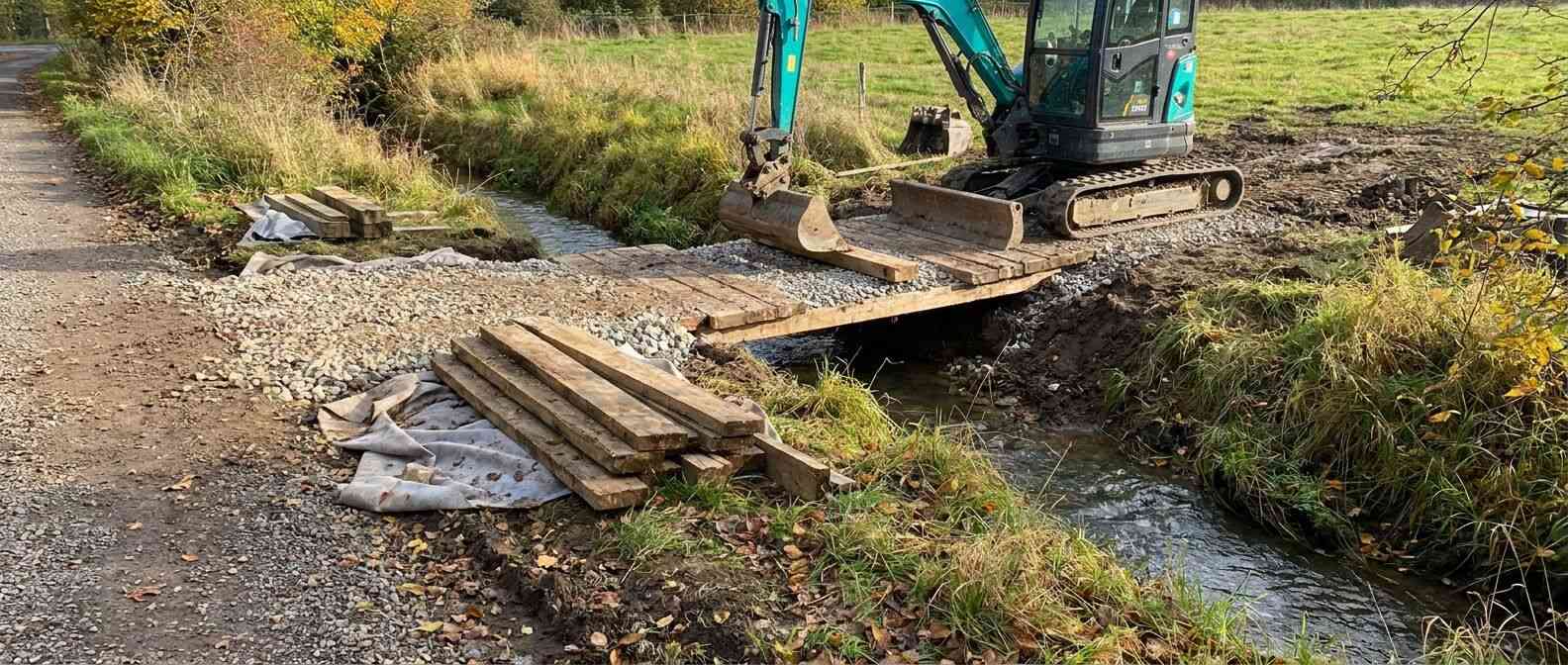
The optional fictional Mill Lane example shows a short enquiry about a temporary access mat beside an unnamed ditch. Classification and land access remain unresolved, and the example does not assume that consent is or is not required. Use “Load worked example” to place these clearly fictional values into the record, or keep the working record empty.
Save and check the enquiry pack
Entries stay in this page's memory only. They are not uploaded or saved by Rospower Projects, and are lost when the page is reloaded. Download the full text record or print it before leaving. Review it against the controlled drawings and project document system. Avoid unnecessary personal or confidential information.
For a separate record of proposed pumping and excavation water management, use the temporary dewatering readiness checklist. It does not address permission for physical works at a watercourse.
Related resources
Civils drawing register builder
Track drawing numbers, revisions, project-defined status, issue purpose, recipients, superseded references and open actions in a printable working index.
Construction noise screening calculator
Estimate combined construction activity noise at a receptor from evidenced source levels, distance, on-time and project-specific acoustic corrections.
Construction RFI log builder
Track technical queries against drawings, project-system responses, review owners and unresolved actions in a printable working log.