From demolition to groundworks: agree the release point
Plan the demolition-to-groundworks handover: record residual structures, services, surveys, access, open risks, evidence and release authority.
By Connor Lyons, Commercial director, MRICS
Generated by your browser's built-in AI. May not be fully accurate.
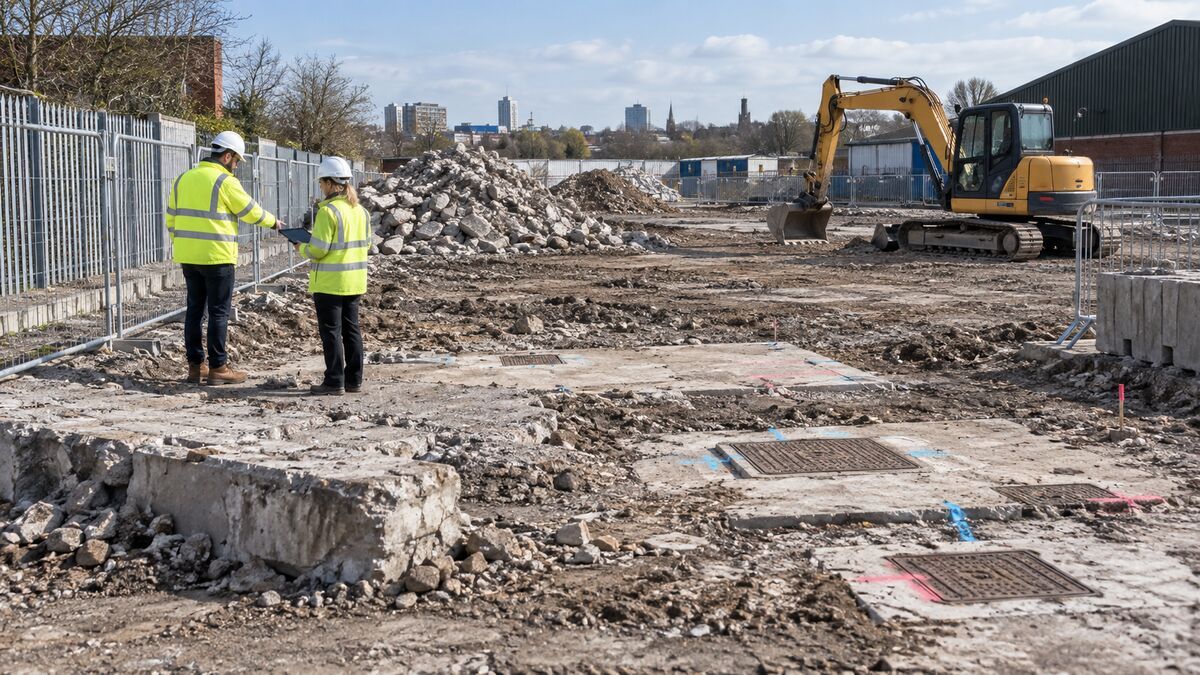
A site can look clear after demolition and still be a poor place to start groundworks. A buried slab, an unrecorded service, an incomplete disconnection or an unresolved access restriction can turn a planned start into a stop-work conversation. The handover between packages needs evidence and named decisions, not a visual impression that the plot is ready.
This article focuses on the transition from demolition into groundworks. It is not a demolition method, asbestos survey, ground investigation or replacement for the full groundworks handover pack. It is a project coordination checkpoint for agreeing what has been completed, what remains and who is allowed to release each area.
Agree the boundary before the last week
The demolition and groundworks scopes often meet at the same line on a drawing but not at the same physical condition. Agree the boundary while both package teams can still answer questions. Identify which buildings, slabs, bases, pits, retaining elements, hardstandings, fences and services are to remain, be removed, be protected or be handed over for later work.
Mark limits on the controlled drawing and describe exclusions in plain language. A note such as “clear site” is not enough if there are buried foundations, known contamination controls, temporary supports, retained duct routes or a live boundary connection. Where the information is uncertain, record that uncertainty instead of converting it into a promise that the ground is unobstructed.
The HSE’s demolition guidance says the client should provide pre-construction information about matters including asbestos, structural stability, alterations and below-ground live services before demolition work begins. For the later groundworks package, identify where that information is stored, what it covers and whether any limitations or follow-up actions remain.
Separate completion evidence from a release decision
Ask the demolition contractor for the records that the contract requires. Depending on scope, these may include demolition completion records, service disconnection or isolation references, survey information, records of retained elements, waste documentation, permit close-out and photographs tied to an agreed location plan. The exact deliverables should come from the contract and relevant dutyholders, not a universal list copied between projects.
Then record the release decision separately. Who has authority to confirm the demolition scope is complete? Who checks the information for the incoming groundworks team? Is the release for the whole site or only a defined area? Does the release allow access only, or does it also confirm a particular workfront is available? A progress email or a contractor leaving site is not automatically the same as an agreed package handover.
Walk the area with the next contractor
A joint walkover helps connect documents to what the crew will actually encounter. Use the controlled plan and mark the items that matter to excavation and setting out:
- structures and slabs that remain, including their limits and known support conditions;
- exposed or capped services, chambers and connection points, with the source of the service information;
- below-ground obstructions or areas where their presence has not been confirmed;
- survey control, datum, access routes, restricted areas and protection to retained assets;
- stockpiles, temporary works, materials or waste that remain in the agreed work area.
The walkover does not locate buried services or prove ground conditions. It helps the team identify discrepancies between the record and the visible site, then route them to the people who can investigate or decide what happens next. Work near services still needs the project’s safe system of work and suitable information.
Carry open risks and actions across the boundary
Write down what is unresolved, who owns the next step and what evidence will close it. Examples include an incomplete survey, a pending utility confirmation, a retained foundation of unknown depth, a restricted access route or an environmental control that must stay in place. If an item prevents a particular work activity, state that link clearly so it does not disappear inside a general risk register.
Keep scope and responsibility distinct from technical approval. A contractor can identify a condition and propose a response, but the appointed designer or relevant authority may need to review it. If a response changes the contracted work, use the project’s instruction and change process. Do not let a handover form create permission to alter a design or proceed outside the agreed method.
Release work in areas, not just by site name
Large or constrained sites may need staged releases. Divide the plot into identifiable areas or workfronts and record the date, boundary drawing, permitted activity, outstanding restrictions and receiving contractor for each one. This avoids a broad statement that “the site is handed over” when one corner still contains retained infrastructure or an active demolition control.
A simple release record can include:
- the area and drawing revision;
- the demolition scope completed there and any exclusions;
- the referenced survey, service and completion information;
- visible restrictions or remaining temporary arrangements;
- open actions, responsible roles and target review dates;
- the person recording the release and the receiving party’s acknowledgement.
Acknowledgement confirms that information was received. It does not prove that every buried condition is known, that the area is safe for any activity or that the groundworks design is approved.
Example: release one workfront and hold another
Imagine a fictional site split into areas A and B on drawing D-20 revision C. The demolition manager has completion evidence for A. In B, the team still needs confirmation of a retained service beside a buried foundation.
The authorised project lead records each decision separately:
| Record field | Area A | Area B |
|---|---|---|
| Boundary | Refer to the marked area on D-20 revision C | Refer to the separate marked area on the same revision |
| Evidence | List the completion, survey and service references reviewed | Identify the service confirmation still outstanding |
| Decision | State the specific activity released, its conditions and who authorised it | Record the affected activity as held pending the named review |
| Receiving team | Record acknowledgement of the boundary and restrictions | Assign the next action and the evidence needed for reconsideration |
The groundworks supervisor briefs the crew on those limits. Nobody treats permission to enter A as clearance to excavate B, or uses an acknowledgement signature to replace the excavation planning process.
Keep one controlled record
Store the signed or accepted release, marked-up plan and referenced evidence in the project’s agreed document system. Preserve the source records and revisions rather than replacing them with a new summary. If the incoming team later finds a mismatch, add the observation and its resolution to the project record so the next package has an accurate history.
Rospower Projects plans groundworks and external works around site access, scope boundaries and the information available before work starts. For an industrial or commercial project, see our construction service or share the project brief.
Connor Lyons is the commercial director at Rospower Projects and a chartered quantity surveyor. Read more about the team on our about page or contact Rospower Projects to discuss a groundworks package.
Related articles

Piling package tender: define the scope before pricing
Set out ground information, design inputs, access, platform duties, testing evidence and return details before piling tender bids are compared.
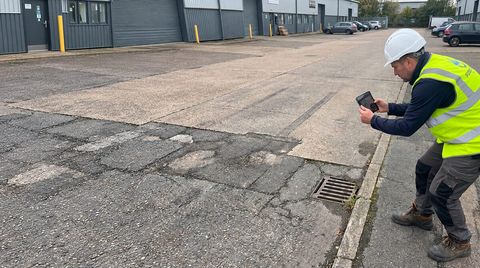
Commercial estate civils: build a maintenance budget from evidence
Turn external asset condition records into scoped maintenance packages, cost allowances and review dates without relying on invented repair rates.
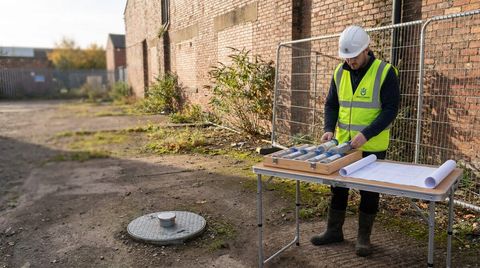
Brownfield ground investigation: write the questions before the scope
Commission a brownfield investigation around the design and contamination decisions it must support, with clear outputs, access limits and review points.