Brownfield ground investigation: write the questions before the scope
Commission a brownfield investigation around the design and contamination decisions it must support, with clear outputs, access limits and review points.
By Connor Lyons, Commercial director, MRICS
Generated by your browser's built-in AI. May not be fully accurate.
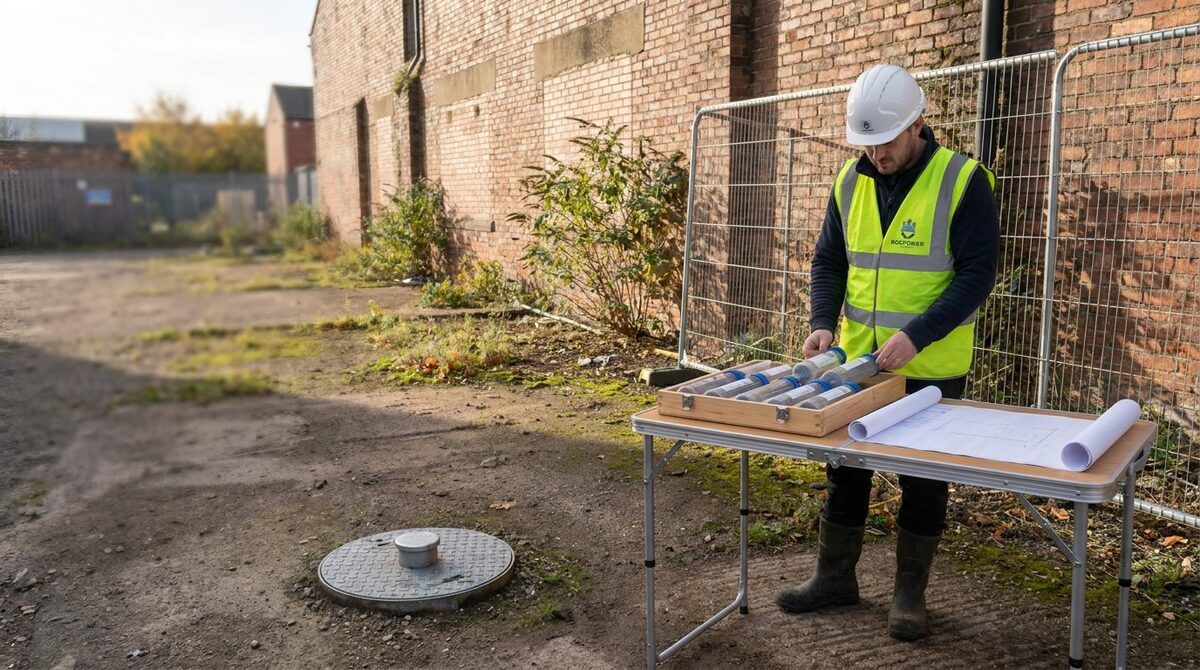
An investigation quotation can list boreholes, trial pits and laboratory tests without explaining which project decisions the results will support. Comparing the number of holes is easy. Comparing whether two proposals answer the same questions takes a better brief.
For a brownfield commercial development, start by separating the engineering questions from the contamination questions, then ask the specialists how to coordinate the work. The same site visit may contribute to both, but a result suitable for one purpose is not automatically enough for the other.
This is a buyer’s enquiry guide, with the planning and contamination discussion scoped to England. It does not choose a sampling grid, foundation, remediation method or waste classification. Those need competent project-specific assessment.
Explain what is being proposed
Issue a site boundary and the current development layout. Describe the proposed buildings, external works, excavations and intended uses. If the layout is provisional, identify what could change and when the design team expects to decide it.
Tell the specialist which decisions are approaching: foundation concept, slab support, pavement design, drainage feasibility or the commercial allowance for ground-related work. Ask the relevant designer to state what information they need rather than letting a generic investigation package stand in for a design brief.
Provide existing reports with their dates, commissioning purpose and known limitations. An old report is evidence to assess, not a certificate for a new scheme. Identify whether its investigation locations fall within the current site and whether the proposed use, levels or footprint have changed.
Keep two question lists visible
Engineering questions concern how the ground and groundwater may affect the works. Contamination questions concern potential harmful linkages and the decisions needed to manage them. The Environment Agency’s LCRM risk-assessment guidance describes integrating geotechnical and contamination investigations as likely to benefit most sites. In your brief, keep the questions and required outputs for each discipline explicit even when investigation work is coordinated.
Use the following as a briefing matrix to discuss with the appointed specialists, not as a list of tests to order yourself.
| Project decision | Question for the relevant specialist | Output to agree in the appointment |
|---|---|---|
| Foundation concept | What information does the structural/geotechnical designer need for the proposed loads and layout? | Defined interpretive advice, assumptions and further work required |
| Slab and yard support | Which uncertainties could affect support conditions or the proposed levels? | Evidence relevant to the designer’s stated questions, with coverage limits |
| Excavation and groundwater | What needs investigating to inform the planned excavations and water-management design? | Relevant observations, monitoring scope and limitations, not a pumping permission |
| Contamination assessment | Which potential sources, pathways and receptors need assessment for the proposed use? | Risk assessment, supporting evidence and unresolved linkages |
| Earthworks planning | Which material properties and location data are needed for the intended works? | Information for the earthworks designer and a separate statement of unanswered material-management questions |
Agree who will interpret each dataset. A factual laboratory report and a design recommendation are different deliverables. State whether interpretation, a design-team meeting and responses to reasonable clarification questions are included in the quotation.
Let the preliminary assessment guide the next stage
The LCRM approach begins with a competent assessment using site history and a walkover to develop a conceptual site model. That model describes possible connections between a contamination source, a route by which it could travel and a person or environmental feature it could affect. Further investigation should address the resulting uncertainties, not follow an arbitrary hole count.
England’s planning guidance on land affected by contamination calls for proportionate investigation information prepared by a competent person where contamination may be an issue. It explains that the initial desk study and walkover can inform what more is needed. Brownfield status alone does not establish that every part of a site has the same contamination or requires the same response.
For procurement, ask the specialist to explain the proposed stages, the decision after each stage and what could trigger additional work. A staged enquiry can still include rates or separately described options. The important point is that the basis for using them is visible.
Describe access before comparing prices
Mark occupied areas, physical obstructions, security arrangements and operating hours. Explain who can give access and which areas cannot presently be entered. Identify relevant service information and the arrangements for agreeing safe investigation locations.
Ask the specialist to describe how the proposed methods fit the available access and how changed locations would be recorded. An inaccessible area should remain a stated limitation until further work resolves it; moving a location to somewhere convenient may change the question it answers.
Intrusive work needs a suitable safe system, including control of buried-service risks. The project’s safe-digging arrangements and the investigation contractor’s methods must be coordinated before fieldwork. A drawing showing a proposed investigation point is not authority to excavate there.
Also clarify responsibility for reinstatement, temporary fencing, arisings, retained installations and any monitoring visits. These can change the scope comparison even when the proposed investigation methods appear similar.
Test the scope with a fictional example
Suppose a developer is considering a warehouse on a former storage yard. The current layout places a loading apron over one part of the site, but a tenant may move it. An old report has factual logs from a different building footprint. No conclusion about actual contamination or ground performance is assumed in this example.
A useful enquiry would identify the two possible apron locations and ask the relevant designers which decisions can be made now and which depend on the layout being fixed. It would give the environmental specialist the old reports and site history for assessment, rather than requiring a predetermined conclusion from them.
The quotation comparison would then ask: do both proposals cover the same development options, include the same interpretation and explain the gaps left by access or historical data? A cheaper proposal excluding monitoring or interpretive reporting is not directly comparable to one including them. Nor should an extra test be bought simply because another bidder listed it. Ask which decision it informs.
Specify the report you need to use
Request an indexed deliverable with identifiable investigation locations, factual results, the agreed interpretation, assumptions and limitations. Ask for an explicit list of questions answered, questions still open and additional work recommended. Agree usable drawing and data formats with the design team before fieldwork starts.
Keep the report’s purpose clear when sharing it. An investigation supporting foundation design does not by itself approve a drainage discharge, confirm a disposal destination or establish that excavated material can be reused anywhere. Obtain the separate assessment needed for those decisions.
For the material-management part of an England project, use our excavated spoil checks before transfer to organise the questions about waste status, classification, the receiving site and transfer records. Keep these decisions separate from the engineering investigation brief.
Review the findings with the design and commercial teams before treating the ground risk as closed. Update the scope, allowances and information schedule with what was actually learned. If the development changes, ask whether the investigation still supports the revised decisions.
For an industrial or commercial civils enquiry, the useful ground information is not merely a thick report. It is evidence linked to the proposed works, with its limits understood and the next decision assigned.
Connor Lyons is the commercial director at Rospower Projects and a Member of the Royal Institution of Chartered Surveyors. Read more on our about page or contact us to discuss a project enquiry.
Related articles
Coal tips to cable trenches: building renewable energy on former mine sites
Former collieries across the UK are becoming solar farms, wind sites, and geothermal heat networks. The groundworks are nothing like greenfield, and that's the point.
Commercial estate civils: build a maintenance budget from evidence
Turn external asset condition records into scoped maintenance packages, cost allowances and review dates without relying on invented repair rates.
Warehouse groundworks: who owns each package interface?
Build a warehouse package responsibility matrix for steelwork, drainage, thresholds and utilities before placing separate or combined orders.