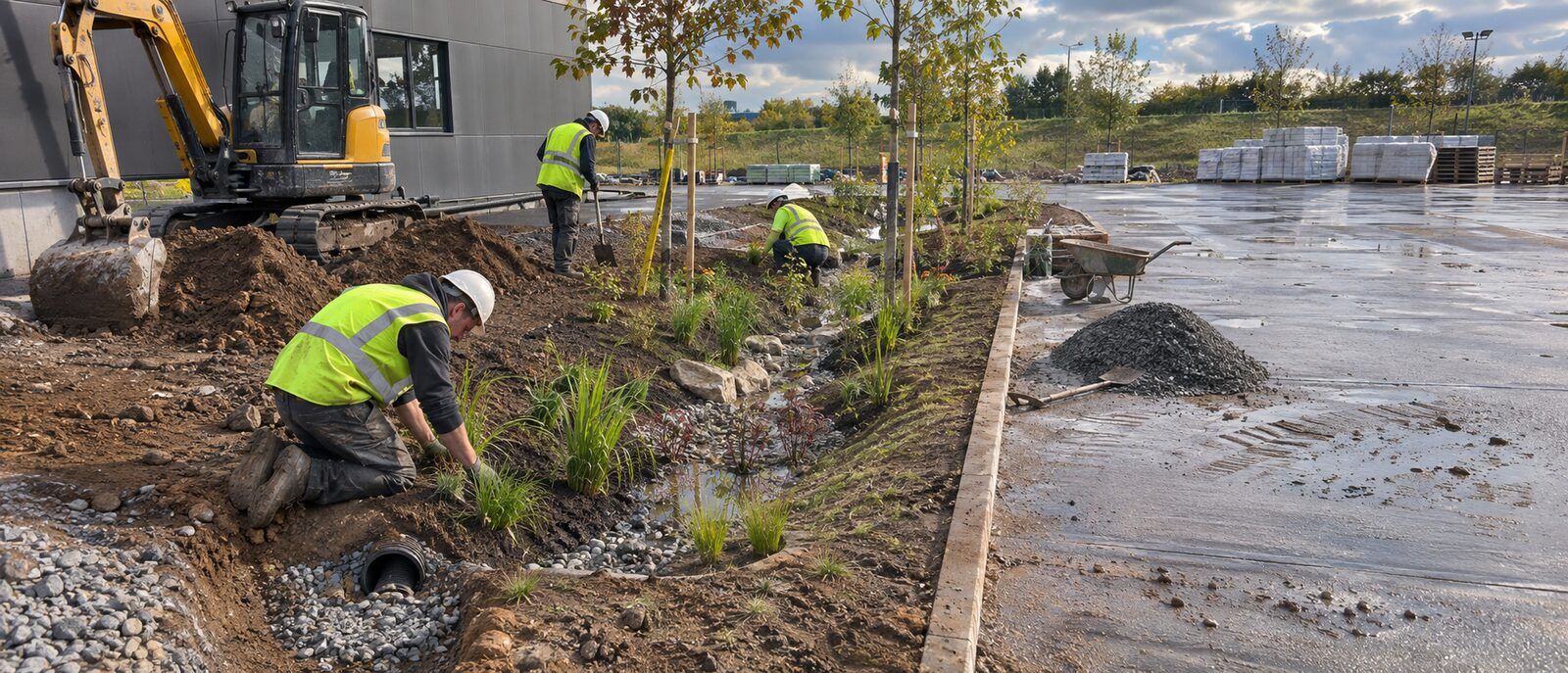
Surface water interception calculator
Turn measured catchment areas and rainfall depths into volumes, then make a transparent provision comparison.
Scope: this calculator works out rainfall volume from values you enter and compares allocated provision with one volume basis you choose. It does not size a drainage system or decide whether a design meets a standard.
Sustainable drainage systems (SuDS) are drainage features that manage runoff close to where rain falls. The calculator does not model infiltration, evaporation, reuse demand, antecedent wetness, drainage routing or how often an interception feature performs.
Worked example: two catchments at a 5 mm depth
For illustration only, an 800 m² roof at 5 mm gives 4,000 litres (4 m³). A 1,200 m² paved area at the same depth gives 6,000 litres (6 m³). Together, the event volume is 10,000 litres (10 m³). If a project records 4.5 m³ for the roof and 5.5 m³ for the paved area, the roof row is +0.5 m³, the paved-area row is −0.5 m³, and the arithmetic total is zero. The total nets the rows; it does not remove either surface's individual comparison.
The example is not a project default, design recommendation or compliance finding. The calculation treats each catchment area and allocated provision once. It does not test the seasonal event proportions in England's Standard 2.
How the calculation works
- Rainfall volume in litres = catchment area in m² × rainfall depth in mm.
- Rainfall volume in m³ = area × depth ÷ 1,000.
- Provision allocation is added once for each catchment. The site total is the sum of the row allocations.
- Difference = provision allocated − selected comparison volume. A negative value is a shortfall against that arithmetic basis; it is not a design verdict.
No data is saved by this page. Export a CSV if you want to keep the current values. Keep the source measurements, drainage routing and allocation basis with the project record.
Related resources
Aggregate & MOT Type 1 tonnage calculator
Work out the tonnage of MOT Type 1, sub-base, capping, sand, gravel, or topsoil by area and depth, with typical UK bulk densities, bulk-bag, and tipper-load counts.
CIS & self-employment tax guide for UK construction workers
Interactive take-home pay calculator, CIS deduction rates explained, and a self-employed vs limited company decision flow with real construction day rates.
Concrete specification quick reference for site
Application selector, exposure classes, cover depths, reinforcement weights, and slump guidance. Everything from BS 8500 that a site agent needs on one page.
Related guidance and tools