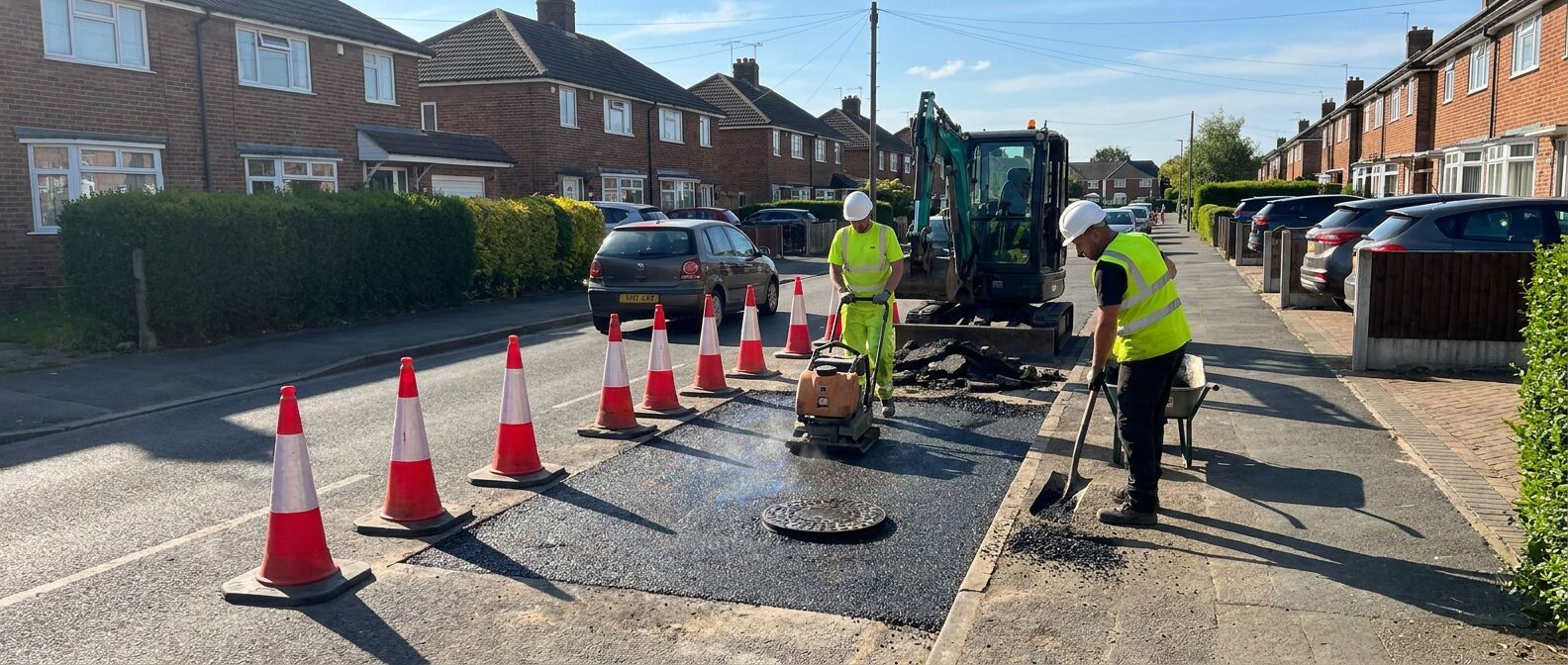
Highway trench reinstatement
Road categories, excavation types, reinstatement layers, and guarantee periods for reinstating a road after street works, from the SROH.
When you open a public road, footway or cycle track to lay or repair services, you must reinstate it to the Specification for the Reinstatement of Openings in Highways (SROH). It is a statutory code of practice made under the New Roads and Street Works Act 1991 (NRSWA), so the standards below are a legal duty for the organisation carrying out the works (the Undertaker), not just best practice. This page pulls the numbers you reach for most often into one place: how roads are categorised, how deep counts as deep, the layers you rebuild, and how long you guarantee them.
Reinstatement requirement finder
Pick the surface you are reinstating and the opening dimensions to see the guarantee period, the excavation category, and which structural design applies. The tables below highlight to match.
This finder points you to the right rule and appendix. It does not replace the full SROH: exact layer thicknesses come from the appendix diagrams for your road and construction type, and your Street Authority may set higher standards on high duty or high amenity surfaces.
Road categories by traffic
The SROH sorts roads into five types by the traffic they are expected to carry over the next 20 years, measured in million standard axles (msa), the cumulative loading from commercial vehicles over 1.5 tonnes unladen. A heavier category needs a stronger reinstatement (SROH Table S1.1).
| Road category | Traffic capacity | Typical roads |
|---|---|---|
| Type 0 | Over 30 to 125 msa | Motorways, trunk roads, heavy freight routes |
| Type 1 | Over 10 to 30 msa | Busy A roads, primary distributors |
| Type 2 | Over 2.5 to 10 msa | B roads, bus routes, district distributors |
| Type 3 | Over 0.5 to 2.5 msa | Local distributor and estate roads |
| Type 4 | Up to 0.5 msa | Lightly trafficked residential and access roads |
Roads carrying more than 125 msa are outside the SROH: the reinstatement design is agreed case by case with the Authority. If the Authority has not classified a road, the Undertaker must classify it and share the result with all parties (SROH S1.3).
Excavation and trench categories
How an opening is classified changes the backfill, the particle size, and the guarantee. The four categories below come from SROH S1.5. Depth of cover means the depth from the finished surface down to the top (crown) of the buried service.
Small excavation
Surface area 2m² or less
A pit or joint hole up to 2 square metres of surface. Test holes up to 150mm diameter are not counted as excavations and are reinstated under SROH S11.
Narrow trench
300mm surface width or less, over 2m²
A typical service trench. If the trench is under 150mm wide, all granular backfill must pass a 37.5mm sieve; wider than that, it must pass a 75mm sieve (SROH S5.3.2).
Deep opening
Cover over the service greater than 1.5m
Any excavation where the depth of cover exceeds 1.5 metres. This is the trigger for the longer three year guarantee. Short stretches over 1.5m for less than 5m in length do not count.
Other opening
Over 2m², wider than 300mm
Any excavation larger than 2 square metres that is not a narrow trench, for example a wide joint bay or a road crossing dug full width.
Guarantee periods
The Undertaker guarantees the reinstatement against defects for a set period. The clock starts when the permanent reinstatement is completed, not when the Authority is told (SROH S1.2).
2 years
Standard reinstatement
Any opening where the depth of cover is 1.5m or less.
3 years
Deep openings
Cover over the service greater than 1.5m, where longer term settlement is more likely.
6 months
Interim to permanent
An interim reinstatement should normally be made permanent within six months (SROH S1.1.3).
If a reinstatement fails during its guarantee period, the Undertaker must put it right. Failing to notify the Authority that the permanent reinstatement is complete is an offence under section 70(6) of NRSWA.
The reinstatement layer stack
You rebuild the opening from the service upward. The road and footway structure is the surface course, binder course, base and sub-base; below it sit the backfill and the surround to the service. Exact thicknesses come from the appendix for your road and construction type; the rules on this page apply across all of them.
Surface course
Was the "wearing course"The running surface, matched to the existing material such as hot rolled asphalt (HRA), stone mastic asphalt (SMA) or asphalt concrete (AC). It must not be inferior to the surrounding road during the guarantee period.
Binder course
Was the "basecourse"The bituminous layer under the surface. Where thickness is tight, the required surface course thickness is kept and the binder course is adjusted to suit (SROH S6).
Base
Was the "roadbase"The main load spreading layer, bituminous or cement bound. On lighter Type 3 and 4 roads a granular base can be used, with each 10mm of extra binder course allowing a 35mm reduction in Type 1 granular base thickness (SROH S6).
Sub-base
Granular or cement boundUsually SHW (the Specification for Highway Works) clause 803 Type 1 or clause 804 Type 2 granular material. For small reinstatements a cement bound sub-base (CBGM B) may be laid 150mm thick, or to match the original (SROH S6.2).
Backfill
Classes A to D, compacted in layersExcavated or imported material classified A to D (see below) and compacted in layers to Appendix A8. No frost susceptible material within 450mm of the surface, unless there is 300mm of bituminous material to insulate it (SROH S5.3).
Surround to apparatus
Max 250mm above the crownProtective material around the service, laid up to 250mm above its crown and not intruding into the road structure. No Class E unacceptable material and nothing larger than 37.5mm (SROH S4).
Buried service (apparatus)
The cable, duct or pipe the works were for. Its depth of cover decides whether the opening is a deep opening.
Backfill material classes
Backfill is classified by how much fine material it contains, measured as the percentage passing a 63 micron (0.063mm) sieve. Finer, more cohesive material is harder to compact and is restricted (SROH S5.1). Class E must never go back into the permanent structure.
| Class | Material | Fines (passing 63µm) |
|---|---|---|
| Class A | Graded granular (includes SHW Type 1 and Type 2 sub-base) | Up to 10%, plasticity index 6 or less |
| Class B | Granular | Up to 10% |
| Class C | Cohesive / granular mix | Between 10% and 80% |
| Class D | Cohesive (clay, silt) | 80% or more |
| Class E | Unacceptable (SHW clause 601) | Not permitted in the permanent structure |
Maximum particle size for granular backfill is 75mm, dropping to 37.5mm in trenches under 150mm wide (SROH S5.3.2). Plasticity index measures how plastic the fine fraction is when wet.
Compaction plant
Each material is placed and compacted in layers, with the number of passes set against the layer thickness and the plant used in SROH Appendix A8, Table A8.1. The plant itself has to meet minimum weights or it will not achieve the required density (SROH S10.3).
Vibrotamper
50kg+
Minimum 50kg nominal mass for general use. Lighter 25 to 50kg units are only allowed in areas of restricted access.
Vibrating roller
600kg/m
Minimum 600kg per metre of roll width. A deadweight roller with no vibrating unit is not permitted for reinstatement.
Vibrating plate
1400kg/m²
Minimum 1400kg per square metre of base plate. The common choice for narrow service trenches.
Interim and permanent reinstatement
The SROH lets you reinstate in two stages, but the standards apply at both.
Interim reinstatement
A temporary but compliant reinstatement that makes the surface safe and usable straight away, for example where the permanent surfacing has to cure or a batch of the right material is not yet available. It must meet the prescribed standards until the permanent works follow, and should normally be made permanent within six months.
Permanent reinstatement
The final reinstatement using the full specified layers and materials. Completing it starts the guarantee period. The SROH tells you to use the highest degree of immediate permanent reinstatement that the circumstances reasonably allow, rather than defaulting to interim work.
Footway, footpath and cycle track categories
Footways are not graded by msa. They fall into three categories, and the higher two can carry stricter Authority standards (SROH S1.4).
High duty
Principal routes used by exceptionally large numbers of pedestrians or cyclists.
High amenity
Decorative or distinctive surfaces such as coloured, textured or specialist paving, kept to a high standard. Common in conservation areas and pedestrian precincts.
Other
Everything that is neither high duty nor high amenity. The great majority of residential and estate footways.
Which specification applies where
The SROH fourth edition became statutory guidance for England on 10 May 2021 and applies to streets that are maintainable at public expense. Wales works to its own edition of the SROH under NRSWA. Scotland uses the equivalent Specification for the Reinstatement of Openings in Roads (SROR), administered by the Scottish Road Works Commissioner, with slightly different numbering. The road categories, deep opening threshold, and guarantee periods on this page are the England and Wales SROH values; always confirm the current edition for your Authority before pricing or reinstating.
Practical notes from site
The things that keep a reinstatement out of the defects register.
The guarantee starts at permanent, so book it in
Because the two or three year clock starts on completion of the permanent reinstatement, an interim that drags on keeps you liable and keeps the trench under scrutiny. Plan the permanent return within the six month window, and record the completion date, because failing to notify the Authority is a section 70(6) offence in its own right.
Compact in thin layers, not one big lift
Most reinstatement failures are settlement from over-thick lifts or a plate that is too light for the material. Match the layer thickness and pass count to Table A8.1 for the plant you actually have on the van. A 1400kg/m² plate on a narrow trench in thin layers beats a heavy roller you cannot get into the opening.
Keep the fines out of the top 450mm
Frost susceptible fines near the surface heave in winter and crack the reinstatement the following spring. Keep Class C and D material low in the trench, use granular Class A or B in the upper layers, and remember the 450mm rule (or 300mm of bituminous cover) before you tip as-dug clay straight back in.
Sources
- Specification for the Reinstatement of Openings in Highways (SROH), fourth edition (Department for Transport, statutory from 10 May 2021)
- New Roads and Street Works Act 1991, section 70 (duty to reinstate) and section 71 (materials, workmanship and standard of reinstatement)
- HAUC(UK) SROH fourth edition briefing pack (Highway Authorities and Utilities Committee)
- Specification for Highway Works (SHW / MCHW Volume 1) for the clause 601, 803 and 804 material references
- Specification for the Reinstatement of Openings in Roads (SROR) (Scottish Road Works Commissioner, the Scotland equivalent)
Built by Rospower Projects, a specialist groundworks and civil engineering contractor. Utility trenching, cable routes, and road reinstatement across the UK.
Discuss your projectRelated resources
Aggregate & MOT Type 1 tonnage calculator
Work out the tonnage of MOT Type 1, sub-base, capping, sand, gravel, or topsoil by area and depth, with typical UK bulk densities, bulk-bag, and tipper-load counts.
Concrete specification quick reference for site
Application selector, exposure classes, cover depths, reinforcement weights, and slump guidance. Everything from BS 8500 that a site agent needs on one page.
Concrete volume calculator & mix selector
Work out concrete volume by shape, get an indicative BS 8500 strength class, a wastage allowance, and a ready-mix truck count for a UK pour.