Cut-off saw dust controls: brief the task before cutting
A supervisor's briefing for cut-off saw work: reduce cuts, set dust suppression and RPE, brief the work area and stop if controls fail.
By Eddie Lyons, Construction director
Generated by your browser's built-in AI. May not be fully accurate.
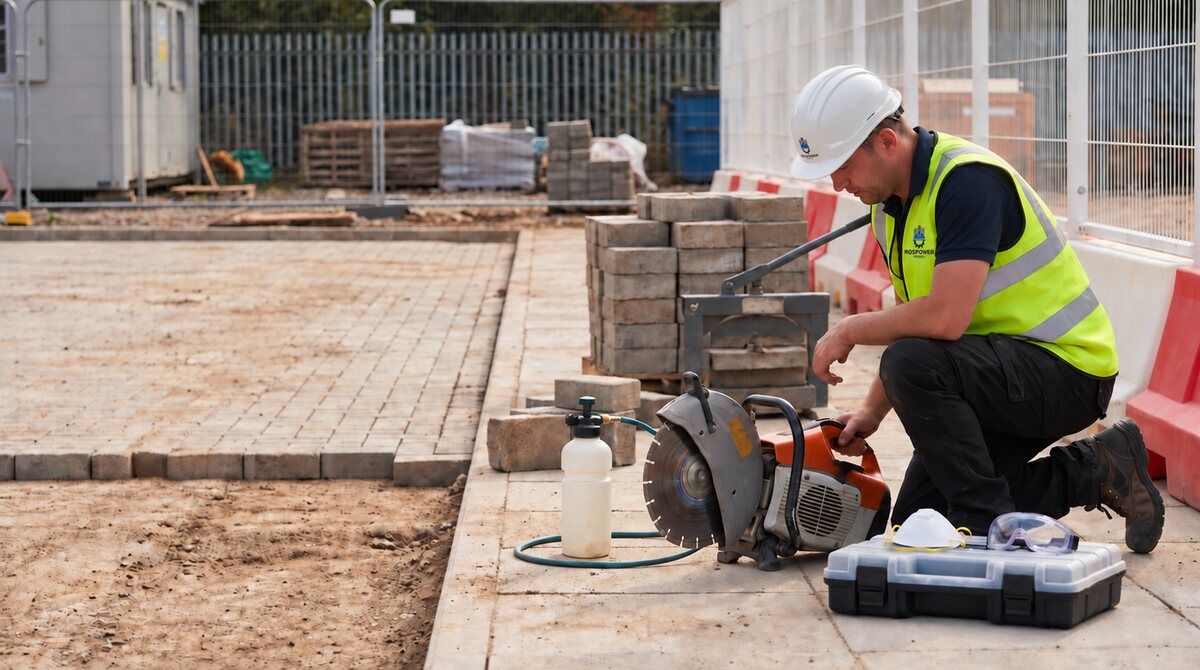
A short run of cuts with a hand-held cut-off saw can create a serious dust exposure. The dust is not always visible, and water suppression does not capture all of it. The control plan therefore needs to be decided before the saw reaches the workface, not improvised after the first cloud appears.
This briefing is about cutting paving blocks, flags and kerbs with a cut-off saw. HSE identifies this as high-risk silica work and sets out task-specific controls. It is not a replacement for the employer’s COSHH assessment, the saw manufacturer’s instructions, the site’s risk assessment or a competent supervisor’s judgement.
First ask whether the saw is needed
The cleanest cut is the one the job avoids. Review the setting-out and cutting list with the person controlling the work. Can the layout be adjusted without compromising the design? Can a suitable block splitter handle the cut? Can the supplier deliver pre-cut material? HSE specifically recommends considering lower-energy equipment, reducing the number of cuts through design or layout, and arranging off-site cutting.
Record what remains for the saw. A simple marked-up plan, sequence or count helps the supervisor check that the work has not expanded into repeated ad hoc cuts. It also tells the team where the cutting station belongs and what areas may be affected by dust, noise, flying fragments and water spray.
Match the control set-up to the actual saw
Before work starts, check the material, saw, disc, water or extraction arrangement and the manufacturer’s operating instructions. HSE’s current task guidance for cutting paving blocks, kerbs and flags describes water suppression or suitable on-tool extraction, together with respiratory protective equipment (RPE) with an assigned protection factor of 20 for this task. It also calls for fit testing where tight-fitting RPE is used.
Do not reduce that to “wear a mask”. The RPE has to fit the wearer, be compatible with other protective equipment, be worn correctly and be maintained. A tight-fitting facepiece requires a clean-shaven seal area and a valid face-fit test. A disposable nuisance-dust mask is not a substitute for the task-specific RPE described by HSE.
If the chosen control is water, confirm that the correct attachment is fitted, the supply is adequate for the equipment, and the jets are clear before cutting. If an extraction system is proposed, confirm that the saw and extractor are designed to work together, the extraction class and capacity suit the task, and the connections are secure. Do not swap between controls based on appearance or convenience. Use the current task guidance and the equipment instructions to confirm the complete arrangement.
HSE’s older INDG461 worker leaflet remains useful background for cut-off saw work, but it was published in 2013. For the specific control combination and equipment now being used, start with HSE’s current task page and verify the saw supplier’s instructions.
Brief the cutting area, not only the operator
The person holding the saw is not the only person who can be exposed. The supervisor should identify who will enter the work area, how pedestrian movement will be kept out of the cutting position, and how other gangs or site users will be kept clear of the dust and flying-fragment area. Set the boundary to suit the location, activity and changing conditions rather than copying an arbitrary distance from another site.
Choose a stable cutting position with enough room to control the saw and material. Keep the operator clear of vehicle routes and plant movements. Arrange material handling so the operator is not lifting awkward pieces while managing the saw. Check the expected noise, vibration, eye protection, hearing protection and water-spray risks as part of the same task brief. Protective equipment must work together and must not obstruct vision, fit or communication.
If cutting beside a live road, occupied building or operating yard, coordinate the exclusion area and work window with whoever controls that operation. Do not direct dust or slurry towards pedestrians, drains, vehicles or other work areas. Agree how water and slurry will be contained and removed under the site’s environmental and housekeeping arrangements.
Make the pre-start checks observable
The briefing should leave the operator and supervisor with checks they can see and repeat:
- confirm the cut list, material and selected method;
- inspect the saw, guard, disc and manufacturer-required safety features;
- check water jets or extraction components, hose connections and supply;
- inspect the RPE, confirm fit-test status where needed, and check compatibility with eye and hearing protection;
- identify the work boundary, nearby people, traffic and the route for handling cut pieces;
- agree who checks controls during the task and who can stop the work;
- explain how slurry, wet residues and waste will be contained and cleared.
Do not set an assumed “safe number of minutes” for cutting. HSE warns that a series of quick cuts can still create a significant exposure. The work method, effective controls and exposure assessment matter; there is no shortcut duration that makes uncontrolled cutting acceptable.
Stop when the control is no longer working
If water stops flowing, jets block, extraction loses performance, a hose disconnects, RPE is damaged or a new person enters the work zone, stop cutting. Do not finish one more cut while the control is absent. Put the saw in a safe state, secure the area and correct the problem before restarting. If the planned control cannot be restored, refer back to the supervisor and reassess the task or use a suitable alternative method.
After a change in material, saw, work location or cutting volume, check whether the original assessment and control plan still fit. HSE’s construction health-risk approach is to plan and assess, prevent or control, train, supervise, maintain and review. A one-time toolbox talk cannot compensate for equipment that is not checked or a work area that has changed.
Close the task without spreading the dust
The task is not finished when the disc stops. Keep people out until the cut area and equipment have been left in a condition that will not expose the next worker. HSE’s COSHH essentials sheet for small-scale clearing of rubble, dust and debris recommends damping down, using an M or H class vacuum for finer material where suitable, and not dry brushing or using compressed air. Check that the vacuum is appropriate for damp material before using it. Keep slurry and captured material contained, and follow the site’s arrangements for its collection and disposal.
Record control failures, changes and corrective actions through the site’s normal reporting route. That gives the next shift something more useful than a note saying “saw cutting completed”. It also helps the supervisor spot repeated problems with water supply, extraction, access or work planning.
Make the briefing specific to the cut
Before the saw starts, the supervisor should be able to point to the planned cuts, the selected equipment, the working dust controls, the RPE arrangements, the boundary, the cleanup method and the person who will check each one. If any of those are still a guess, hold the task and resolve it first.
For a project that includes repeated paving or kerb cutting, bring the method and work area into the pre-start discussion. See our PPE compliance checker or contact Rospower Projects to discuss the wider civil engineering scope.
Eddie Lyons is the construction director at Rospower Projects. Read more about the team on our about page or contact us to discuss an upcoming project.
Related articles
Concrete delivery tickets: check the order and record discrepancies
Compare ready-mix delivery information with the controlled order, record discrepancies and preserve a clear link between each load and its placement.
Food factory wash-down areas: establish the drainage route first
Scope an external food-factory wash area around the drainage destination, process water and consent evidence before specifying its civil works.
Warehouse floor brief: define the loads first
A warehouse floor brief for tenants, racking and equipment suppliers: record load cases, layouts, movement, joints, interfaces and missing inputs.