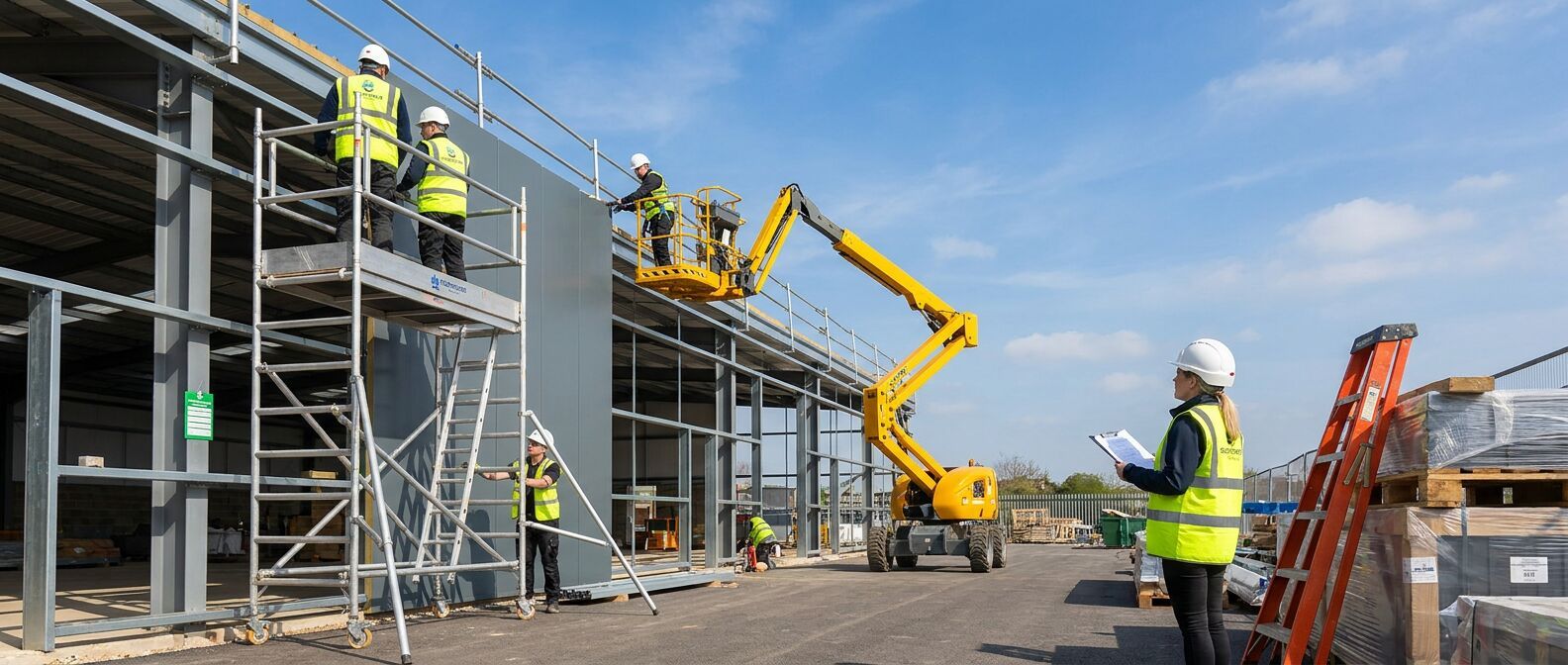
Working at height equipment selector
Pick the safest access method for short tasks, repeated work, roof edges, fragile surfaces, and material handling before the job reaches site.
Start with the hierarchy
Work at height means any work where a person could fall a distance liable to cause personal injury. The Work at Height Regulations require planning, suitable equipment, and priority for collective protection where it is reasonably practicable.
Avoid
Do the task from ground level, pre-assemble at ground level, or move the work to a safer location.
Prevent
Use collective protection such as scaffold, guardrails, tower platforms, or MEWPs. A MEWP is a mobile elevating work platform.
Minimise
Use fall arrest or other controls only where the fall risk cannot be prevented. Rescue planning then becomes part of the method.
Select the access method
Choose the work pattern. The result highlights the matching equipment card and the checks to complete before work starts.
HSE ladder guidance uses 30 minutes at a time as a short-duration guide. Medium and long categories are Rospower planning prompts, not legal thresholds.
Likely equipment
Ladder or stepladder only if the risk is low
A ladder can be suitable for a short, light, low-risk task where the worker can maintain three points of contact.
Checks to make
Equipment cards
The highlighted card is the selector output. Use the notes to challenge whether the task can be avoided, made collective, or simplified.
Avoid work at height
Use first where possible. Move assembly, inspection, or measurement to ground level before choosing access equipment.
- • Pre-assemble brackets, ducts, frames, or signs before lifting.
- • Use extendable tools or remote inspection where the output is still reliable.
- • Design out roof access for routine maintenance where possible.
Ladder or stepladder
Use only for low-risk, short-duration work after safer options have been considered. HSE notes that short duration is not a justification where the risk is not low.
- • Maintain three points of contact where practicable.
- • Do not use where heavy materials, side loading, or two-handed force is needed.
- • Inspect condition, angle, footing, tie-in, and surface before use.
Podium, platform steps, or tower
Better for repeated light work, two-handed tasks, or work needing a small platform. A tower should be erected by someone trained for that system.
- • Check manufacturer instructions, guardrails, toe boards, outriggers, and ground bearing.
- • Prevent moving the tower while occupied.
- • Segregate from plant routes and public areas.
MEWP
Useful where the ground can support the machine and the work moves across elevations. MEWP selection must account for reach, rescue, crushing risk, and ground conditions.
- • Confirm trained operator, rescue plan, exclusion zone, and overhead hazards.
- • Check slabs, service covers, soft ground, slopes, and underground voids before setup.
- • Plan pedestrian and vehicle segregation around the work zone.
Scaffold or edge protection
Usually the right route for longer duration elevation work, open edges, facade work, repeated access, or work where tools and materials need a stable platform.
- • Confirm design, handover, inspection regime, ties, loading bays, and access points.
- • Use guardrails, toe boards, brick guards, and debris controls where needed.
- • Keep scaffold changes under competent control.
Roof and fragile surface controls
Treat rooflights, asbestos cement, liner panels, and deteriorated sheets as fragile unless proved otherwise. Fragile surfaces need prevention, not just warning signs.
- • Use edge protection, staging, crawling boards, covers, netting, or a designed access system.
- • Mark and physically protect fragile zones before access.
- • Include rescue arrangements where fall arrest is used.
Pre-start checklist
Use this before equipment is delivered or hired. The safest answer may be to change the method, not to upgrade the harness.
Sources
- HSE INDG401 working at height brief guide - practical guide to the regulations
- HSE when and how to use ladders safely - low-risk, short-duration ladder guidance
- HSE scaffold checklist - scaffold controls and inspection prompts
- HSE roof work guidance - fragile surface and roof edge controls
- Work at Height Regulations 2005 - legislation text
Related resources
CDM 2015 dutyholder identifier
Interactive decision pathway for UK construction projects. Identify your CDM role, principal dutyholder appointments, F10 notification position, and pre-start document checks.
Daily noise exposure calculator (LEP,d)
Add noisy tasks from a shift to calculate daily unprotected noise exposure LEP,d and HSE exposure points, then compare the result with the lower and upper action values.
Hand-arm vibration (HAVS) exposure calculator
Add the power tools used in a shift to get the daily hand-arm vibration exposure in m/s² A(8) and HSE exposure points, with a traffic-light check against the EAV and ELV and the time each tool is safe to use.