From NESO grid offer to civils start
Ofgem set and revised NESO Gate 2 offer deadlines. See what developers and civils teams must verify across acceptance, permissions, scope and workfront release.
By Connor Lyons, Commercial director
Generated by your browser's built-in AI. May not be fully accurate.
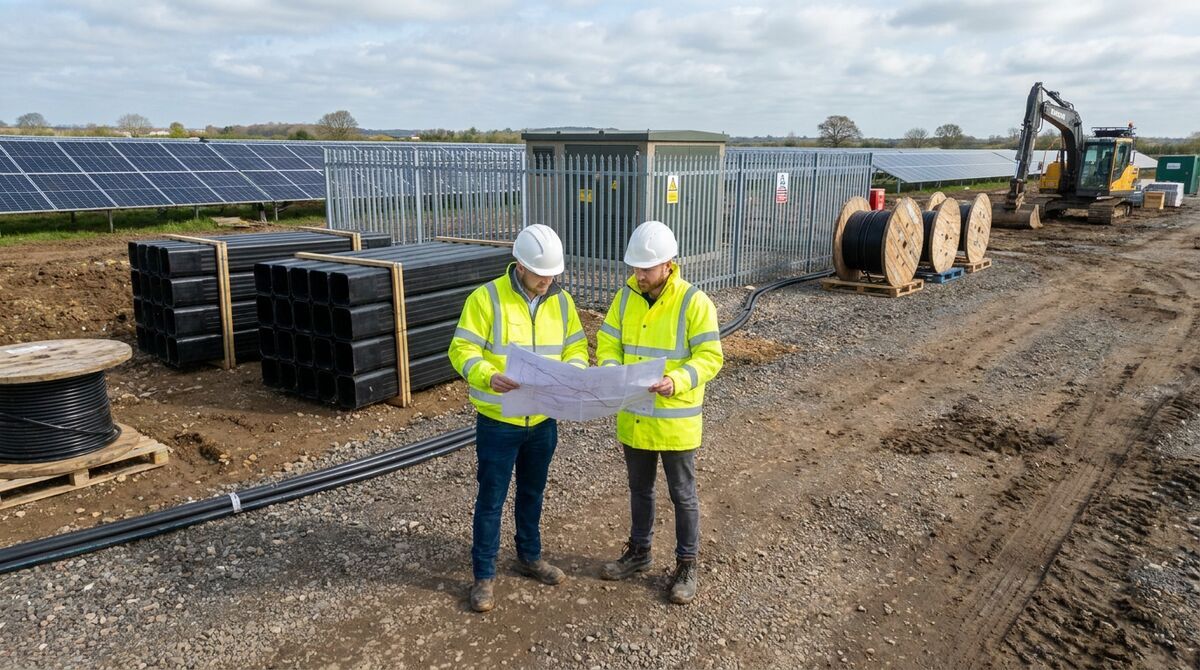
A connection offer records a commercial stage in the Gate 2 to Whole Queue programme. Contractors still need a contractual workfront release before mobilisation. A completed connection also depends on network construction, land, consents, design, procurement and project finance.
Since the original May version of this article, Ofgem has agreed the phased timetable NESO requested, and NESO has published a newer public account of delivery. This update replaces the earlier commentary with those primary sources and a practical handoff matrix for developers, principal contractors and civils subcontractors.
What changed after May
On 3 June 2026, Ofgem agreed an alternative timetable under condition E12.14(c) of the ESO licence, aligned to NESO’s re-baselined programme. The decision set NESO deadlines of 30 September 2026 for Phase 1 offers and 31 January 2027 for Phase 2 offers. It also set expected downstream distribution offer completion dates of 30 November 2026 for Phase 1 and 31 March 2027 for Phase 2. On 2 October, Ofgem approved a further limited extension for NESO’s Phase 1 offers, moving that issue deadline from 30 September to 31 October. Its decision leaves the other June dates unchanged. The extension applies to NESO’s issuance of Phase 1 offers. It leaves the DNO completion dates unchanged. These Ofgem decisions approve offer-issuing timetables. Project readiness and delivery depend on separate evidence and agreements.
NESO’s connections reform timeline publishes target windows. The page labels its timeline update 13 February 2026 and says the text was clarified on 17 April. It lists Phase 1 transmission and large-embedded offers from mid-May to mid-September, and Phase 1 distribution offers from early July to mid-November. For Phase 2 it lists transmission and large-embedded offers from early September to mid-January, and distribution offers from mid-October to mid-March. NESO says locations may be sequenced according to engineering complexity and reassessment needs. These are programme windows for offer issuance. The later Ofgem decisions set formal licence deadlines for NESO and separate expected completion dates for downstream DNO offers. Connection and mobilisation dates require project-specific evidence.
The latest broad public progress statement found in our 6 November source checks was published by NESO on 1 October. Its Director of Connections said more than 75% of the offers needed to support the 2030 energy system had been issued. This is a programme-level statement. It carries no project-level completion count. The same account says offer issuance leaves work ahead. Networks still need to build infrastructure, while developers must secure consent, finance and supply chains.
A 10 June joint NESO and Energy Networks Association release reports a more specific milestone. Of the 1,223 projects in the Phase 1 pre-2030 pipeline, 713 had received offers, representing 58% of the cohort and 37GW of offered capacity. NESO notes that some projects may receive post-2030 connection dates after transmission-owner studies. The release says DNOs led offers for lower-voltage distribution connections, while NESO led transmission offers. The figures report offer status and capacity. Construction and connection status require separate project evidence. In a 25 September letter to Ofgem, NESO reported it had issued around 75% of offers needed for 2030 and that 133 of 158 Gate 2 Phase 1 offers from NESO to England and Wales DNOs had been issued. The 133/158 figure covers NESO offers to DNOs. DNO offers to end customers are tracked separately.
The 25 September letter requested a further extension for NESO Phase 1 offers to 31 October, citing engineering complexity, some later offers requested by customers and, for affected DNO offers, upstream transmission-owner construction offers. Ofgem’s 2 October decision granted that limited extension. The letter and decision record the request and its authorisation. A source check on 6 November found no published NESO confirmation that it met the 31 October deadline. The Ofgem decision dated 3 June authorises the phased programme. Check the latest correspondence and your project’s written offer status when planning against a deadline.
A live National Grid Electricity Distribution (NGED) Phase 1 schedule gives one operator’s batch status. When checked on 6 November 2026, NGED listed Batch 8 as issued on 9 October. Batches 10 and 11 were awaiting information, with expected issue dates of 20 and 27 November. The schedule warns that individual dates and batches may change. These statuses apply to NGED’s listed batches. National Phase 1 completion and project mobilisation readiness require separate evidence.
The distinctions are practical. Published target windows describe programme expectations. Ofgem’s 3 June decision authorises NESO’s offer timetable. An offer and its acceptance record project-specific terms. Connection dates depend on delivery and contractual arrangements. Civils subcontractors need confirmed access under the project’s secured rights and a written work instruction before starting.
The route from offer to a released workfront
An offer may set out a proposed connection point, capacity, milestones, technical requirements, securities and acceptance deadlines. The project team needs to read the actual documents and confirm which network company and connection route apply. A transmission-connected project and a distribution-connected project follow different technical and commercial processes. An embedded connection can involve both a distribution network operator and upstream transmission works. Great Britain includes England, Wales and Scotland, while Northern Ireland has a separate system and regulatory arrangements. Check the relevant jurisdiction and network operator against the project documents.
Four states help organise the civils handoff.
- Offer received. Record the issuing party, project and connection identifiers, date, acceptance deadline, capacity, connection point, milestones, design references, securities and outstanding queries. After receipt, confirm acceptance separately.
- Offer accepted. Record the authorised signatory, acceptance evidence, payment or security obligations, and the contract or agreement that took effect. Record separate evidence for land access, planning approval, permits and construction authority.
- Project permissions and rights secured. List the land parcels and access routes, easements or wayleaves, planning and environmental conditions, highway approvals, third-party consents, and any required network outage or interface approvals. Identify the party responsible for each and retain the actual written evidence. A route drawing identifies a proposed alignment. Executed rights establish access and installation permission.
- Civils workfront released. The employer or principal contractor issues the notice to proceed under the relevant contract after confirming design status, permits, possession, interfaces, programme, RAMS and any hold points. A subcontractor should confirm its own contractual release and site instruction before starting work.
Offer-to-civils responsibility matrix
Offer and acceptance
- Developer or connection customer. Check project identity, scope, conditions, deadlines, securities and authorised signatory. Obtain internal approval.
- Network company and NESO. Issue the offer and technical schedules. NESO coordinates reform, and the relevant network company owns its connection role.
- Principal contractor or EPC. Review interfaces and programme assumptions. Fix package dates after written acceptance.
- Civils subcontractor. Price the stated scope and assumptions. Identify exclusions and quotation validity.
- Evidence to close. Complete offer pack, dated accepted agreement and query log.
Scope and boundary
- Developer or connection customer. Define generation and storage plant, connection assets, route, contestable work and owner interfaces.
- Network company and NESO. Confirm adopted network scope, technical requirements, connection point and customer works boundary.
- Principal contractor or EPC. Set package boundaries from approved design and employer requirements. Coordinate electrical, civils and third-party interfaces.
- Civils subcontractor. Confirm quantities, specification, temporary works, exclusions and by-others items in writing.
- Evidence to close. Signed scope matrix, drawing register, interface schedule and current revisions.
Route, access and permissions
- Developer or connection customer. Secure land and route rights, planning conditions and third-party permissions. Confirm the jurisdiction.
- Network company and NESO. Provide route and approval requirements. Identify network assets and access constraints.
- Principal contractor or EPC. Coordinate possession, permits, traffic management and sequencing with landowners and authorities.
- Civils subcontractor. Work within instructed limits and agreed access. Report conflicts and unknown services.
- Evidence to close. Executed rights, permits and consents, possession plan and approved setting-out information.
Design ownership
- Developer or connection customer. Appoint competent designers for customer assets. Approve the design basis and changes.
- Network company and NESO. Own or approve network design where required by the connection agreement and adoption arrangements.
- Principal contractor or EPC. Manage design coordination and construction information. Verify responsibility and status.
- Civils subcontractor. Build to released-for-construction information. Refer design conflicts for resolution.
- Evidence to close. Design responsibility matrix, approvals, revision status, design risk and change record.
Release and mobilisation
- Developer or connection customer. Confirm finance, procurement, programme and the decision to proceed.
- Network company and NESO. Confirm network milestones and required interface or outage dates.
- Principal contractor or EPC. Issue the contractual notice to proceed and workfront release after hold points close.
- Civils subcontractor. Mobilise against the written instruction, defined scope, access and dates.
- Evidence to close. Dated notice to proceed, permits, possession, approved RAMS, programme and hold-point release.
These responsibility blocks are a project control aid. The offer, connection agreement, EPC and subcontract documents govern the allocation. Name an owner for every open item, set a due date, and record what document closes it. If the responsibility is disputed, resolve it in writing before the affected work is priced as included or started.
What to put in the civils release pack
Before fixing labour, plant or material dates, request the latest written connection status and a dated programme from the developer or EPC. Then align each civils package with its own release conditions. The pack should record the following items.
- the offer issue, acceptance and any modification dates, plus the current connection and energisation assumptions.
- the boundary between customer, contestable and adopted network works, with named design owners.
- released drawings, specifications, surveys, service information and design-change control.
- route land rights, access arrangements, possession limits, planning conditions and statutory approvals.
- interfaces with the DNO, transmission owner, NESO processes, highways, landowners and other contractors.
- the contractual notice, lead time, cancellation or suspension terms, and who pays for standby or remobilisation.
- the assumptions behind rates, indexation, validity, quantities, working hours and material procurement.
- explicit hold points for unresolved design, access, permit, environmental or network-interface items.
The civils programme should be dated and conditional. If an offer window or connection target changes, assess the effect on the package, site access, seasonal restrictions, procurement and cost. Agree the contractual mechanism before moving a subcontract start to a new quarter. Once the route scope and product schedule are agreed, the duct run quantity planner can total named sections and parallel duct quantities. Designers and project teams retain responsibility for connection design and excavation safety.
Keep the commercial exposure visible
A Gate 2 offer can improve a project’s position in the reformed queue. Construction risk remains. NESO’s October update says network companies plan and build infrastructure, while developers remain responsible for consent, finance and supply chains. Ofgem’s June decision adds oversight to the timetable for issuing offers. It gives no assurance that a substation, transformer, cable route or outage will be ready when a contractor expects to mobilise.
For a civils subcontract, define what happens if the workfront is not released on the assumed date. Address quotation validity, stored materials, design or preconstruction fees, cancellation, suspension, demobilisation and remobilisation, inflation and any long-lead commitments. Tie any start trigger to a document or event that the parties can identify and verify. Where a contractor cannot control an upstream connection milestone, the subcontract should price any standby exposure and set a clear limit.
This is a coordination problem as much as a connection problem. NESO, network companies, developers, EPCs, landowners and contractors each control different parts of the route from offer to energisation. A clear matrix makes those boundaries visible early enough to price and programme the work responsibly.
Rospower Projects delivers groundworks, cable trenching and substation civils for UK renewable energy and utility projects. For a project-specific discussion about scope, access, programme assumptions or package boundaries, contact our commercial team.
Connor Lyons is commercial director at Rospower Projects.
Sources and further reading
- Ofgem agreement on the Gate 2 to Whole Queue offer timetable (3 June 2026)
- Ofgem agreement on the further Phase 1 extension (2 October 2026)
- NESO’s 25 September request to Ofgem for additional time
- NGED Gate 2 Phase 1 offer schedule (live operator schedule)
- NESO and electricity networks issue offers to over half of energy projects needed by 2030 (10 June 2026)
- NESO connections reform timeline, published 13 February 2026 and clarified 17 April with links to June correspondence
- What industry needs next from connections reform, NESO (1 October 2026)
Related articles

Recycled aggregate: evidence to check before use
Check the product, intended use, delivery record and waste-status evidence for recycled aggregate before it is accepted into a groundworks package.

UK construction events 2027: dates confirmed
Confirmed 2027 UK construction, plant, utilities, energy and food manufacturing events, plus major calendars still awaiting dates as of August 2026.
Civils starts jump 34% while the wider market stalls
Glenigan's August index shows civils starts up 34% on the quarter while overall starts fell 11%. What the summer 2026 data means for clients planning work.