Check your yard drainage now, not in the first week of October
Autumn storms can expose accumulated problems in gullies, channels, interceptors and attenuation. A late-summer checklist for yards and estates.
By Eddie Lyons, Construction director
Generated by your browser's built-in AI. May not be fully accurate.
Every autumn the same phone call comes in, usually in the second week of proper rain. Water over the yard, water at the dock doors, a car park with a lake in the corner and a tenant asking whose fault it is. Sometimes rainfall has exceeded the site’s design capacity or arrived from outside the boundary. Often the avoidable part is simpler: months of silt, leaves and pallet debris have reduced a system that was already close to its limit.
The time to deal with that is now, in late August and September, not when the water is already standing. The ground is usually drier, access is easier and planned jetting or survey work can be booked before seasonal demand rises. Problems found now can often be handled as planned maintenance or scoped civils work rather than discovered during an emergency response.
Why late summer is the window
Drainage on a yard or estate is sized for the site working as designed: clean gullies, clear pipes, a flow control passing what it should. It is not sized for a system that is half full of silt when the wettest part of the year arrives. The 1991 to 2020 averages in the Met Office rainfall series show October through January as the four wettest months for the UK overall, just as leaf fall adds another source of blockage.
There is a practical angle too. A gully sucked out in September costs you a routine visit. The same gully found blocked in November, under standing water, with a tenant claiming stock damage, costs you an emergency call-out, an argument about liability and possibly an insurance claim. Same gully. Same silt. Very different invoice.
What actually blocks
After years of maintaining and repairing yard drainage, the failure list is short and it barely changes:
- Gully pots. They are designed to trap silt, which means accumulation is expected. Inspect them against the site maintenance plan and empty them when the recorded silt level begins to reduce working capacity; the right interval depends on traffic, debris loading and flood risk.
- Channel drains at dock doors. The classic. Fines, shrink wrap, banding offcuts and broken pallet chips wash straight into the channel, and the first blockage puts water exactly where the forklifts and the stock are.
- Interceptors. Petrol interceptors on yards and car parks need periodic inspection, servicing and emptying. If the site records do not show when that last happened, establish the condition before autumn. Once retained oil or silt exceeds the unit’s capacity, treatment performance drops and a restriction can contribute to an upstream backup.
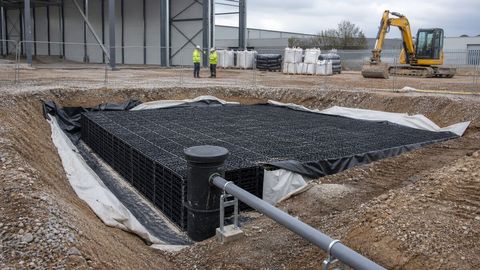
- Flow controls on attenuation. Newer estates drain through an attenuation tank with a vortex control or an orifice plate, and those openings are deliberately small. A blocked flow control means the tank fills, stays full, and the next storm has nowhere to go. The system everyone forgot about becomes the reason the yard is under water.
- Soakaways. They lose capacity gradually as silt binds the surrounding ground. A soakaway that “always used to cope” and no longer does is telling you something, and it will not fix itself.
- Ditches and headwalls. On older estates, the outfall is often a ditch with unclear maintenance responsibility that nobody mows or thinks about until it is a hedge with a trickle through it. If the outfall cannot take the water, nothing upstream matters.
- Pumped systems. Where a yard drains to a pump station, check it actually runs. Float switches stick, one pump of a duty-standby pair quietly dies, and nobody notices until the wet weekend both were needed.
The walk-round: signs it is already struggling
You do not need a survey to get the first read; you need twenty minutes and dry weather. Silt fans on the surface show where water is arriving faster than the gully takes it. Tide marks and staining show where it ponds and how deep. Moss and algae lines follow the water that sits longest, which is a free map of your levels problem. A gully that never quite dries out, a manhole lid that lifts or burps in heavy rain, a smell around the channel drain: all of it is the system telling you where it hurts before the weather makes the point properly.
Write down what you find and photograph it dry. Dated photographs and service records can help document the observed condition and maintenance history if the cause of a later flood needs to be investigated.
On newer estates, check the permission and maintenance plan
For a development in England where SuDS were required through planning, the local planning authority should have been satisfied that clear maintenance and adoption arrangements were in place for the lifetime of the development. The government’s flood risk planning guidance explains that expectation. Other UK nations use different approval regimes, and older or smaller sites vary, so the planning decision, drainage approval and site maintenance plan remain the source of truth. The detailed design and maintenance logic is set out in the SuDS Manual, and we covered the English planning process in our piece on warehouse SuDS and drainage.
The practical point for a management company or landlord is blunt: the attenuation tank, flow control, permeable paving and treatment features on an estate are not passive assets. Where they form part of the approved drainage strategy, their performance depends on the inspection and maintenance regime specified for the site. If you do not know what SuDS features your estate has or who is responsible for them, our SuDS compliance guide is a sensible place to start, followed by the maintenance schedule in the drainage approval.
Repairs worth doing before winter
Cleaning is half the job. The walk-round usually turns up small civils defects, and small is the operative word, because they do not stay small through a winter of HGV traffic and freeze-thaw:
- Broken or rocking gully gratings and frames. Movement under yard traffic can worsen cracking, damage the surrounding surface and create a wheel hazard. Repair the frame before repeated loading enlarges the defect; duration depends on the frame, bedding and reinstatement required.
- Ponding over joints and around gullies. Standing water can enter failed joints and pavement layers, where winter freeze-thaw may accelerate deterioration. Survey the levels and defect first; local regrading may restore the intended route where incorrect falls are the cause. Our drainage gradients reference covers the falls that yards and margins should hold.
- Kerb and edge failures. A dropped kerb line or failed edge can divert water away from its intended collection point and into vulnerable pavement layers. We wrote about how moisture can contribute to estate road and car park failures, alongside loading, construction and material condition.
- Repeat blockages in the same run. Recurring restriction can come from silt loading, limited capacity, a displaced or bellied pipe, roots or an outlet problem. A planned CCTV survey, supported by hydraulic investigation where needed, can establish the cause and turn “mystery annual flood” into a priced, plannable repair.
If the water comes anyway
Some sites sit in flood risk areas and no amount of gully sucking changes that. For sites in England, the government’s check for flooding service shows live warnings and river levels, and the prepare for flooding guidance sets out practical steps. If warnings are available for the site’s postcode, sign up before the season starts. Sites in Scotland, Wales and Northern Ireland should use the flood information and warning service for their own nation.
Sort it in September
To be clear about where we fit: Rospower is not a jetting contractor, and a routine clean is a job for a drainage maintenance firm with a tanker. Where we come in is when the maintenance visit finds the civils problem underneath: the collapsed run, the failed gully, the yard that needs regrading, the attenuation tank that needs repair, or the estate that needs drainage it never had. That work is far better scoped in September, in the dry, as a planned package than discovered in November as an emergency.
If your walk-round has turned up something that looks structural, send us what you have found through work with us or request a proposal, and we will tell you honestly whether it is a repair, a rebuild or nothing to worry about.
Rospower Projects is a specialist groundworks and civil engineering contractor working across the South East and the wider UK, with over 35 years of experience delivering drainage and external works packages for industrial, warehouse, and commercial developments. Contact us to discuss your project.
Related articles
Warehouse SuDS and drainage: what planning requires in England
What England's planning system asks of warehouse surface water drainage: discharge hierarchy, runoff limits, attenuation storage and maintenance.

Asphalt estate roads and car parks: patch, resurface or rebuild?
When an asphalt estate road or car park fails, patching, resurfacing and structural repair are not interchangeable. How to choose the right scope.
Adding EV charging to an existing car park: the civils side
For rapid EV charging in an occupied car park, the connection and civil works can drive cost and programme. What estate managers should plan first.