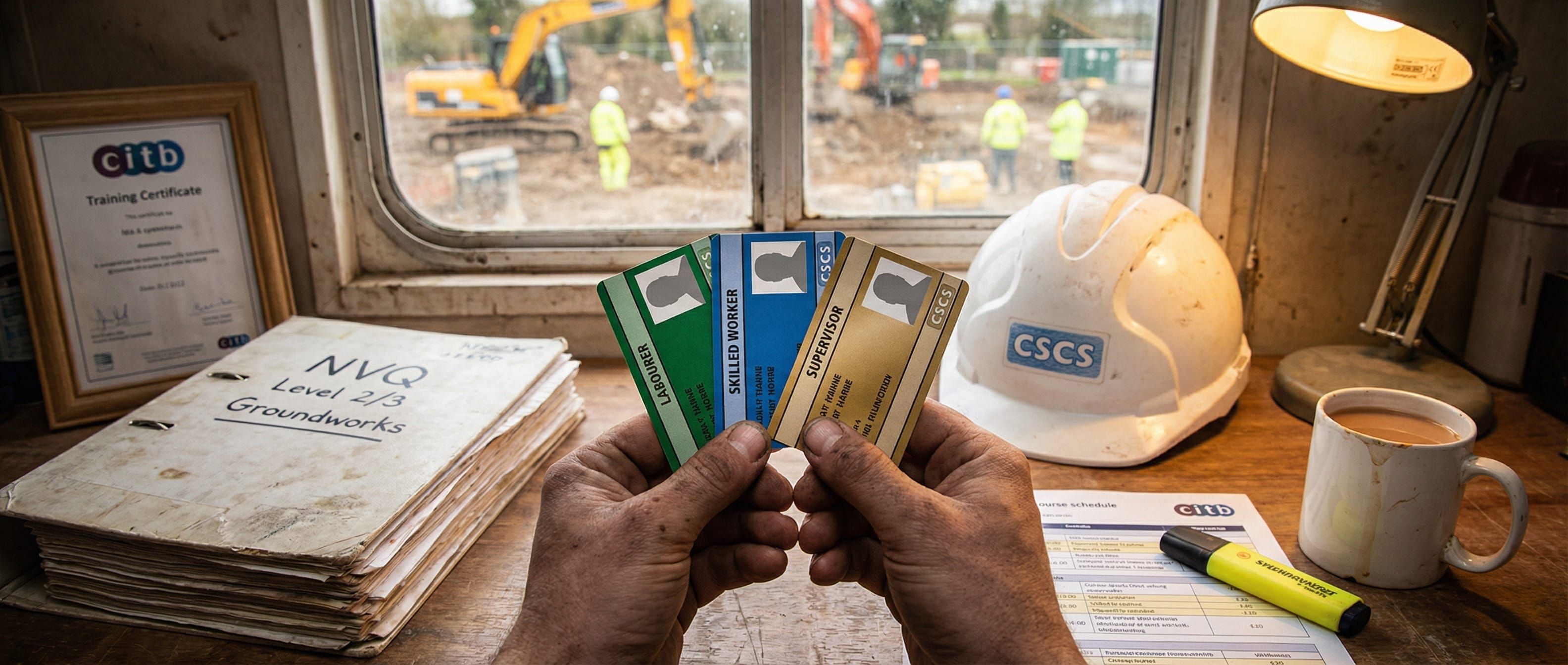
CSCS Cards for Groundworkers
Which card you need, how to get it, what it costs, and how long it takes. Groundworker-specific, not generic construction.
EUSR Change: 30 June 2026
If you do utility connections (gas, water, electric), your SHEA card will no longer carry the CSCS logo from 30 June 2026. Workers doing utility work on construction sites will need a separate EUSR CSCS card. This affects most groundworkers who do connections work.
What to do now: Check whether your current card is SHEA-issued. If it is, contact EUSR about the transition to the new card scheme before the June deadline. If your card is standard CSCS (issued by CSCS directly), you're not affected.
The Groundworker Card Pathway
Click any card to see the full requirements, costs, and timeline.
Green Card: Labourer / Trainee
Entry-level. Most groundworkers start here.
Blue Card: Skilled Worker
The standard card for experienced groundworkers. Increasingly required on commercial sites.
Gold Card: Supervisor / Advanced Craft
For foremen, gangers, and site supervisors managing groundworks teams.
Black Card: Manager
For site managers, project managers, and contracts managers overseeing groundworks projects.
Plant Cards: CPCS vs NPORS
Most groundworkers need plant operator cards alongside their CSCS card. These are separate schemes run by separate organisations.
CPCS (Construction Plant Competence Scheme)
Run by NOCN Job Cards (formerly CITB). The most widely recognised scheme. Two card levels:
Red: Trained Operator
Passed the CPCS technical test. Valid for 2 years. Must upgrade to Blue within that period or it expires.
Blue: Competent Operator
Achieved NVQ Level 2 in Plant Operations + CPCS technical test. Valid for 5 years, renewable.
Accepted on virtually all major construction sites in the UK.
NPORS (National Plant Operators Registration Scheme)
Run by NPORS. An alternative to CPCS, gaining wider acceptance. Two card types:
Traditional Card
Passed the NPORS practical and theory test. Does NOT carry CSCS logo. Accepted by some sites, not all.
NPORS + CSCS Logo Card
Same as above plus CITB HS&E test passed. Carries the CSCS logo. Accepted on most sites that accept CPCS.
Generally cheaper than CPCS. Some Tier 1 contractors still prefer CPCS, so check site requirements.
Common Plant Categories for Groundworkers
| Machine | CPCS Category | Typical Training Cost | Duration |
|---|---|---|---|
| 360° Excavator (above 10t) | A59 | £800-£1,500 | 5-10 days |
| Forward Tipping Dumper | A09 | £500-£900 | 2-5 days |
| Ride-on Roller | A31 | £500-£800 | 2-3 days |
| Telehandler | A17 | £700-£1,200 | 3-5 days |
| Slinger / Signaller | A40 | £400-£700 | 2-3 days |
Costs are for full training courses (novice). Experienced operators may qualify for shorter "assessment-only" or "refresher" courses at lower cost. Prices vary by region and provider.
Frequently Asked Questions
Can I work on a construction site without a CSCS card?
My CSCS card expired. Do I need to redo the NVQ?
I have NPORS cards. Do I still need a CSCS card?
I've been a groundworker for 15 years but never done an NVQ. What's the quickest route to a Blue card?
Can my employer pay for my NVQ through CITB grants?
Useful Links
- CSCS - Official CSCS card scheme (card applications, card finder tool)
- CITB HS&E Test - Book the Health, Safety & Environment test (£22.50)
- CPCS / NOCN Job Cards - Construction Plant Competence Scheme
- NPORS - National Plant Operators Registration Scheme
- EUSR - Energy & Utility Skills Register (utility sector cards)
- Go Construct - CITB's career information site for construction
Built by Rospower Projects. We invest in our people's training and development because the alternative is worse.