What sustainability actually looks like on a groundworks site
A practical guide to sustainable civil engineering in the UK. Recycled aggregates, cut-fill balance, SuDS compliance, waste management plans, and the regulations that actually apply to groundworks contractors.
By Eddie Lyons, Construction director
Generated by your browser's built-in AI. May not be fully accurate.
The “sustainability in construction” conversation lives in conference presentations and corporate brochures. It involves phrases like “net zero ambition” and “circular economy principles” and pictures of wind turbines, and it has almost nothing to do with what a groundworks subcontractor does on a Tuesday morning in January when it’s raining and there’s 3,000 cubic metres of clay to shift.
This piece covers what sustainability actually looks like at ground level: the regulations, the material choices, the site practices, and the commercial reality of doing the right thing when there’s a programme to keep.
Recycled aggregates: the easiest win
The single biggest sustainability impact most civils contractors can make is using recycled aggregates instead of virgin stone. And the good news is that it usually saves money too.
What’s available
6F2 recycled capping replaces virgin limestone or granite capping in road and hardstanding construction. It’s produced from crushed concrete and masonry demolition waste, graded to the same Specification for Highway Works (SHW) requirements as primary aggregates. Most reputable producers hold WRAP quality protocol certification, which means the material has been through a process that takes it from “waste” to “product” status.
Type 1 recycled sub-base performs identically to virgin Type 1 in most applications. It’s cheaper (typically 20-30% less per tonne delivered, depending on your location and the nearest recycling facility), it diverts demolition waste from landfill, and it meets the same compaction and grading requirements under BS EN 13285.
Recycled topsoil and general fill. On large earthworks jobs, processed site-won material (screened, tested, and certified) can replace imported fill. This is where the CL:AIRE Definition of Waste Code of Practice becomes essential.
The CL:AIRE DoWCoP
If you’re moving soil or aggregate between sites, or reusing material that would otherwise be classified as waste, you need to understand the CL:AIRE Definition of Waste Code of Practice. This is the mechanism that allows you to treat excavated material as a “non-waste” product rather than controlled waste, provided it meets certain conditions:
- The material must be suitable for its intended use (demonstrated through testing)
- There must be a clear demand for it (you can’t just stockpile it and call it a product)
- The quantity must not exceed what’s needed
- A qualified person must sign a declaration confirming the above
Why this matters commercially: Without a DoWCoP declaration, moving excavated material off-site requires waste carrier licences, landfill tax payments (£130.75 per tonne for non-qualifying material from 1 April 2026), and waste transfer notes. A 10,000-tonne earthworks export that goes to landfill instead of beneficial reuse could cost your client over £1 million in landfill tax alone. The DoWCoP declaration costs a few hundred pounds in consultancy fees. The maths is obvious.
Cut-fill balance: getting it right before you start
The most sustainable earthworks strategy is not to import or export material at all. If you can balance the cut (what you dig out) against the fill (what you need to put back), you eliminate thousands of lorry movements, hundreds of tonnes of CO2 emissions, and a significant chunk of the earthworks cost.
How it works in practice: The site levels are designed so that material excavated from high areas is used to fill low areas, ideally within the same site. A good earthworks designer will produce a mass haul diagram showing exactly where material moves from and to, minimising haul distances.
Where it goes wrong:
- Ground conditions don’t match the desktop study. The geo-tech report says “firm clay” but you hit soft alluvial deposits at 1.5 metres. That material can’t be used as engineered fill without treatment, so your balanced cut-fill becomes a deficit that needs importing.
- The civil engineer didn’t account for bulking. Clay excavated from the ground expands (bulks) by 20-30%. A cut-fill calculation based on in-situ volumes will always leave you with surplus material unless bulking is factored in.
- Contamination in the fill areas. If the site has a history of industrial use, some of the cut material may be classified as contaminated and can’t be reused without treatment or verification testing.
The sustainable contractor’s approach: Flag these issues at tender stage. If the earthworks balance looks too neat, question it. Ask for the mass haul diagram. Ask about the testing regime for reuse. Pricing for an earthworks job without understanding the cut-fill balance is pricing blind.
SuDS: the regulations you can’t ignore
Sustainable Drainage Systems (SuDS) are, in practice, expected on almost every new development in England, but the legal route is not the one many people assume. Schedule 3 of the Flood and Water Management Act 2010, which would have made SuDS approval by a local SuDS Approval Body (SAB) mandatory, was never commenced in England. The government confirmed in 2025 that it would deliver SuDS through the planning system rather than switching on Schedule 3, and consulted on the options into 2026. So SuDS are driven by national planning policy (the NPPF) and local planning conditions, not a standalone SAB sign-off. In Wales, by contrast, Schedule 3 has been in force since January 2019.
Either way, for groundworks contractors the practical result is the same: SuDS appear on the specification of nearly every job.
What SuDS means on site
Permeable paving for car parks and low-traffic areas. Instead of a standard asphalt surface draining to a piped system, you’re laying block paving on a graded aggregate sub-base that stores and infiltrates rainwater. The construction is different: the sub-base needs to be open-graded (no fines), the blocks need specific joint widths, and there must be a separation geotextile to prevent migration of fines from the subgrade.
Swales and filter drains replacing traditional piped surface water drainage. These are vegetated channels or stone-filled trenches that slow down runoff and filter pollutants. For the groundworks contractor, the excavation profiles are wider and shallower than pipe trenches, and the backfill specification is different (clean, single-size stone rather than granular fill).
Attenuation basins and tanks. Most sites still need some form of attenuation to limit the rate of discharge to greenfield runoff rates. Underground attenuation crates (geocellular storage) are common on tighter sites. Open basins are cheaper and easier to maintain but need more land.
Rain gardens and bioretention. Increasingly specified on commercial developments as part of the landscaping package. These are essentially planted areas engineered to receive and treat surface water runoff. The groundworks involve specific soil mixes, under-drainage, and overflow connections.
The commercial angle
SuDS work is generally more labour-intensive than traditional drainage. Permeable paving takes longer to lay than standard asphalt. Swale excavation profiles need more precision than pipe trenches. If you’re pricing a job and the drainage design includes SuDS elements, make sure your rates reflect the additional time and skill required. Don’t price permeable paving at the same rate as standard block paving; the sub-base alone takes twice as long to construct.
Site waste management
The Environmental Protection Act 1990 and the Waste (England and Wales) Regulations 2011 make you legally responsible for any waste produced on your site until it reaches a licensed facility. That duty of care doesn’t end when the skip wagon pulls off site.
What good waste management looks like
Segregation at source. Separate skips for timber, metal, concrete/rubble, mixed waste, and hazardous waste (contaminated soil, fuel, oils, paint). Segregated waste is cheaper to dispose of and more likely to be recycled. Mixed waste goes to landfill and costs more.
Waste transfer notes for every movement. When a skip or tipper lorry leaves your site with waste, you need a waste transfer note or (for hazardous waste) a consignment note. These must record: the type of waste, the quantity, the carrier’s details and licence number, and the destination facility. Keep them for two years minimum (three years for hazardous waste). The Environment Agency can ask to see them at any time.
Carrier licence checks. Before you let anyone take waste off your site, check they hold a valid waste carrier licence on the Environment Agency public register. If they’re not registered and your waste ends up fly-tipped, you’re liable. This happens more often than people think, particularly with smaller operators offering cheap muck-away rates.
Reducing waste in the first place. Order materials to cut lengths where possible. Use precast concrete products instead of in-situ construction where they reduce formwork waste. Specify recycled aggregate to close the loop on demolition waste from other sites. These aren’t dramatic gestures; they’re standard good practice that saves money.
Environmental controls during construction
Every civils site should have a Construction Environmental Management Plan (CEMP) in place before work starts. On larger sites, this will be a condition of planning permission. On smaller jobs, it’s still best practice and demonstrates competence to main contractors and clients.
Pollution prevention
Silt management is the primary concern on any earthworks site. Exposed soil + rain = silt-laden runoff entering watercourses. The standard measures: silt fencing at low points around the site perimeter, settlement ponds or lagoons for wheel wash and dewatering discharge, and silt socks around drainage inlets. The Environment Agency’s pollution prevention guidance (PPG series) sets out the requirements.
Fuel and chemical storage. All fuel, oils, and chemicals must be stored in bunded containers with 110% capacity. Drip trays under plant during refuelling. Spill kits within 10 metres of any fuel storage. If you’re refuelling a machine and diesel hits the ground, you’ve got an environmental incident. Report it, clean it up, record it.
Dust suppression. On dry days, particularly during bulk earthworks, dust from vehicle movements can be a significant nuisance and a breach of your environmental permit or Section 61 agreement. Water bowsers, wheel washes, and reduced speed limits on haul roads are the standard controls.
Ecological protection
If the site has ecological constraints (badger setts, great crested newt habitats, nesting birds, Japanese knotweed), these will be detailed in the ecological survey. As the groundworks contractor, you need to know where the exclusion zones are, what seasonal restrictions apply (no vegetation clearance during bird nesting season, March to August), and who the ecological clerk of works is. Breaching ecological protection conditions is a criminal offence under the Wildlife and Countryside Act 1981.
Carbon reporting: where the industry is heading
The bigger main contractors are increasingly asking subcontractors for carbon data. PAS 2080 (Carbon Management in Infrastructure) provides the framework. In practical terms, this means being able to report:
- Materials: Tonnes of aggregate, concrete, steel, and pipe used, and their embodied carbon values (available from manufacturer EPDs or the ICE Database)
- Transport: Lorry movements, distances, and vehicle types (Euro VI diesel vs electric)
- Plant: Fuel consumption for excavators, dumpers, and compactors
- Waste: Quantities sent to landfill vs recycled
You don’t need to be a carbon consultant to do this. You need accurate delivery records, fuel receipts, and a simple spreadsheet. The contractors who can provide this data will increasingly win work from Tier 1 clients who have their own net zero targets to meet.
The commercial reality
Here’s the truth that the conference speakers don’t say out loud: sustainability only sticks when it saves money or wins work.
Recycled aggregates save money. Using them is sustainable and commercially sensible. Easy decision.
SuDS compliance is mandatory. You don’t have a choice. The question is whether you understand the specification well enough to price it correctly and build it competently. If you do, you’ll win the work. If you don’t, you’ll either lose the tender or lose money on site.
Waste segregation saves money compared to mixed skips going to landfill. The landfill tax escalator has made this equation straightforward.
Carbon reporting wins tenders. It’s not the deciding factor yet, but it’s a scored criterion on a growing number of frameworks. Constructionline and Achilles BuildingConfidence both include environmental management questions in their assessments.
The firms that treat sustainability as a cost burden are the ones who haven’t done the maths. The firms that treat it as a way to reduce costs, comply with regulations, and differentiate themselves in a competitive market are the ones winning work.
Rospower Projects is a specialist groundworks and civil engineering contractor based in Fulmer, Buckinghamshire. We deliver complete external works packages for industrial, warehouse, and food manufacturing developments across the South East and the wider UK. Our independently audited environmental management systems support sustainable delivery on every project. Get in touch to discuss your next project.
Related articles
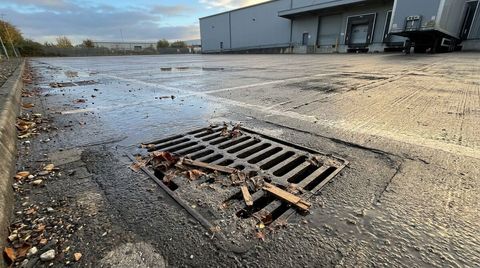
Check your yard drainage now, not in the first week of October
Autumn storms can expose accumulated problems in gullies, channels, interceptors and attenuation. A late-summer checklist for yards and estates.
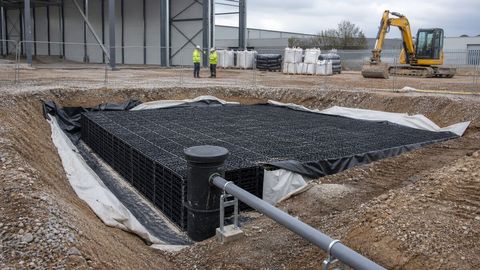
Warehouse SuDS and drainage: what planning requires in England
What England's planning system asks of warehouse surface water drainage: discharge hierarchy, runoff limits, attenuation storage and maintenance.
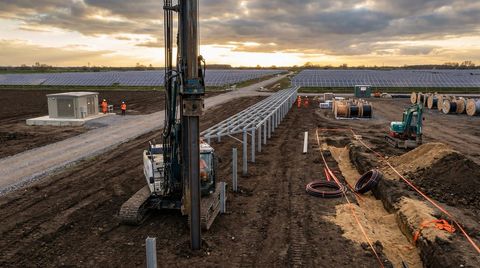
UK's largest solar farm approved: what 800MW of groundworks looks like
The 800MW Springwell Solar Farm just got consent. What civil engineering contractors actually build on a project this size: piling to cable trenching.